

Continental a winter-tire frontrunner
Continental's winter tires put rubber to road with confidence
Advertisement
Read this article for free:
or
Already have an account? Log in here »
To continue reading, please subscribe:
Monthly Digital Subscription
$0 for the first 4 weeks*
- Enjoy unlimited reading on winnipegfreepress.com
- Read the E-Edition, our digital replica newspaper
- Access News Break, our award-winning app
- Play interactive puzzles
*No charge for 4 weeks then price increases to the regular rate of $19.00 plus GST every four weeks. Offer available to new and qualified returning subscribers only. Cancel any time.
Monthly Digital Subscription
$4.75/week*
- Enjoy unlimited reading on winnipegfreepress.com
- Read the E-Edition, our digital replica newspaper
- Access News Break, our award-winning app
- Play interactive puzzles
*Billed as $19 plus GST every four weeks. Cancel any time.
To continue reading, please subscribe:
Add Free Press access to your Brandon Sun subscription for only an additional
$1 for the first 4 weeks*
*Your next subscription payment will increase by $1.00 and you will be charged $16.99 plus GST for four weeks. After four weeks, your payment will increase to $23.99 plus GST every four weeks.
Read unlimited articles for free today:
or
Already have an account? Log in here »
Hey there, time traveller!
This article was published 08/10/2010 (5534 days ago), so information in it may no longer be current.
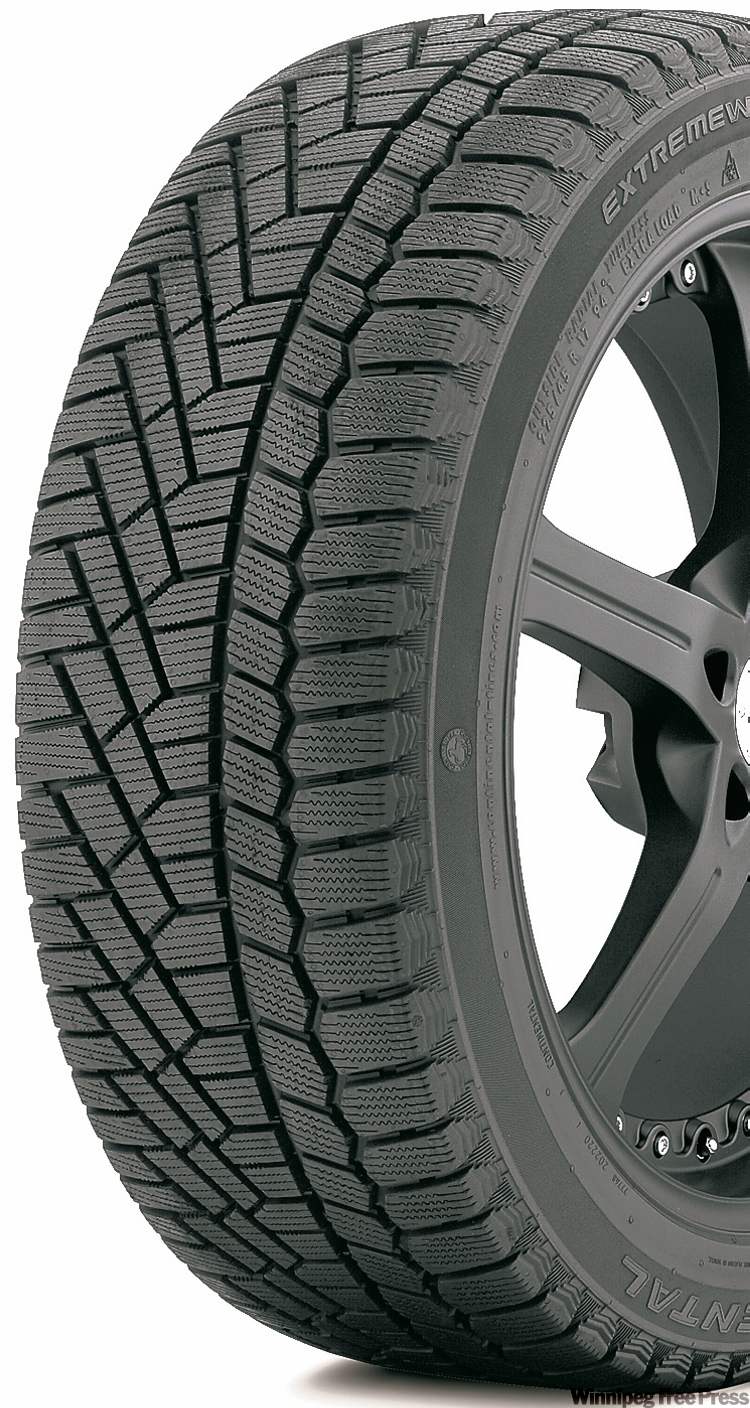
Each autumn my 2004 Mazda6 Sport Wagon gets to try on a new set of boots in an effort to see the latest and greatest that studless winter tire technology has to offer. This time it was the new Continental ExtremeWinterContact, size 215/50R-17; same as the original equipment Michelin Pilot all-seasons with which the car came equipped.
Never being one to accept the “all-season” moniker as being sufficient for our harsh winter conditions, I insist that our family vehicle ride on dedicated winter tires; those that wear the trademark snowflake-on-mountain symbol that differentiates them from their less capable brethren.
All-season rubber compounds lose their flexibility — and therefore the tire’s traction — as the mercury drops. The general consensus among major tire manufacturers is that 7C is the temperature at which traction loss is significant enough to affect a driver’s ability to control the car safely in an emergency situation.
Dedicated winter tires are made from rubber compounds that are designed to operate in temperatures below about 10C. Drive on them at warmer temperatures and expect to wear them down a whole lot faster while at the same time hampering your vehicle’s performance on the road.
But as the difference in rubber compounds is difficult to recognize just by looking at it, a winter tire’s vastly different tread pattern is a sure giveaway that it’s purpose-built for winter conditions. The first thing to look for is tiny zigzag slits or ‘sipes’ in the tread blocks of the tire. When combined with the more pliable rubber, these allow a significant degree of flexibility in the tread blocks. As the forces of acceleration and braking initiate this flex in the tread, a single block turns into a series of biting edges to maximize the tires’ ice traction.
You might also notice that the tread blocks on winter tires have wide grooves between them. This is to aid in deep-snow driving and give the tires a better chance of digging in and finding solid ground after a fresh snowfall.
Those are the basic building blocks of winter tires, with the rubber compounds and siping being the major differentiators between these and traditional “snow tires” of decades gone by.
Certain handling traits are to be expected when the changeover to winter tires takes place. For example, your car’s steering response will be somewhat dulled due to the added flexibility of the tire tread. The larger spaces between the tread blocks can also lead to a noisier ride on dry and wet pavement, and even if you only use the winter tires in colder conditions, tread life is not among the fortés of this type of tire. In fact, unlike all-season tires, winter tires seldom carry tread wear warranties.
But the cost of those winter tire quirks pale in comparison to the benefits of increased safety and performance in winter conditions. And besides, winter tire technology is constantly evolving to reduce or even eliminate such minor annoyances.
And that brings us to the subject of this year’s winter tire review, the ExtremeWinterContact (EWC) by Continental. While it employs the basic technologies noted earlier, every tire is built and marketed with differentiating features to set it apart from the competition. In the case of the EWC, it has an asymmetric tread pattern to give unique handling properties to different areas of the tire’s contact patch.
On the outside, the tread blocks are more compact (and therefore stiffer) to address the tendency for winter tires to hamper steering response. The centre area has larger grooves between the tread blocks as expected, but the engineers at Continental have added traction ridges within the grooves to aid in deep snow bite. The grooves on the inner areas of the tread are angled with respect to the direction of travel to quickly evacuate water from the area beneath the tire.
After driving the entire 2009/2010 winter season on these tires, I can comfortably put them right up alongside the Nokian Hakkapeliitta RSi (reviewed in 2006) as the best winter tires I’ve tried to date. And that speaks volumes, considering that the previous two seasons saw Michelin X-Ice Xi-2 and Bridgestone Blizzak WS60s mounted on my car.

I was particularly impressed with the EWC’s performance on ice compared with the perennial ice favourite from Michelin. Where the car felt slightly unsettled on icy curves with the X-Ice, the EWC gave it a more secure, planted demeanour in similar conditions. Similarly, satisfying deep snow performance meant that we were never intimidated by snowfall amounts that didn’t exceed the car’s bumper height.
On the downside, the tires are noisy, particularly on wet pavement. So if you’re in a region where the temperatures stay close to freezing and liberal use of de-icers in employed on the roads, this might be an issue. On my car they were no noisier than the Michelins, but it’s just something that prospective buyers should be aware of when shopping for winter tires.
With the ExtremeWinterContact, Continental has a front-runner in the realm of studless winter tires for passenger cars.