

Canada’s fleet played role in Cuban crisis
Advertisement
Read this article for free:
or
Already have an account? Log in here »
To continue reading, please subscribe:
Digital Subscription
One year of digital access for only $75*
- Enjoy unlimited reading on winnipegfreepress.com
- Read the E-Edition, our digital replica newspaper
- Access News Break, our award-winning app
- Play interactive puzzles
*Billed as $5.77 plus GST every four weeks. After 52 weeks, price increases to the regular rate of $19.95 plus GST every four weeks. Offer available to new and qualified returning subscribers only. Cancel any time.
Monthly Digital Subscription
$4.99/week*
- Enjoy unlimited reading on winnipegfreepress.com
- Read the E-Edition, our digital replica newspaper
- Access News Break, our award-winning app
- Play interactive puzzles
*Billed as $19.95 plus GST every four weeks. Cancel any time.
To continue reading, please subscribe:
Add Free Press access to your Brandon Sun subscription for only an additional
$1 for the first 4 weeks*
- Enjoy unlimited reading on winnipegfreepress.com
- Read the E-Edition, our digital replica newspaper
- Access News Break, our award-winning app
- Play interactive puzzles
*Your next Brandon Sun subscription payment will increase by $1.00 and you will be charged $17.95 plus GST for four weeks. After four weeks, your payment will increase to $24.95 plus GST every four weeks.
Read unlimited articles for free today:
or
Already have an account? Log in here »
Hey there, time traveller!
This article was published 15/10/2012 (4969 days ago), so information in it may no longer be current.
Fifty years ago this month, then-Soviet premier Nikita Khrushchev agreed reluctantly to pull medium-range ballistic missiles and theatre nuclear weapons out of Cuba — thus ostensibly ending the perilous Cuban Missile Crisis.
Some historians and commentators have described this tense period as Kennedy’s “finest hour” and highlighted his decisiveness and adroit leadership skills.
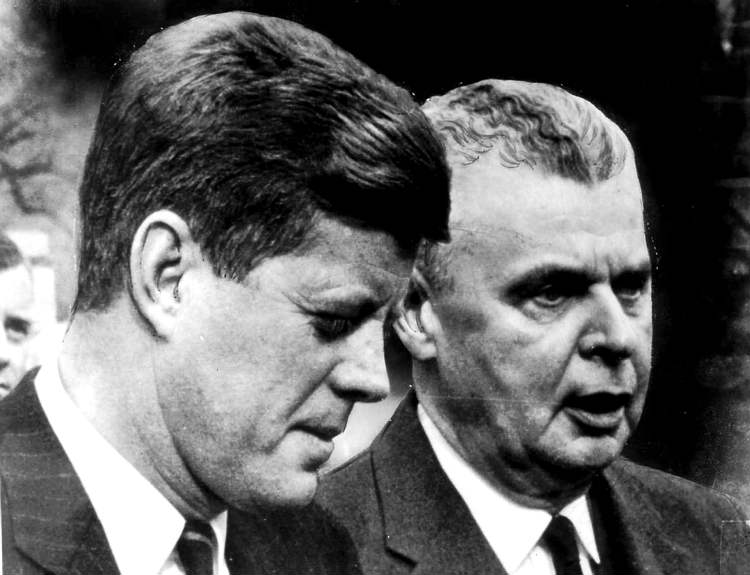
Others are less effusive in their praise, saying that Kennedy was close to having this crisis spin out of control and barely averted a nuclear confrontation.
Avoiding a nuclear cataclysm also had profound implications for Canada, since many of the missiles in Cuba could reach into Canadian territory. While much was made at the time of Canadian prime minister John Diefenbaker’s unwillingness to immediately accept the U.S. line on the crisis, underscored by the intense personal enmity between Diefenbaker and Kennedy, few are aware of Canada’s naval contribution during that nerve-racking period.
Part of the threat came from nuclear-equipped Soviet submarines operating off the Atlantic coast and the wider eastern seaboard.
And because of Canada’s military prowess in anti-submarine warfare (ASW), it was expected that the Halifax-based Canadian navy (minus the carrier HMCS Bonaventure, which missed much of the search for Soviet submarines) could assist the U.S. navy in this regard.
It was also understood at the time that the Russian fishing and merchant fleet often performed a supporting role for the Soviet navy. In fact, it was an open secret that these trawlers routinely collected important intelligence information on western naval movements and helped in refuelling Soviet subs.
Some preliminary reports in October 1962 intimated that there were several Soviet submarines operating off the coast of Atlantic Canada. For the most part, the senior naval leadership in Halifax knew that it was normal for less than 10 Soviet subs to operate in the North Atlantic.
It was the Atlantic fleet’s job (along with a small number of Argus patrol aircraft) to carefully monitor both the Soviet submarines and the Russian fishing vessels. As part of its co-ordinated effort to defend North America, the Canadian navy was tasked in very rough seas with creating a “submarine screen” in the Northwest Atlantic to defend against the Soviet subs and, if need be, to engage them.
Canada’s navy involvement was also important because it allowed the United States to deploy its naval assets further south and thus participate directly in the 60-ship naval quarantine of Cuba.
Although the evidence is pretty scarce that the Canadian navy actually contacted or confronted any Soviet submarines during their ocean surveillance, it would have been a major international incident had they engaged the Soviets during this tense period.
One could argue, of course, that the very existence of the submarine screen was enough to deter the Soviet navy from engaging in any provocative behaviour.
In contrast, historian Tony German has argued that there were almost 30 contacts with Soviet submarines that October. Most experts, though, admit that they really don’t know how many Soviet subs were operating in the North Atlantic — and won’t know for sure until the Russian naval archives are finally opened.
Retired submariner Peter Haydon has written extensively and carefully on this subject. He maintains that Canadian destroyers seeking to corner one Soviet submarine on Georges Bank were harassed by some Russian fishing vessels. Things could have got scary had one side or the other over-reacted or miscalculated badly.
It is worth noting (though I’m not for a moment suggesting that Canadian sailors or Argus pilots with nuclear depth bombs did the same) that the U.S. navy forced several Soviet submarines near the quarantine line to surface.
In one instance, a Navy Commander took the high-risk step of recklessly dropping a depth charge near one of the subs.

Interestingly, not much has been said or written about the confusion surrounding whether the Canadian navy had the proper political authorization to deploy for purposes of ASW. There has been some scholarly debate (see Peter Haydon’s outstanding work) about whether it was covered under existing military arrangements with the U.S. navy, that Canadian defence minister Douglas Harkness had given the order or that a newly revised War Book had invested the military brass in Ottawa with all the authority that it needed.
Clearly, there is much that we still don’t know about the scope and extent of the Canadian ASW angle–and what military and political lessons were learned in the aftermath.
What is not in dispute, however, is that the Atlantic fleet played a sizable role, working in concert with their American counterparts, in one of the most dangerous international crisis that the world has ever seen.
Peter McKenna is professor and chair of political science at the University of Prince Edward Island in Charlottetown.