

Mona Lisa copy painted alongside master
Advertisement
Read this article for free:
or
Already have an account? Log in here »
To continue reading, please subscribe:
Digital Subscription
One year of digital access for only $75*
- Enjoy unlimited reading on winnipegfreepress.com
- Read the E-Edition, our digital replica newspaper
- Access News Break, our award-winning app
- Play interactive puzzles
*Billed as $5.77 plus GST every four weeks. After 52 weeks, price increases to the regular rate of $19.95 plus GST every four weeks. Offer available to new and qualified returning subscribers only. Cancel any time.
Monthly Digital Subscription
$4.99/week*
- Enjoy unlimited reading on winnipegfreepress.com
- Read the E-Edition, our digital replica newspaper
- Access News Break, our award-winning app
- Play interactive puzzles
*Billed as $19.95 plus GST every four weeks. Cancel any time.
To continue reading, please subscribe:
Add Free Press access to your Brandon Sun subscription for only an additional
$1 for the first 4 weeks*
- Enjoy unlimited reading on winnipegfreepress.com
- Read the E-Edition, our digital replica newspaper
- Access News Break, our award-winning app
- Play interactive puzzles
*Your next Brandon Sun subscription payment will increase by $1.00 and you will be charged $17.95 plus GST for four weeks. After four weeks, your payment will increase to $24.95 plus GST every four weeks.
Read unlimited articles for free today:
or
Already have an account? Log in here »
Hey there, time traveller!
This article was published 02/02/2012 (5225 days ago), so information in it may no longer be current.
MADRID, Spain — A Mona Lisa copy owned by Spain’s Prado Museum was almost certainly painted by one of Leonardo da Vinci’s apprentices alongside the master himself as he did the original, museum officials said Wednesday.
The stunning find of what the Prado now says is probably the earliest known copy of La Gioconda will give art lovers and experts an idea of what the Mona Lisa looked like back in the 16th century, said Gabriele Finaldi, the museum’s deputy director collections.
“It is as if we were in the same studio, standing at the next easel,” he told reporters.
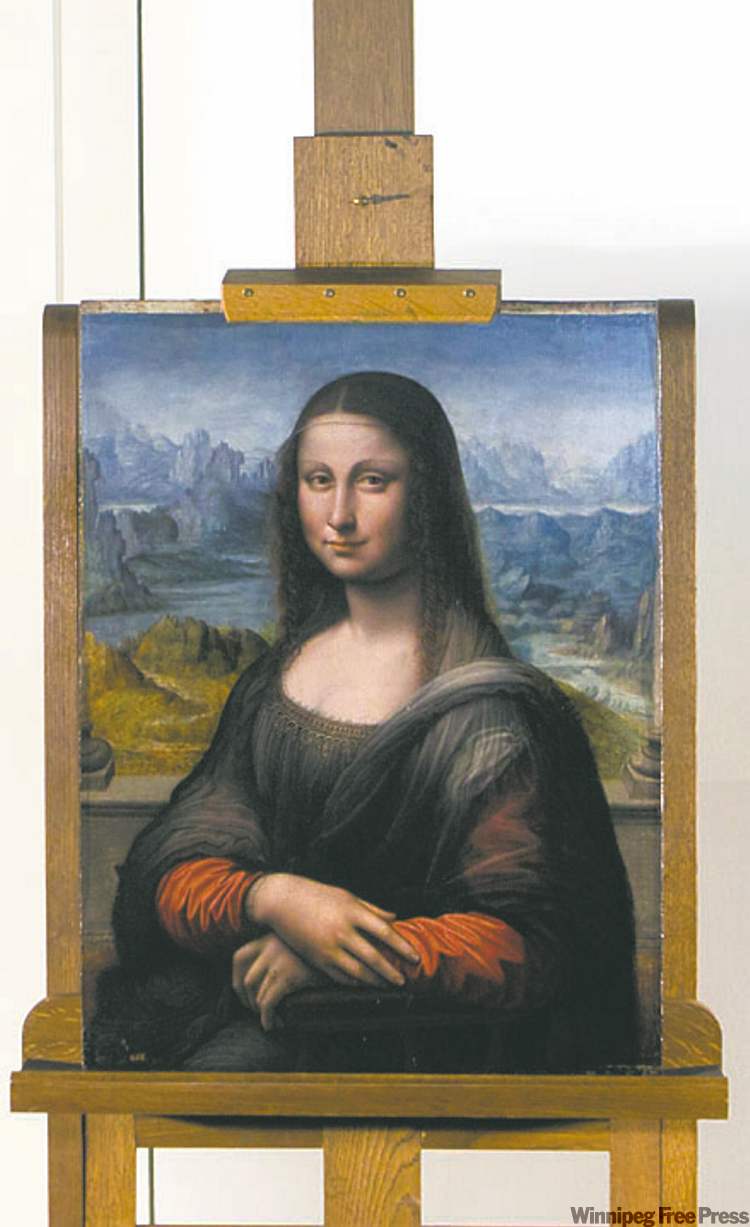
The copy has been part of the Prado collection for years and displayed occasionally but no one paid much attention to it because around the woman in the Mona Lisa was a stark black background, not the pretty landscape seen in the original.
Two years ago, to get the copy ready for a da Vinci exhibit later this year in Paris, where the original hangs in the Louvre, tests were done and this gave restorers a hint that something lie under the black coat, which was added in the 18th century for reasons not fully understood.
When the black covering was removed, a Tuscan landscape very similar to the one in the original emerged.
And X-ray tests that allow experts to peek under a painting’s surface to see how it developed as it was composed showed that changes made in the copy were similar to changes made to the original as it evolved.
Varnish has also been removed from the Mona Lisa’s face, making it look brighter and younger than the face coated with cracked, darkish varnish at the Paris museum.
“You can imagine that this is what the Mona Lisa looked like back in the 16th century,” Finaldi said.
Miguel Falomir, the Prado’s director for Italian painting, said the copy gives art lovers and experts a chance “to admire the Mona Lisa with totally different eyes.”
He and Finaldi said the museum’s best guess is that the copy was done by a da Vinci apprentice named Francesco Melzi, because of the style observed in it.
Besides the black background, one other difference from the original is the woman in the copy has eyebrows and the Mona Lisa in the real masterpiece does not.
There are dozens of the surviving replicas of the masterpiece from the 16th and 17th centuries.
The Louvre supports the Prado’s new evaluation of the painting, Finaldi said.
The Prado plans to put it on display later this month before it travels to France for the da Vinci show.
— The Associated Press