

Storytelling’s role perfectly paradoxical
Advertisement
Read this article for free:
or
Already have an account? Log in here »
To continue reading, please subscribe:
Monthly Digital Subscription
$0 for the first 4 weeks*
- Enjoy unlimited reading on winnipegfreepress.com
- Read the E-Edition, our digital replica newspaper
- Access News Break, our award-winning app
- Play interactive puzzles
*No charge for 4 weeks then price increases to the regular rate of $19.00 plus GST every four weeks. Offer available to new and qualified returning subscribers only. Cancel any time.
Monthly Digital Subscription
$4.75/week*
- Enjoy unlimited reading on winnipegfreepress.com
- Read the E-Edition, our digital replica newspaper
- Access News Break, our award-winning app
- Play interactive puzzles
*Billed as $19 plus GST every four weeks. Cancel any time.
To continue reading, please subscribe:
Add Free Press access to your Brandon Sun subscription for only an additional
$1 for the first 4 weeks*
*Your next subscription payment will increase by $1.00 and you will be charged $16.99 plus GST for four weeks. After four weeks, your payment will increase to $23.99 plus GST every four weeks.
Read unlimited articles for free today:
or
Already have an account? Log in here »
Hey there, time traveller!
This article was published 24/06/2023 (899 days ago), so information in it may no longer be current.
Former University of Toronto professor J. Edward Chamberlin, an officer of the Order of Canada now living in British Columbia, leads off his new book Storylines with an example of a pure paradox:
“… we believe the world is round. But we also believe that we are standing right side up, not upside down as we might if the world really were round. Which it is. And with that we go about our business, comfortable in a contradiction that sets both truth and belief on their heads — and leaves us with a good story.”
Chamberlin makes the point that storytelling allows us to wonder, not worry, about things in science and religion that are unproven. Storytelling gives reasons to believe while still acknowledging the presence of doubt. The word storytelling itself embraces the many ways in which stories have been told over the centuries: orally (through songs as well as recited poems and told stories), drawn and written on cave walls and on paper, and ultimately conveyed by printing press and computer.
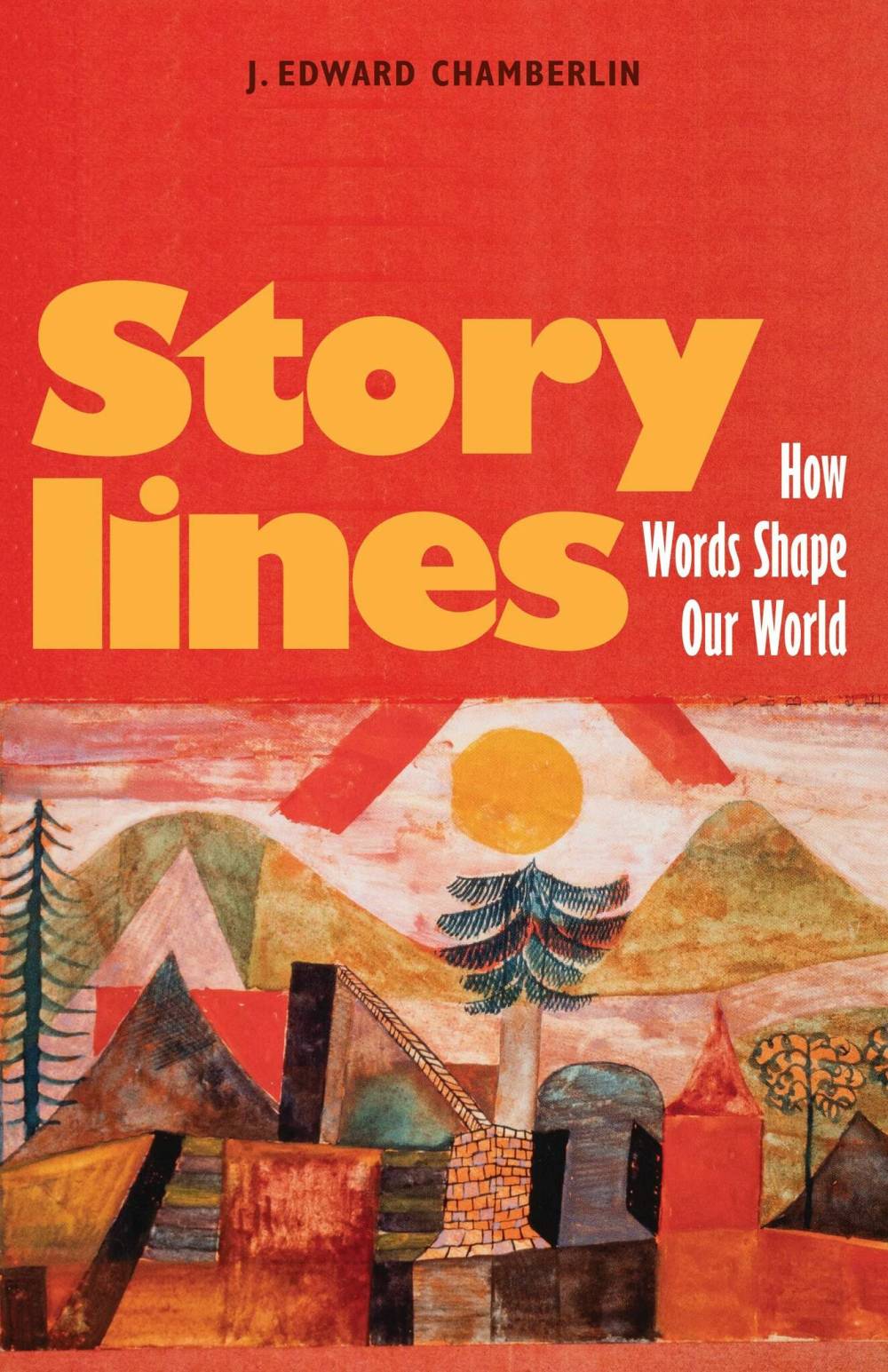
Storylines
The subtitle of Chamberlin’s book, How Words Shape Our World, suggests the author presents meaningful examples of writers’ works down through the ages. And he does, though some are obscure or dated; but, like many a novelist, he relies heavily on telling rather than showing. Fifteen pages of end notes detail the sources of his points.
In a chapter called Resistance and Survival, Chamberlin points out that “we always need relief. Something to give us ease in the midst of so much disease — social and economic and political and medical… . That’s where storytelling can help us, bringing a sliver of light, a spirit of defiance, and some pleasure into the sometimes sunless and dispiriting workplace of life and giving us direction and encouragement.”
Through much of the book, Chamberlin points to the history of Indigenous people in America for excellent examples of how storytelling can not only give relief from catastrophe but help sustain life and purpose.
“Until all too recently,” Chamberlin writes, “Indigenous oral storytelling about history and homeland has been discounted as unreliable — not verifiable and therefore not ‘true’ in the way written documents are, even when the storytelling is performed by elders as scrupulously trained in testimonial storytelling as any academic scholar or religious faith keeper.”
Much of Chamberlin’s book is devoted to rethinking the way Indigenous peoples have been treated by historians, especially in coverage of migration after 1492. “‘Columbus discovered America’ is a brutally stupid sentence,” Chamberlin says. “Despite its transparent nonsense, even now this statement is as traumatic for many Indigenous people as Holocaust denial is for Jewish people, for it denies their humanity.”
Had it looked at the world more recently, Storylines could have been greatly enhanced by consideration of such recent paradoxes as fake news, the throwing around of the word “woke” and AI (artificial intelligence). Recent news stories on the misuse of AI, especially in the classroom, might suggest whole new catastrophes in the world of creative writing. News media might well be affected — there seem to be so many versions of the truth. And is woke good or bad?
Chamberlin does raise some still-contemporary issues and even sees humour in some of them. Many of his examples are old, but one could argue they are timeless. Perhaps the best takeaway from this book is offered in the first few pages, a memory from Chamberlin’s Grade 1 class. The teacher wrote “C-A-T” on the blackboard and asked him what it was. He answered, “They are three letters on the blackboard.” “C-A-T. That is a cat,” said the teacher, and, when he repeated what he had said, she sent him out of the classroom.
It was Chamberlin’s introduction to a paradoxical world.
Dave Williamson is the Winnipeg author of 10 books, including three works of non-fiction.