

Book Review: Tessa Hulls feeds her family’s ghosts by bringing them to light in rich graphic memoir
Advertisement
Read this article for free:
or
Already have an account? Log in here »
To continue reading, please subscribe:
Monthly Digital Subscription
$0 for the first 4 weeks*
- Enjoy unlimited reading on winnipegfreepress.com
- Read the E-Edition, our digital replica newspaper
- Access News Break, our award-winning app
- Play interactive puzzles
*No charge for 4 weeks then price increases to the regular rate of $19.00 plus GST every four weeks. Offer available to new and qualified returning subscribers only. Cancel any time.
Monthly Digital Subscription
$4.75/week*
- Enjoy unlimited reading on winnipegfreepress.com
- Read the E-Edition, our digital replica newspaper
- Access News Break, our award-winning app
- Play interactive puzzles
*Billed as $19 plus GST every four weeks. Cancel any time.
To continue reading, please subscribe:
Add Free Press access to your Brandon Sun subscription for only an additional
$1 for the first 4 weeks*
*Your next subscription payment will increase by $1.00 and you will be charged $16.99 plus GST for four weeks. After four weeks, your payment will increase to $23.99 plus GST every four weeks.
Read unlimited articles for free today:
or
Already have an account? Log in here »
Hey there, time traveller!
This article was published 11/03/2024 (636 days ago), so information in it may no longer be current.
When Tessa Hulls sets out to tell her family’s story, she’s feeding their ghosts in the best way she’s learned how: by pulling them into the light.
Hulls’ graphic memoir “Feeding Ghosts” covers three generations of women, starting with her grandmother, Sun Yi, who herself was once a bestselling author of a memoir. Sun Yi’s path wades through a treacherous Chinese history, from the brutal massacre of Chinese in Nanking by Japanese soldiers through her escape to Hong Kong in 1957 — just missing the Great Leap Forward and the mass starvation that came with it. Then, as Sun Yi withdraws into a spiral of hospitalizations and mental illness, the story picks up through Sun Yi’s daughter, Rose, until we reach the author herself, Rose’s daughter, as she pieces together their past to make better sense of the reverberating wounds that have threatened to drown each of them in matrilineal succession.
From Sun Yi’s roots in China to Tessa Hulls’ in California, it’s clear the story is going to address generational trauma right out of the gate. But you can rest assured there’s a profound sense of closure waiting at the end.
Despite the extreme weight of the story, the density of the historical context and the way every bit of space is utilized to communicate pictorially or verbally, that information is surprisingly digestible — and even nourishing.
With this high level of approachability, Hulls conveys the kind of historical details that turn staggering and unimaginable numbers into a reality you can feel: people eating bark off the trees, then painting over the trees’ nakedness when Mao Zedong comes to inspect; bodies left where they died waiting in food lines while grossly inflated reports of crop production greenlight the export of those same basic necessities so desperately needed at home.
Immensely interesting family history aside, Tessa has lived her own exciting life, including a season working at McMurdo Station in Antarctica. Her explosive joy in the freedom of that vastness beams from the page.
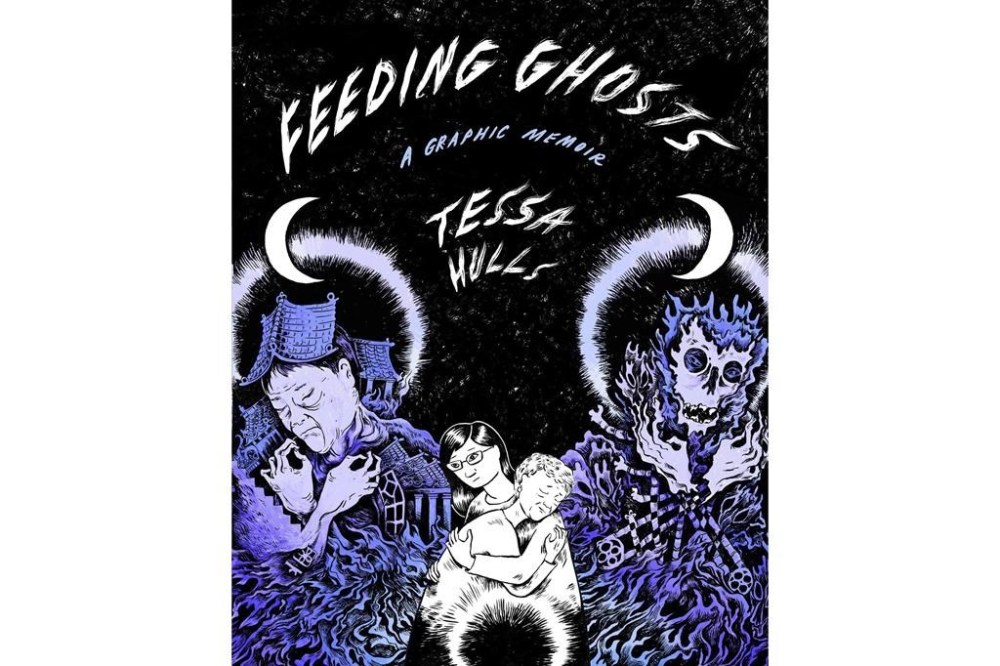
The art is simple — cartoons drawn with black strokes on white paper — but what it conveys is so much more intricate. Panels often bleed into one another as if the gutters that divide them are mere suggestions, allowing for layered illustrations rich in metaphor.
Hulls visually represents trauma as ghosts in her bones, emanating from her, her mother and her grandmother, often intermingling like smoke; veins of their shared history branching out from their bodies as a physical representation of their emotional interconnectivity.

Then there are these beautiful spreads that echo earlier imagery, reverberating without subtlety or fanfare.
As the pieces fall into place and healing and understanding take root, the rib cage once gushing with ghosts now bursts with tree branches reaching toward the sky.
“Feeding Ghosts” is courageously and heartbreakingly bare, and Hulls’ attempt to present it all in a subjective manner only heightens the memoir’s emotional impact. Her words narrate the story while the art carries the weight of the emotions. And the author pauses more than once to remind the reader that a memoir is curated, and therefore only a slice of the truth. At the same time, hers is deeply grounded in historical fact. Pointing out when she takes artistic license only strengthens the story’s trustworthiness.
___
AP book reviews: https://apnews.com/hub/book-reviews