

AUTO TECH: Technology, chemistry mix in snow tires
Advertisement
Read this article for free:
or
Already have an account? Log in here »
To continue reading, please subscribe:
Monthly Digital Subscription
$0 for the first 4 weeks*
- Enjoy unlimited reading on winnipegfreepress.com
- Read the E-Edition, our digital replica newspaper
- Access News Break, our award-winning app
- Play interactive puzzles
*No charge for 4 weeks then price increases to the regular rate of $19.00 plus GST every four weeks. Offer available to new and qualified returning subscribers only. Cancel any time.
Monthly Digital Subscription
$4.75/week*
- Enjoy unlimited reading on winnipegfreepress.com
- Read the E-Edition, our digital replica newspaper
- Access News Break, our award-winning app
- Play interactive puzzles
*Billed as $19 plus GST every four weeks. Cancel any time.
To continue reading, please subscribe:
Add Free Press access to your Brandon Sun subscription for only an additional
$1 for the first 4 weeks*
*Your next subscription payment will increase by $1.00 and you will be charged $16.99 plus GST for four weeks. After four weeks, your payment will increase to $23.99 plus GST every four weeks.
Read unlimited articles for free today:
or
Already have an account? Log in here »
Hey there, time traveller!
This article was published 26/03/2010 (5737 days ago), so information in it may no longer be current.
WITH spring here, it may seem strange to talk about winter tires, but it is also the time of year when many drivers are taking off their worn winter tires and installing their summer or all-season tires. Now is the time to start budgeting and looking at what tires are available so you won’t feel pressured next fall when the snow flies again.
I recently spent time with the tire engineers from Cooper Tire as we looked at winter tire technology. Cooper Tire is bringing a new premium winter tire, the Weather-Master WSC, to market for next season and here is some of the technology that goes into making a great winter tire.
There are two parts to providing traction on snow and ice. First, there is the mechanical part. This includes tread design and physical features. Then there is the chemistry of the rubber compounds.

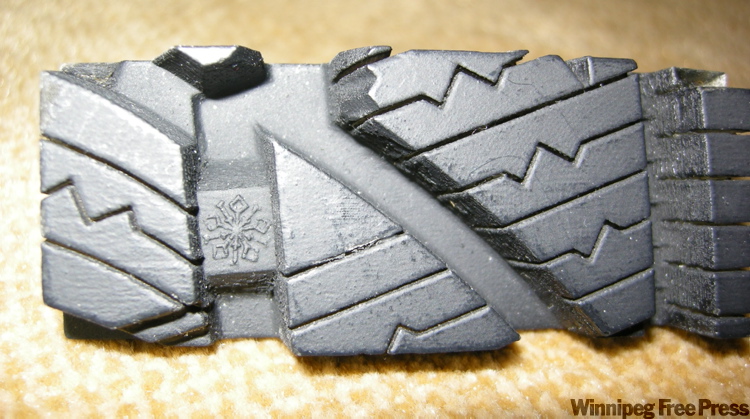
The mechanical design is easier to see. The WSC tire uses a directional tread design to help grip the snow. Snow grips snow better than rubber grips snow. The directional pattern holds snow in the grooves so it can in turn grip the snow on the road. The tread also has tapered sawtooth patterns on the sides of the tread blocks to help grip the snow between the blocks.
A unique WSC tire feature is the snowflake tread wear indicator moulded into the tire grooves. The snowflake appears when the tires are half-worn. The tires will still grip on ice for the full depth of the tread but optimum snow traction performance decreases on all tires after the tread is about half worn. The WSC also has 132 stud holes for drivers who want to have studded tires.
The final visible feature is the tire sipes. The WSC has more than 3000 biting edges compared to about 2200 on the well-known Hakkapeliitta winter tire. The WSC uses .020-inch-wide sipes compared to the more common .030 inch sipes. The narrower sipes help keep the tread blocks more stable for better handling on all road surfaces.
Unseen mechanical features include stiffer rubber used in the base layer below the tread blocks and stiffer material in the tire sidewalls to enhance handling performance even though the actual tread blocks have more flexible rubber.
The specific chemical composition of a tire is a well-guarded secret by any tire manufacturer. Cooper Tire is no different, but they did share some insight. The tire tread formula starts with a polymer – raw and synthetic rubber. Then fillers such as carbon black or clay are added to improve the compound strength. The result is a long chemical chain compound so vulcanizing agents are added to create cross-links in the chains.
Next comes binding agents that help bond components in the mix. Silica is one of those products that require a binding agent to keep it encapsulated with the rubber. Silica comes in several grades and the particles are measured on the nano scale, so you won’t see them with your eye.
Silica adds several properties. First, the type and grade of silica will change the wear rate of the tread. Winter tires use silica for traction. Theories are that the silica nano particles create grip both chemically and physically with the ice surfaces. One of the keys to producing a premium winter tire is to mix the right type and amount of silica so it is dispersed throughout the tire tread.
Accelerator agents are then added to the mix to speed up the vulcanizing process in the mold. Next, plasticizers such as aromatic oils are added to keep the tire tread flexible at low temperatures. Using the right chemical mix allows the tire to be flexible yet also have good wearing characteristics.
About 70 per cent of all tire components are oil-based products, so as oil prices vary so will the price of tires although the price changes appear to be slower. Many of the oil products are actually by-products of the refining process. The other 30 per cent of a tire makeup are fabrics and natural products such as natural rubber.
Activators such as zinc oxide are added to the mix to get the vulcanizing process started and finally anti-oxidants such as wax are added to slow tire oxidation or aging so it will last for years.
This is a simple overview of winter tire technology and chemistry. Amazingly, all this technology is available in a tire, often at a lower price that a pair of trendy running shoes!
Jim Kerr is an experienced mechanic, instructor and member of the Automobile Journalists’ Association of Canada.
kerr.jim@sasktel.net