

Little supervision, few drownings
Manitoba's beach safety officers don't wait for trouble, they focus on preventing water tragedies

Advertisement
Read this article for free:
or
Already have an account? Log in here »
To continue reading, please subscribe:
Digital Subscription
One year of digital access for only $75*
- Enjoy unlimited reading on winnipegfreepress.com
- Read the E-Edition, our digital replica newspaper
- Access News Break, our award-winning app
- Play interactive puzzles
*Billed as $5.77 plus GST every four weeks. After 52 weeks, price increases to the regular rate of $19.95 plus GST every four weeks. Offer available to new and qualified returning subscribers only. Cancel any time.
Monthly Digital Subscription
$4.99/week*
- Enjoy unlimited reading on winnipegfreepress.com
- Read the E-Edition, our digital replica newspaper
- Access News Break, our award-winning app
- Play interactive puzzles
*Billed as $19.95 plus GST every four weeks. Cancel any time.
To continue reading, please subscribe:
Add Free Press access to your Brandon Sun subscription for only an additional
$1 for the first 4 weeks*
- Enjoy unlimited reading on winnipegfreepress.com
- Read the E-Edition, our digital replica newspaper
- Access News Break, our award-winning app
- Play interactive puzzles
*Your next Brandon Sun subscription payment will increase by $1.00 and you will be charged $17.95 plus GST for four weeks. After four weeks, your payment will increase to $24.95 plus GST every four weeks.
Read unlimited articles for free today:
or
Already have an account? Log in here »
Hey there, time traveller!
This article was published 05/08/2017 (3214 days ago), so information in it may no longer be current.
Children on the sandy shores. Teenagers water-skiing. Adults and families boating or paddling on many of the province’s 110,000 lakes.
Tens of thousands of Manitobans will be in or near water this long weekend, as they are all summer long.
But very little of that water is under the supervision of beach safety officers or lifeguards.
Indeed, there is a dichotomy at work when it comes to water safety in Manitoba: fewer provincial and municipal beaches are providing supervision, yet the number of drownings overall has fallen since the 1990s.
Since 1996, in fact, there have been just seven drownings in supervised environments, according to statistics from the Manitoba Lifesaving Society. From 2010 to 2014, less than one per cent of drownings in Manitoba occurred under lifeguard supervision.
Contrast that to the 1980s, when between one and four drownings occurred at Grand Beach alone each year. But there were none at the popular destination from 1999 to 2015.
Exactly a year ago on the August long weekend, two friends — an 11-year-old girl and a 12-year-old boy — drowned there after parents lost sight of them in the water.
There was also a drowning at Birds Hill West Beach on Aug. 20 last summer — the first at the provincial park since 2001.
In the 1980s, up to 16 provincial parks were staffed with lifeguards. Today, there are only three: Winnipeg Beach, Grand Beach and Birds Hill Park. (Safety measures provided at 83 provincial park beaches include signage and buoy lines, the province says.)
So why are there fewer drownings and fewer supervised beaches?
“That’s because you’re making the assumption that the drownings have been happening where there are lifeguards,” said Kevin Tordiffe, operations manager for the lifesaving society.
“Most drownings in Canada happen in wild environments, so to speak. They’re out in the lake, where there are no lifeguards, or off a dock at some guy’s cabin. Or they’re out boating, commuting between northern communities, or rollovers into ditches. Or poorly supervised kids in a home environment. Those are where most of the drownings are happening.”
So what happened?
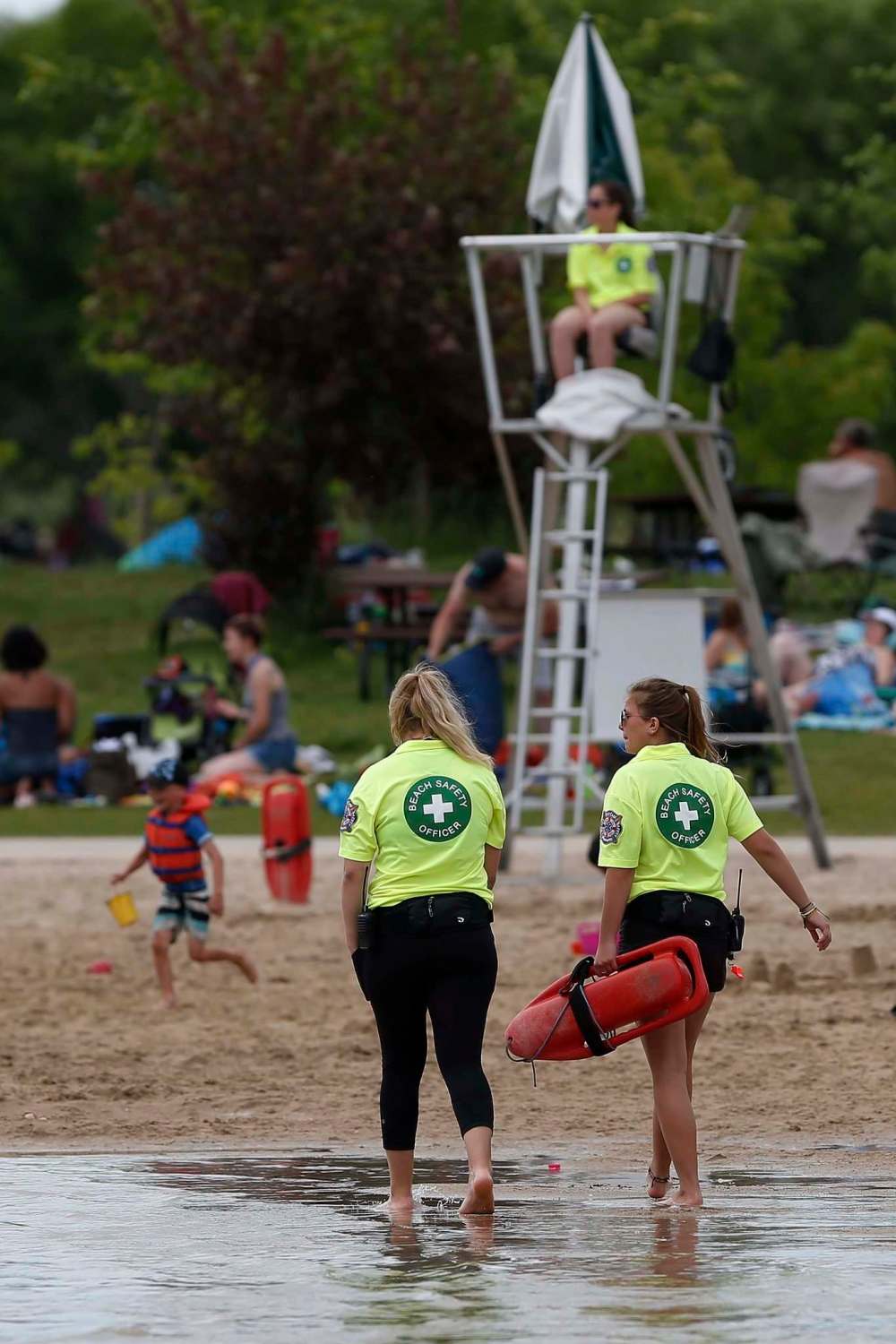
In 1990, following an inquest into two drownings the previous summer at West Hawk Lake, which was staffed with lifeguards who were on a break at the time of the deaths, the province decided to change policy, rebranding lifeguards as “beach safety officers.” The number of staffed beaches was reduced to 11.
“(The province) felt that visitors were depending on lifeguards and having that false sense of security,” said Jenny Davin, Manitoba’s beach safety co-ordinator. “They weren’t going to be providing lifeguarding services at that point.
“Everyone is responsible for watching their own children and keeping them within arm’s reach. Parents are their children’s best lifeguards.”
And that has been the province’s policy ever since. In fact, after additional drownings at provincial parks in 1990, all beach safety programs were disbanded except for Grand Beach, from 1991 to 1995.
It was only after three drownings at Winnipeg Beach in the summer of 1995, and a subsequent public hearing, that beach safety officers returned there.
Birds Hill was added in 1998, when beach safety officers were installed in advance of the 1999 Winnipeg Pan Am Games, coinciding with a $10-million rebuilding of the beachfront.
It’s estimated a million people visit those three beaches each summer; Davin said it’s “remarkable” there have been relatively few deaths over the last two decades.
“No drownings is good news,” she said. “It’s unfortunate when it happens but it shows that our beach safety officers are doing great work.”
But supervision is not cheap. The total cost for safety patrols for the three beaches is about $930,000 a year. Maximum staff for Birds Hill is 20, Grand Beach 14 and Winnipeg Beach 12.
Costs include rescue equipment, including inflatable Zodiac boats.
“In 1996 we didn’t have defibrillators on those beaches,” Tordiffe added. “We do now.”
Beach safety officers’ primary role is to provide education by talking to parents and scanning the water for risky behaviour, Davin said.
“That would be the bulk of the public contact beach safety officers are making,” she said. “Prevention is really the focus.”
Tordiffe said the Manitoba program is unique in one distinct way.
“When you talk to your provincial government and ask them, ‘What do your beach safety officers do?’ the one thing you’re going to find that’s missing off of their list is ‘active supervision in the aquatic environment,’” he said.
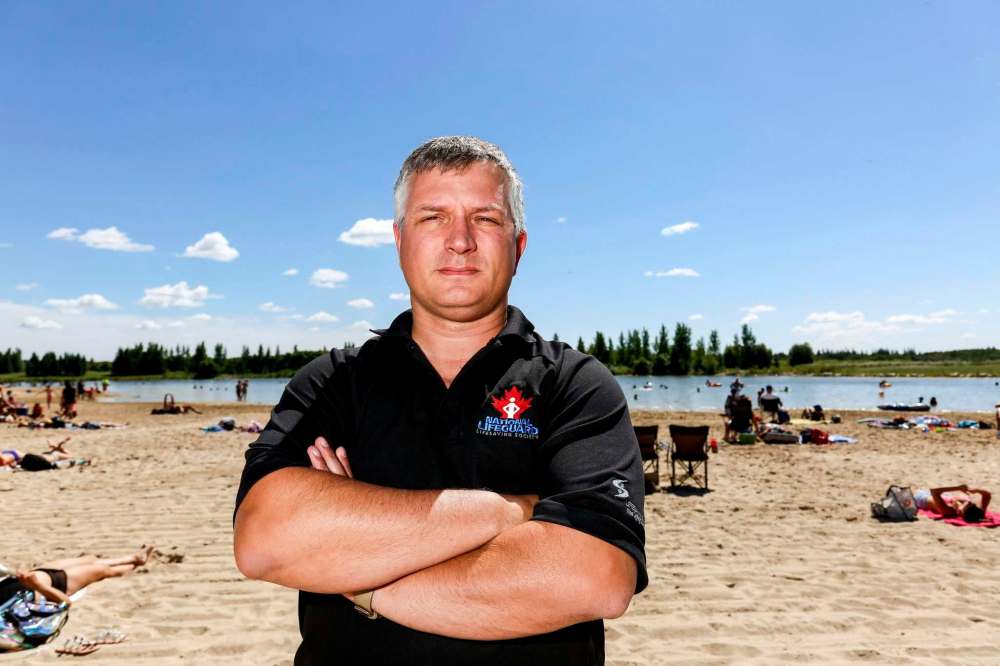
“That’s the lifeguard in a lifeguard chair, watching the water for a drowning incident to occur. That’s the part that’s been pulled out.
“Everything else that a beach officer or a lifeguard does is identical.”
Each province has its own approach to water safety. In Quebec, for example, the government mandates all municipalities to provide safety services for designated swimming environments in open waters.
The Nova Scotia Lifeguard Society supervises 17 beaches around the province, while B.C. has no lifeguards at provincial parks. There are no lifeguards at Ontario provincial parks, although Toronto has 70 to 80 lifeguards on the city’s municipal waterfront.
In Manitoba, Tordiffe said the number of municipalities that provide beach safety or lifeguards has “dried up,” largely due to cost and, in some cases, potential liability.
One municipal government has investigated staffing a beach three separate times in the last 20 years, he said.
“Each time, they’ve walked away from the option clearly because of the cost,” he said. “They have to weigh the cost-benefit analysis. In a small community of 10,000 or less population, they are evaluating whether they should put a quarter-million dollars into a three-month beach safety program or could that quarter-million dollars be funding a police officer in their community year-round?”
Chris Hornby, manager of parks and recreation for the RM of Gimli, said the municipality has in the past looked into the cost of a safety program for about a one-kilometre stretch of beach on Lake Winnipeg.
“I don’t think there’s an immediate call for it right now,” Hornby said. “Our system seems to be working.”
In an emergency, the RM can contact the Canadian Coast Guard station, which is based in Gimli. Meanwhile, a half-dozen members of the parks and recreation staff monitor the beach, which can attract between 500 and 1,000 visitors on an average sunny summer day.
At the same time, the province continues to review drowning incidents and, if warranted, upgrade procedures. Following two drowning deaths at St. Malo Provincial Park Beach in 2014, for example, the province introduced a Beach Smart program, where park interpreters deliver water-safety public education during peak visitation periods.
The program is predominantly directed toward children and parents, as well as newcomer Canadians. The interpreters made 8,200 “beach contacts” in 2016, the province said.
Other water-safety programming at St. Malo includes a life-jacket loan program, life-preserver ring stations with roped alarms, steep-dropped keep-out buoys installed beyond the safe swim line and supplemental child-supervision signage.
Tordiffe said the key focus in the future should be to continue targeting water-safety and education programs for northern communities, since the number of drowning deaths in supervised areas remains minimal.
Over the last 13 years, the province and federal government have funded the northern water smart program, where staff from the Manitoba Lifesaving Society travel to as many as 40 communities each summer to provide swim-to-survive education, boat operating courses and community grants to introduce water-safety programs.
“The Manitoba beach safety officer program isn’t perfect, but it’s doing a good job,” said Tordiffe, who would still prefer more provincial parks be staffed. “It’s had a positive impact. Maybe we could expand that to other areas but… if we really want to reduce those 20 or so drownings that happen each year in Manitoba we have to look at other targets.
“It’s a question of what do politicians want to do for their public? What do they see as their responsibility to the public when it comes to these aquatic environments? What can they afford? And ensuring whatever they do put in place is meeting standards.”
randy.turner@freepress.mb.ca
Twitter: @randyturner15
Randy Turner
Reporter
Randy Turner spent much of his journalistic career on the road. A lot of roads. Dirt roads, snow-packed roads, U.S. interstates and foreign highways. In other words, he got a lot of kilometres on the odometer, if you know what we mean.
Our newsroom depends on a growing audience of readers to power our journalism. If you are not a paid reader, please consider becoming a subscriber.
Our newsroom depends on its audience of readers to power our journalism. Thank you for your support.
Stats
25
average number of drowning deaths in Manitoba between 2010-2014
2.0
death rate per 100,000 population, putting Manitoba above the national rate of 1.3
84
The percentage of drowning victims are male between 2010 and 2014
3.8
death rate per 100,000 for children under five years of age, the highest of any province
3.4
death rate per 100,000 for young adults aged 20 to 24, which is the next highest drowning death rate in Manitoba
<1
Percentage of drowning deaths in lifeguard-supervised settings
52
percentage of drowning fatalities that took place on the weekend (Friday, Saturday, Sunday)
56
Percentage of drowning deaths that occur during motor vehicle travel, such as a rollover into a ditch
93
Percentage of cases where children under 5 drowned and supervision was absent or distracted
— Lifesaving Society of Manitoba 2017 report
Randy Turner
Reporter
Randy Turner spent much of his journalistic career on the road. A lot of roads. Dirt roads, snow-packed roads, U.S. interstates and foreign highways. In other words, he got a lot of kilometres on the odometer, if you know what we mean.
Our newsroom depends on a growing audience of readers to power our journalism. If you are not a paid reader, please consider becoming a subscriber.
Our newsroom depends on its audience of readers to power our journalism. Thank you for your support.
Advertisement Advertise With Us
Advertisement Advertise With Us