|
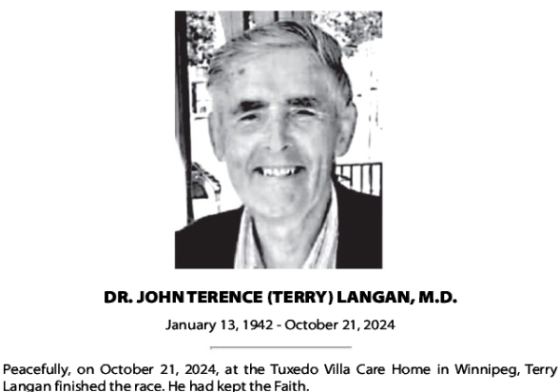
Dr. Terry Langan’s Irish eyes were smiling as he helped Winnipeggers see better.
Terry, who died on Oct. 21 at 82 years of age, was an ophthalmologist who worked in a clinic on Vaughan Street for decades.
But it wasn’t supposed to be that way.
Advertisement

Terry was born in Cork, Ireland. The oldest of three children, he was the first generation to go to school and be taught all his subjects in the Irish language or, as he would say, Gaeilge.
At school, Terry became a strong scholar and a very good tennis player on the country’s grass tennis courts.
He played for the tennis team at University College Galway while earning a general medical degree by the time he turned 24. He wasn’t content to only get a post-graduate medical diploma in ophthalmology; he also earned diplomas in paediatrics, obstetrics, infectious diseases and psychiatry.
While Terry was proud to receive his earlier schooling in the country’s language, he also faced one of the country’s more unfortunate traditions: emigration.
The poverty and the lack of opportunity in Ireland saw him and 24 of his 30 high school classmates forced to leave their home country.
Before Terry left he met Mary, who became his wife of 49 years.
Why did Terry choose Winnipeg? A close friend convinced him to try a locum there.
As Terry’s obituary says, “the young couple came to Winnipeg with a plan to only stay six months, but never left. They would eventually build a new life in a land where the lakes were bigger than their home country, the weather could be deadly, and the pubs had strange rules about opening on Sunday (they didn’t) or allowing children (also didn’t).”
The first day Terry opened the doors of his clinic he had two patients. The next day only one, but that was better than day three: zero.
But in the years ahead his practice did grow, serving not just ordinary Winnipeggers but, due to its location, everyone from cabinet ministers to corporate CEOs to street gangsters.
And, when the provincial government cut healthcare spending in the early 1990s, Terry became known for treating people who were unable to pay him. As he said at the time, health care “isn’t about balanced budgets. It’s about helping the patient sitting in front of you.”
Once out of the clinic, Terry was a terror on the city’s tennis courts. He joined several clubs and, with his three-generation-old racquets, he and his longtime doubles partner, Dr. Klaus Wrogemann, became finalists in the Canadian Senior Doubles, over 45 category, and Western Canadian champions in the over 55, 60, 65, 70 and 75 age groups. And, on his own or with other partners, Terry won numerous singles, doubles and mixed doubles championships.
Terry was also active in politics and once even painted his house red in celebration of a Liberal victory.
And, while Terry’s profession helped Winnipeggers see better, his family and others also saw a man who had concern for his fellow man, a good sense of humour, a love of sports and an open mind.
Terry is survived by his wife, three sons and several grandchildren.
Read more about Terry.
How They Lived
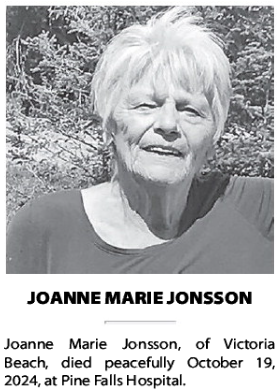
Joanne Jonsson was an avid horticulturalist.
Joanne, who died on Oct. 19 at 84 years of age, ran a greenhouse operation on her Victoria Beach property for many years.
She also helped Victoria Beach’s sports club and community centre evolve from simpler times and operated the Dockside Deli at Hillside Marina at the family harbour.
Read more about Joanne.
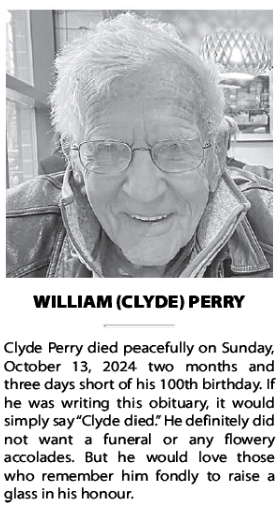
Clyde Perry said he joined the navy in the Second World War to save democracy… and get a warm coat and new boots.
Because of his service, Clyde — who died on Oct. 13, only three days before his 100th birthday — was able to receive help from the federal government’s veterans’ support program, which he used to go back to school and become a teacher.
Clyde worked in the Winnipeg School Division and his last role there was as a legendary principal at Tec Voc High School.
He was later inducted into the Manitoba Basketball Hall of Fame for his coaching of high school basketball.
Read more about Clyde.
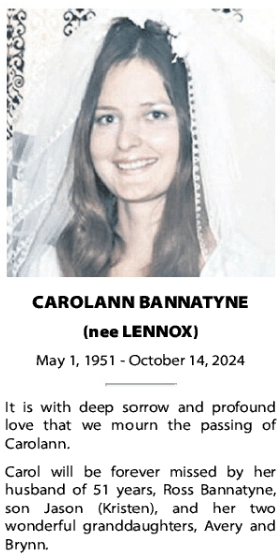
Carolann Bannatyne spent her entire career in insurance.
Carolann, who was 73 when she died on Oct. 14, began working for an agency when she was 18 years old, sparking her decision to become a Chartered Insurance Professional.
She became a commercial underwriter at Hayhurst Elias Dudeck and rose to become vice-president of underwriting with the company. She stayed in that position, even after the firm was purchased by Western Financial, until she retired in 2021.
Read more about Carolann.
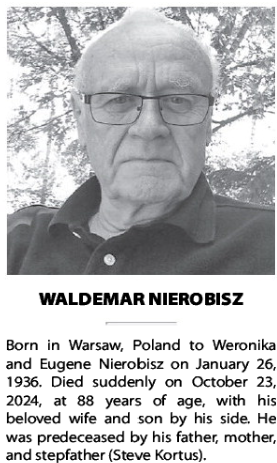
Waldemar Nierobisz was 15 and had only $5 in his pocket when he came to Canada in 1951 with his traumatized mother after the Second World War.
His father was killed during the war and Waldemar, who died on Oct. 23 at 88 years of age, became the family’s main breadwinner, working from sun-up to sun-down on a farm.
He continued to work hard through his life and, years later, he retired as a project officer in the City of Winnipeg’s civic buildings department.
At the time, there were many Polish refugees in Winnipeg and he not only attended events put on by them, but also volunteered with The Polish Combatants Association, Branch No. 13, the Canadian Polish Manor, and the annual Warsaw Pavilion during Folklorama.
Read more about Waldemar.
Greg Halabut died after years of dealing with multiple health conditions.
But Greg, who was 68 when he died on Oct. 21, and his wife made sure Manitobans knew what the health-care system was like in the wake of controversial reforms made by the previous provincial government and following the pandemic.
You can read their views in this Free Press story here.
Read more about Greg.
A Life’s Story
Ian Smith’s first scientific laboratory was in his parents’ north Main Street basement when he was a child. It was a hint of his future.
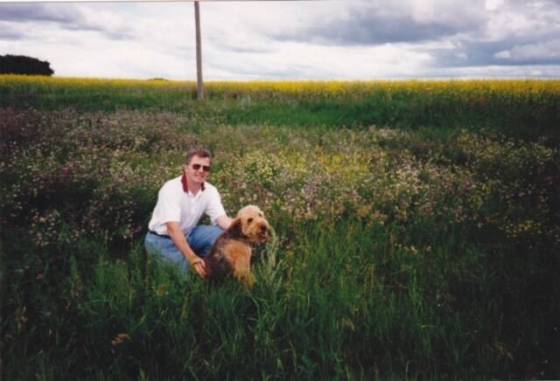
Ian Smith, a husband, father and Winnipeg scientist, died in May at the age of 84. (Supplied)
Ian, who was 84 when he died on May 9, ended up studying chemistry in university and, years later, became a search officer in the chemistry division of the National Research Council. In 1992, he was tasked with building the NRC’s Institute for Biodiagnostics in Winnipeg, where he oversaw the research and commercialization of non-invasive health diagnosis devices until the facility closed due to federal government funding cuts.
“He loved his science, he loved Canada, he loved doing things for Canada,” said his wife Eva.
Read more about Ian’s life here.
Until next time, I hope you continue to write your own life’s story.
|