|
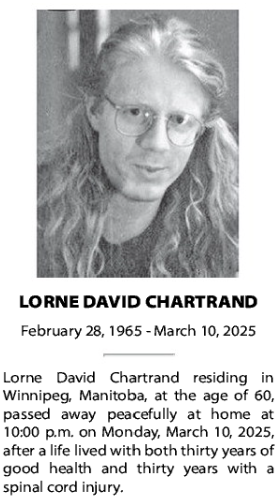
Lorne Chartrand’s life was divided neatly into two parts.
For 30 years, he led an active life. He ran marathons and played hockey, and he graduated from the University of Manitoba with a double major in political science and journalism.
Then came his spinal cord injury. For the next 30 years, Lorne’s advocacy helped the paraplegic community he had joined.
Advertisement

Lorne was 60 when he died on March 10.
Lorne was born in Benito, Man., near the Saskatchewan border.
He moved to Winnipeg and developed his love of music, attending the Winnipeg Folk Festival and working as a DJ.
Lorne also loved photography, cooking, and fantasy hockey — he won several championships with the teams he created.
A long-ago lawsuit gives a hint about what happened next.
Lorne was at the Assiniboine Gordon Inn on the Park, going to or from a washroom, when he came upon a group of people blocking a stairway. He made the decision to get past them by hopping over a railing, and he tripped and fell.
He would later joke he was injured on March 15, 1995 — “the Ides of March, for Shakespeare fans.”
Lorne had always wanted to be a video journalist and he continued to pursue that dream after his injury. He studied broadcast journalism at Red River College and received several awards when he graduated.
He went on to work for the Canadian Paraplegic Association (Manitoba) where he was editor of its Paratracks newsletter. He also sat on the organization’s board of directors.
In one of his first columns for the publication in 2003, he wrote that before going to Red River, he had been receiving a modest disability pension which would have allowed him to never return to work.
“I could live a life of leisure; never again need I suffer the invasion of an alarm clock on my morning slumber,” he wrote.
But after 10 months, he realized “such an existence would — for me — be a life of irrelevance.”
So, risking his pension, he went back to school. “I am confident that, somehow, I will be able to make a difference in this world.”
His family says he did accomplish that goal.
“Lorne was an advocate for creating a better life for those who struggle with spinal cord injuries as well as self-managed care and his work he began will continue on.
“Lorne brightened any room he entered and had epic and endless topics of conversation with splashes of the best humour throughout.”
Lorne was predeceased by his mother and a brother and is survived by his father, three sisters, and a brother.
Read more about Lorne.
How They Lived
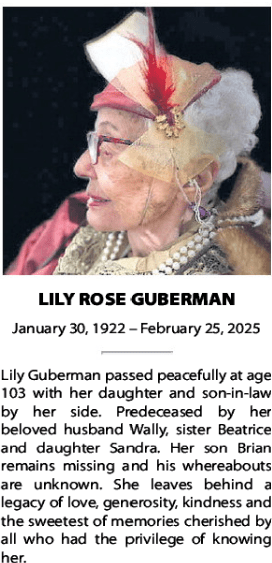
Lily Guberman was the oldest living original member of the Royal Winnipeg Ballet.
Lily was only 17 in 1939, when she was invited by the founders of what was then called the Winnipeg Ballet Club.
Last year, she was invited back to take part in the ballet’s 85th anniversary, by performing a walk-on role in full dress costume in The Nutcracker production.
Lily also faced tragedy during her life. Her son, Brian, was living in Edmonton when he suddenly disappeared without a trace in 1974.
Lily was 103 when she died on Feb. 25.
Read more about Lily.
Helen Torbiak recalled being teased at school about a handsome boy she had met.
Years later, she met him again, fell in love, and they married.
The couple owned two local businesses: the Green Brier Inn and RJ’s Pizza.
Helen was 87 when she died on Feb. 11.
Read more about Helen.

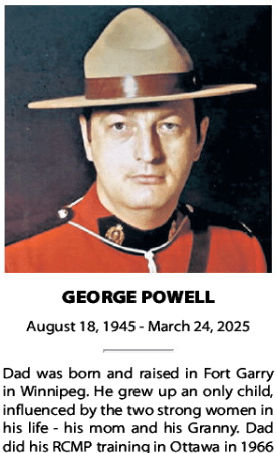
George Powell was one of the last Mounties trained to ride a horse in the RCMP.
George, who died on March 24 at 79 years of age, was posted in various places in Saskatchewan until he took what he called a “corporate” job at Winnipeg’s D Division headquarters in 1982.
He worked in the security systems area and consulted on federal building security while also coordinating security for VIP visits.
That’s how George was able to shake the hands of Queen Elizabeth, Pope John Paul II, Jimmy Carter, and all the prime ministers between 1982 to 2000. He was also part of the team that protected Manitoba MLA Elijah Harper when he voted against the Meech Lake Accord.
Read more about George.
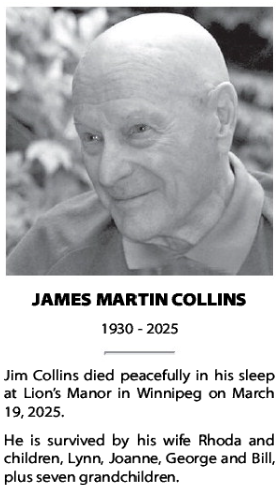
Jim Collins worked in heavy construction.
Jim, who died on March 19 at age 94, moved earth and blasted rock throughout the western provinces and northern territories.
His knowledge ice-road construction brought him to Antarctica, where he built a permanent ice runway for the British Antarctic Survey in 1984.
Read more about Jim.
Angela Jamieson was in charge of the voices of the provincial government.
Angela, who was 65 when she died on March 14, was director of the provincial public affairs branch. That’s the non-partisan unit that deals with media queries to provincial departments.
She came to the role after working in journalism in Alberta, followed by several years working communications and public affairs for the Alberta government and a private consulting firm.
Read more about Angela.

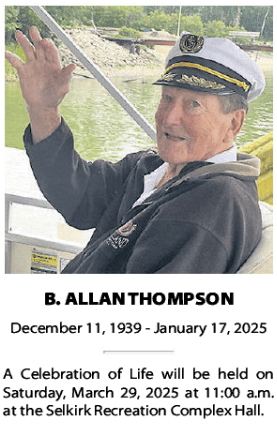
Allan Thompson was a teacher before his career went to the dogs — actually, the hot dogs.
That’s because Allan, who died on Jan. 17 at 85 years of age, bought the iconic Skinners restaurant in Lockport with his wife.
They expanded it to include the Wet ‘n’ Wild waterslide attraction and later opened a restaurant location at The Forks.
Read more about Allan.
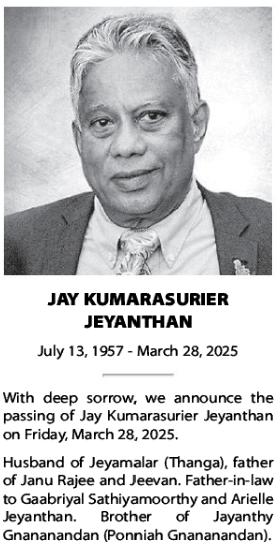
Jay Jeyanthan devoted himself to community service.
Jay, who was 67 when he died on March 28, moved here from Sri Lanka and graduated from the University of Manitoba. He worked for the federal government for 25 years.
He volunteered extensively in the community and took on leadership roles in several organizations including the Tamil Society of Manitoba, the Hindu Society of Manitoba, Folklorama, United Way, and the Liberal Party of Canada.
Read more about Jay.
A Life’s Story
Harry Schellenberg was a politician who put community, faith and family first.
Harry, who died in November, was born on a farm near Boissevain. He pursued a career in education, teaching history at River East Collegiate for 25 years.

Harry Schellenberg talks with constituents during the 1999 provincial election, where his victory over incumbent Vic Toews was called the “best political comeback story in Manitoba history.” (Boris Minkevich / Free Press files)
He became president of the Manitoba Parents for German Education and, after lobbying for several years, the first German bilingual class began in 1981. The program is still operating today.
In 1993, Harry became the MLA for Rossmere in a byelection, but was defeated just two years later by Tory MLA Vic Toews. Just four years later he returned the favour, defeating Toews, then a cabinet minister, by 5,000 votes.
Read more about Harry’s life in our weekly Passages feature.
Until next time, I hope you continue to write your own life’s story.
|