|
“The opposite of poverty is not wealth; the opposite of poverty is justice.”
— American lawyer and social justice activist Bryan Stevenson
Could a government savings account started now help eradicate poverty 18 years from now?
Advertisement

The Macro
Tucked deep within the folds of U.S. President Donald Trump’s “One Big Beautiful Bill Act,” expansive omnibus legislation that completely reshapes the scope and purpose of the American federal government, there is an odd and intriguing provision to create savings accounts, with taxpayer money, for all children born between January 2025 and December 2028.
Every eligible child would get $1,000 from the federal government to open the account. Employers and parents could contribute up to $5,000 per year to the account.
There are restrictions on these accounts. The money cannot be withdrawn until the child is 18, and the money can only be used for education, to buy a house or start a business. And withdrawals are taxed at the U.S. capital gains rate, rather than the higher income tax rate.
Trump Accounts were back in the news this week after Michael Dell — chairman and CEO of Dell Technologies — and his wife Susan announced they were donating $6.25 billion to augment the initial government contribution. The Dell contribution would provide an extra $250 for an estimated 25 million eligible children. If this gift comes to pass, it would be one of the largest ever charitable donations to be paid directly to Americans.
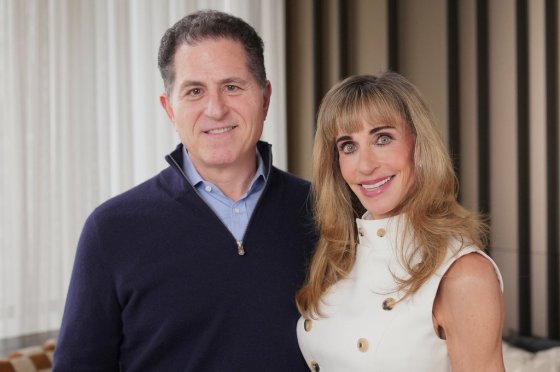
Michael and Susan Dell (Frank Franklin II / The Associated Press files)
After reading multiple stories about the Dell largesse, I wondered: could this actually be an improvement on the existing system of tax credits and direct government supports? In doing research on the Trump Accounts, it did not take me long to see how redundant and ill-conceived they are.
First and foremost, the accounts are available to every American child regardless of family income. (The Dells did stipulate their additional contribution would only be available to children from families who live in zip-code areas with median family incomes of less than $150,000.) The injustice of leaving out an income test is pretty easy to spot. The White House calculated if a family and/or their employer met the maximum $5,000 annual contribution, at normal market rates a child born in 2026 would reap $300,000 when they turn 18, or just over $1 million if they left the money in their Trump Accounts until they were 28.
What of children from families that cannot afford the maximum annual contribution? The White House calculated they would get $5,800 by age 18 and $18,100 by age 28.
I’m not a huge fan of across-the-board income tax cuts for the same reasons that I do not like the Trump Accounts.
Income tax cuts only help people who make income. The more income you make, the bigger the savings. If you make very little and perhaps fall below the basic personal exemptions, you get no benefit at all.
The Trump Accounts take a bad idea to help improve national wealth (broad and indiscriminate income tax cuts) and make it worse. Much, much worse.
Apart from the obvious fact you don’t get much from the accounts unless you have the disposable income to make the maximum annual contribution, the cost of the government’s initial $1,000 initial contribution required deep cuts to programs that directly help lower-income Americans.
The Congressional Budget Office, a non-partisan federal agency which analyzes the economic impact of government policies, noted in the OBBB Act, the Trump Accounts are accompanied by deep cuts to Medicaid and SNAP (the Supplemental Nutrition Assistance Program) which provides more than 42 million Americans with monthly payments via an EBT card to help with the cost of food essentials. The CBO estimated cuts to these programs alone — Trump has eviscerated a much broader array of social programs since he began his second term — will reduce income support by more than $1,600 per year, per recipient.
It also occurs to me that Trump, who is famously averse to big government and who has used a hacksaw to reduce the federal civil service, has not yet calculated the size of the bureaucracy needed to administer this program. Perhaps it will all be done through the Internal Revenue Service although Trump cut the IRS by 25 per cent.
Advertisement

There are a number of valid ways to help lower-income people make ends meet. In Canada, the Child Tax Benefit has been very successful at reducing the number of families living in poverty. The point here is despite the ideological rantings of right-wing fiscal hawks — who pursue smaller government specifically to pay for lower taxes — if the mission is to alleviate poverty and reduce income inequality, you need to get help to where it’s needed most.
I don’t expect anyone in Canada is stupid enough to propose something like the Trump Accounts. But then again, past Conservative governments have tried to provide daycare assistance to upper-income families that don’t use daycare. Oh, and boutique tax credits as a way of making life more affordable. Even though you’d have to have the money to pay for ballet, or art, or whatever other children’s activity, in order to reap the benefits.
So, for now, we’ll say never say never on Trump Accounts.
|