

Surge in soybean production
Rain, extended harvest season helped boost bumper crops
Advertisement
Read this article for free:
or
Already have an account? Log in here »
To continue reading, please subscribe:
Monthly Digital Subscription
$1 per week for 24 weeks*
- Enjoy unlimited reading on winnipegfreepress.com
- Read the E-Edition, our digital replica newspaper
- Access News Break, our award-winning app
- Play interactive puzzles
*Billed as $4.00 plus GST every four weeks. After 24 weeks, price increases to the regular rate of $19.95 plus GST every four weeks. Offer available to new and qualified returning subscribers only. Cancel any time.
Monthly Digital Subscription
$4.99/week*
- Enjoy unlimited reading on winnipegfreepress.com
- Read the E-Edition, our digital replica newspaper
- Access News Break, our award-winning app
- Play interactive puzzles
*Billed as $19.95 plus GST every four weeks. Cancel any time.
To continue reading, please subscribe:
Add Free Press access to your Brandon Sun subscription for only an additional
$1 for the first 4 weeks*
*Your next subscription payment will increase by $1.00 and you will be charged $16.99 plus GST for four weeks. After four weeks, your payment will increase to $23.99 plus GST every four weeks.
Read unlimited articles for free today:
or
Already have an account? Log in here »
Hey there, time traveller!
This article was published 07/12/2016 (3382 days ago), so information in it may no longer be current.
A growing infatuation with soybeans continues to pay dividends for Manitoba farmers.
Statistics Canada released the 2016 crop-production numbers for Manitoba Tuesday, and they show farmers reported a fifth consecutive record year for soybean production — 1.8 million tonnes. That was an increase of 27.2 per cent from 2015.
Statistics Canada attributed the surge in production to a record number of acres of the crop being harvested this year — 1.6 million in total — and record yields of 41.3 bushels per acre. It said the acreage was up 14.5 per cent from a year ago, and yields were 11.6 per cent higher.
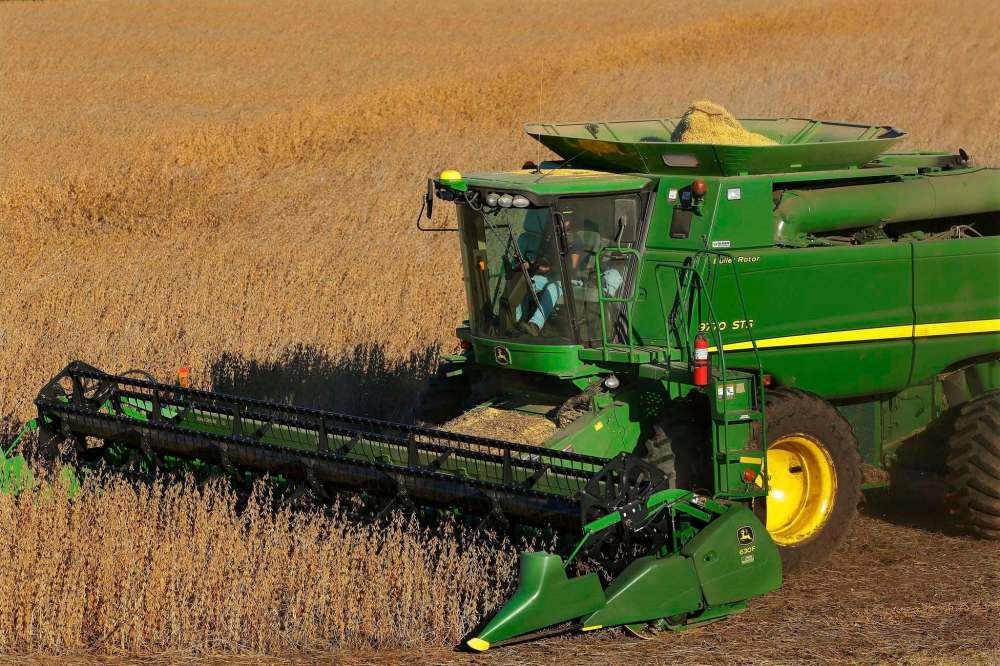
Keystone Agricultural Producers president Dan Mazier said the growing conditions were almost perfect this year for soybeans as well as corn for grain. Not only was there lots of rain during the summer months, the harvest season was unusually long.
“Any time you get a wet August, soybeans absolutely love that,” he said. “And there was no frost, so they didn’t get nipped off at the end of the production cycle.”
Mazier said Manitoba farmers are growing more soybeans — this was the eighth consecutive year a record number of acres was planted — because they don’t need to apply nitrogen fertilizer and because new varieties have been developed that are better suited to growing conditions in Manitoba.
Pam de Rocquigny, a cereal crop specialist with the provincial Agriculture Department, said soybeans seem to be one of those crops that can handle almost anything Mother Nature throws at it.
She said it was also a good year for growing corn for grain and spring wheat. Statistics Canada said corn production soared by 48.4 per cent to 1.2 million tonnes in the wake of a 35 per cent increase in the number of acres of the crop that were harvested and record average yields of 139.4 bushels per acre.
Spring wheat production was up by 1.1 per cent to 3.9 million tonnes after a 5.1 per cent increase in average yields more than offset a 3.8 per cent decline in the number of acres of wheat that were harvested.
Mazier and de Rocquigny said corn is another crop that can handle quite a bit of rain during the growing season. Growing conditions for wheat were also pretty good, although disease was an issue with some crops.

Statistics Canada said not all crops saw an increase in production this year. Canola production was down four per cent to 2.7 million tonnes because of a 3.2 per cent decrease in average yields. Barley production declined by 4.6 per cent to 540,000 tonnes because of fewer acres of the crop being harvested, and oats production fell by 15.5 per cent to 502,800 tonnes in the wake of a 16.2 per cent decrease in the harvested area.
De Rocquigny and Mazier said it was one of those years in which some areas got too much rain during the summer growing season, some got too much during the fall harvest and others got just the right amount throughout the year.
“There really seemed to be that variability this year, from farm to farm and from field to field and from area to area,” de Rocquigny added.
She said even though, generally speaking, yields for cereal crops were average to slightly above average, excess rain may have hurt the quality of the grain in some cases. That usually means farmers will get less money for it, she added.
murray.mcneill@freepress.mb.ca
History
Updated on Wednesday, December 7, 2016 7:47 AM CST: Adds photo