

I’m pumped to be the Accidental Activist
Who knew a letter to the editor could become one of life's turning points?
Advertisement
Read this article for free:
or
Already have an account? Log in here »
To continue reading, please subscribe:
Digital Subscription
One year of digital access for only $1.44 a week*
- Enjoy unlimited reading on winnipegfreepress.com
- Read the E-Edition, our digital replica newspaper
- Access News Break, our award-winning app
- Play interactive puzzles
*Billed as $5.77 plus GST every four weeks. After 52 weeks, price increases to the regular rate of $19.95 plus GST every four weeks. Offer available to new and qualified returning subscribers only. Cancel any time.
To continue reading, please subscribe:
Add Free Press access to your Brandon Sun subscription for only an additional
$1 for the first 4 weeks*
- Enjoy unlimited reading on winnipegfreepress.com
- Read the E-Edition, our digital replica newspaper
- Access News Break, our award-winning app
- Play interactive puzzles
*Your next Brandon Sun subscription payment will increase by $1.00 and you will be charged $17.95 plus GST for four weeks. After four weeks, your payment will increase to $24.95 plus GST every four weeks.
Read unlimited articles for free today:
or
Already have an account? Log in here »
Hey there, time traveller!
This article was published 05/08/2012 (5056 days ago), so information in it may no longer be current.
From a perspective of naiveté, I submitted a letter to the editor at the Winnipeg Free Press in response to an article written by architect Brent Bellamy on the “jewel with a big problem.” I had never felt inclined before to put pen to paper in this regard, but the story drew me in.
You can imagine my surprise when I was labelled the Accidental Activist in a recent CBC radio interview with Marcy Markusa regarding my efforts to save the James Avenue Pumping Station.
Me? An activist? Did this mean I’d hit that next curve in the road of life that becomes a defining moment?
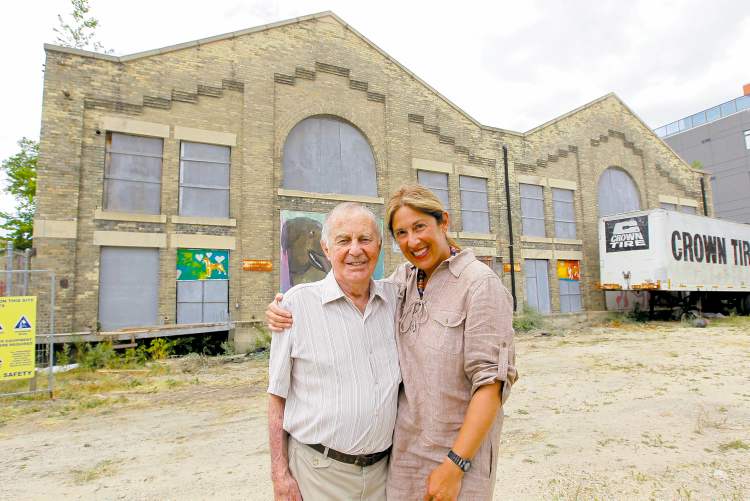
For years, I had been parking in front of the pumping station or driving past it on my way to meetings, and every time I rounded the corner at James Avenue and Waterfront Drive, I kept seeing something beyond the boarded up windows and the graffiti-strewn exterior. I envisioned a multi-use building that not only brought this gem-in-the-rough back to its original glory, but a marketplace that could service the surrounding residential community and the arts patrons who frequent the ballet, opera, theatre and the symphony. It could be a destination for business people, locals and tourists, who would serve as guardians of this jewel by stopping by during their day to have a meal in the coziness of a brew pub/restaurant. I basically envisioned a life at this corner where none currently existed!
Once Bellamy shone the spotlight on this building in his article, developers Leon Moryl and Keith Budd, visionaries who emerged in the late ’90s, responded to my letter by pronouncing their passion for the pumping station and recounting their previous experience in trying to maintain the integrity of the building.
From that point on, every two days, an additional groundswell of support surfaced in the larger community from other like-minded citizens who took the time to write their personal comments. I felt like I was riding a tidal wave, but rather than being swept under, I was actually sitting atop the crest with the clearest perspective I ever thought possible! This heritage building was a critical part of Winnipeg’s past. Without being given a second chance it was now at risk of being turned into a mere shadow of its former glorious and functional self.
If you take Frank Albo’s Hermetic Code Tour at the Manitoba Legislature, as I did last summer, it starts to become clear Winnipeg was the darling of the architecture world during the early 1900s. So much so that — as local blogger Christian Cassidy wrote in his July article in the Free Press — the pumping station formed not only the backbone of the city’s water supply, but it also became a wonder of engineering, inspiring the British Science Association to make the arduous trek across the pond to see it in 1909.
But what does all this mean in the grand scheme of development if you don’t have a heart at the epicentre of all this activity? Just as concerned citizens of Winnipeg have been reaching out to me, I too have reached out to them. And one special gentleman I had the recent pleasure of meeting was David Mackling, a pump operator who worked at the now defunct station in the 1940s and ’50s.
Mackling, 91, invited me to his house to hear personal stories of what it was like to be operating this building within an evolving city landscape.
“I am disappointed this building has not been considered a heritage site. The equipment is historically unique as the pumps were operated by gas-driven engines and the gas was originally produced on site and stored in a huge holding tank and maintained throughout the year next to the building. The preservation of it is so important.”
Mackling recalled a night in 1954 when he received a call the Times Building at Portage and Hargrave was on fire.
As the fire progressed, and more water and pressure was needed, he ultimately pressed all six pumps in the building into service to fight a fire that could not even be seen from the pumping station.

During his first visit to the pumping station in many years, Mackling said he was sad to see its neglected state. He strongly feels this building should be turned into a permanent exhibit to give Winnipeggers a place to understand how city planners had the incredible foresight to build a facility that serves today as a benchmark for fire and flood protection.
“It is, after all, an historic site at over 100 years old. The equipment, or a sample of it, should be on display. You don’t have to keep each engine, but we should maintain some of what is in there now so people can get an idea of what the original machinery looked like.
As for me, I am grateful for unofficially being anointed the Accidental Activist. It urged me on to meet all these passionate people. Sadly, Mackling’s voice and those of his colleagues from the past will soon be silenced. That means it will be up to accidental activists everywhere to help make his vision happen!
Lisa Abram is a former Torontonian married to a fourth-generation Winnipegger and has a passion for embracing the history of this city.