

A lasting legacy
Husband-wife team honoured for lifetime commitment to environmental causes
Advertisement
Read this article for free:
or
Already have an account? Log in here »
To continue reading, please subscribe:
Digital Subscription
One year of digital access for only $1.44 a week*
- Enjoy unlimited reading on winnipegfreepress.com
- Read the E-Edition, our digital replica newspaper
- Access News Break, our award-winning app
- Play interactive puzzles
*Billed as $5.77 plus GST every four weeks. After 52 weeks, price increases to the regular rate of $19.95 plus GST every four weeks. Offer available to new and qualified returning subscribers only. Cancel any time.
To continue reading, please subscribe:
Add Free Press access to your Brandon Sun subscription for only an additional
$1 for the first 4 weeks*
- Enjoy unlimited reading on winnipegfreepress.com
- Read the E-Edition, our digital replica newspaper
- Access News Break, our award-winning app
- Play interactive puzzles
*Your next Brandon Sun subscription payment will increase by $1.00 and you will be charged $17.95 plus GST for four weeks. After four weeks, your payment will increase to $24.95 plus GST every four weeks.
Read unlimited articles for free today:
or
Already have an account? Log in here »
Hey there, time traveller!
This article was published 14/03/2015 (4105 days ago), so information in it may no longer be current.
The province’s environmental movement owes a debt to Peter Miller and Carolyn Garlich.
This month, the Manitoba Eco-Network recognized the couple with a lifetime achievement award– the Anne Lindsey Protecting Our Earth Award.
“As activist members of a number of influential environmental organizations over the years, Peter Miller and Carolyn Garlich have been uncommonly busy on the ground,” Eco-Network executive director Curt Belton said in an email.
On the issues of waste reduction, city planning, water quality, climate change and renewable energy, the couple have tirelessly organized events, prepared briefs and presentations, contributed ideas, and educated themselves and others, Belton said. They’ve written letters to the editor, participated on boards and steering committees and appeared at legislative and other public hearings.
“They have pressed for sustainable policies and practical solutions,” Belton said.
Both are retired — Miller sees his pension as their salary. They’ve downsized since raising three kids and now live in a modest bungalow in Fort Garry with a big garden out back.
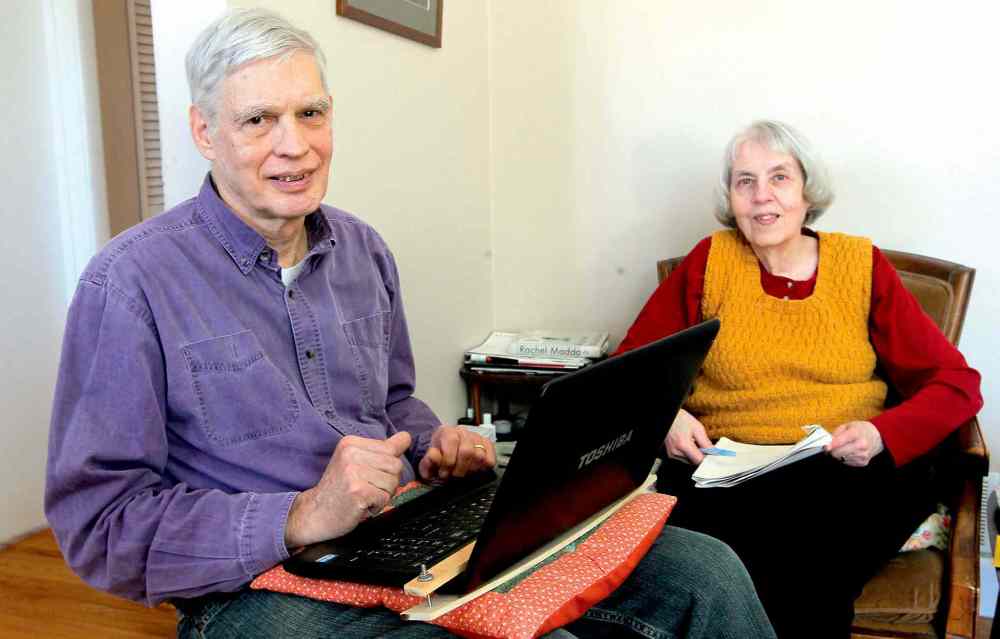
Every day, they work across from each other, settling into two armchairs in their living room. Miller with his laptop, Garlich with her pile of papers, the phone on a wooden stool beside her.
“The first test of any proposal is one another,” Miller said.
She had hip surgery in December and sits on a small pillow for extra support. She makes her husband use one to rest his laptop on. “Because of the radiation,” she said.
In more than 40 years of work, neither sought out the front lines of protest marches. Their arena was the boardroom; they’ve helped usher in the city’s big bin/ recycling program, as well as changes in the Canadian forestry industry, including bringing tree-huggers and loggers to the same table.
They’ve made too many presentations to count at Public Utilities Board hearings in Manitoba.
“There are basically three things that we do: research, write and make presentations,” Garlich said.
The couple, married for more than 55 years, met as university students at Yale in the days of president John Kennedy and the American Camelot.
By the time the Vietnam War had split the generations, Garlich, from Oakland Calif., and Miller from Chicago, had married and were living in New Haven, Conn., looking for a way out.
“Peter was not a draft dodger. We had two children, and we were in the position of having to pay taxes to support the war, and we didn’t support the war,” Garlich said.
Miller had a job offer at a college in Missouri.
“We decided we’d much rather live in Canada, and I contacted every university in Canada and said, ‘Here I am. I’m a new philosophy graduate,’ ” Miller said.
Winnipeg’s United College, now the University of Winnipeg, had a job and the couple moved here in 1967.
A detailed ink portrait of the family by Garlich shows the couple and one of their children bundled in winter clothes in their first Winnipeg home during Canada’s 1970s energy crisis. It still hangs in their kitchen.
“There are a lot of people who get enthusiastic about a cause, and then they get disappointed,” Garlich said. “And they go away. We just didn’t go away.”
Miller added: “I see myself as a contributor to something much larger than myself. I don’t see myself as someone who did this or did that. That’s the government. The government takes the credit.”
Manitoba’s green plan, Tomorrow Now, is one example, said Miller, who credits Conservation Minister Gord Mackintosh with the heavy lifting. “Tomorrow Now is a policy that reflects a lot of our thinking,” he said.
Former Tory environment minister Glen Cummings was equally pivotal to recycling in Manitoba.
Miller said a fellow professor recruited him to start one of the city’s first sustained recycling efforts. It began with little containers on professors’ desks.
“There was no recycling back then,” Miller said of the period in the 1980s.
The campus effort paid off, leading to debates led by the Opposition NDP during the Tory administration under former premier Gary Filmon, and finally, the city’s recycling program. It only took about 20 years or so.

“It has to be sustainable if it’s going to have any effect,” Miller said.
“It has to be more than collecting cans; it needs to be institutionalized, and we knew the city would have to have curbside pickup. I spent most of my time talking to government so that they would have the policies, the incentives and the framework to do it.”
The environmentalist who nominated Miller and Garlich said the couple has had an enormous influence on Manitoba’s environmental footprint.
“It is no exaggeration to say that Manitobans all across the province have benefited from the education and advocacy undertaken by Peter and Carolyn,” environmental activist Randall McQuaker said in the announcement recognizing their contributions.
alexandra.paul@freepress.mb.ca