

Looking back at my 2011 flood journal
Advertisement
Read this article for free:
or
Already have an account? Log in here »
To continue reading, please subscribe:
Digital Subscription
One year of digital access for only $75*
- Enjoy unlimited reading on winnipegfreepress.com
- Read the E-Edition, our digital replica newspaper
- Access News Break, our award-winning app
- Play interactive puzzles
*Billed as $5.77 plus GST every four weeks. After 52 weeks, price increases to the regular rate of $19.95 plus GST every four weeks. Offer available to new and qualified returning subscribers only. Cancel any time.
Monthly Digital Subscription
$4.99/week*
- Enjoy unlimited reading on winnipegfreepress.com
- Read the E-Edition, our digital replica newspaper
- Access News Break, our award-winning app
- Play interactive puzzles
*Billed as $19.95 plus GST every four weeks. Cancel any time.
To continue reading, please subscribe:
Add Free Press access to your Brandon Sun subscription for only an additional
$1 for the first 4 weeks*
- Enjoy unlimited reading on winnipegfreepress.com
- Read the E-Edition, our digital replica newspaper
- Access News Break, our award-winning app
- Play interactive puzzles
*Your next Brandon Sun subscription payment will increase by $1.00 and you will be charged $17.95 plus GST for four weeks. After four weeks, your payment will increase to $24.95 plus GST every four weeks.
Read unlimited articles for free today:
or
Already have an account? Log in here »
Hey there, time traveller!
This article was published 02/06/2012 (5104 days ago), so information in it may no longer be current.
Shirley Nordal is a former small-business owner and retired bookkeeper who lived on her own in the house she built at Sugar Point Trail in Sugar Point until the 2011 flood drove her out. She’d decided to retire to a “less stressful environment” for health reasons.
444Water has risen in my crawl space under the vapour barrier. I am stunned by this discovery as I have never had any moisture there before. My neighbour’s well has begun to overflow and water is pooling on the rain-soaked ground.
May 5 — Just heard it is possible the lake will rise even further! The word is another six to 12 inches at least and will likely not go down for two months. The Portage Diversion is pumping at full capacity and will continue for some time. I now have four inches of water in my crawl space. As the lake level increases, the water will put pressure on my septic tank. After just having my tank emptied, I now must call our septic service to put water back in the tank to keep it from pushing out of the ground. Then I called the plumber and he had to install a temporary sump pump from the floor joists. It pumped steadily for more than hours to get the level down. Meanwhile, the vibration it caused on the floor below my bedroom made it difficult to sleep. Now, it is my well that starts to overflow as well and I need to have an extension put on it.
May 7 — The retaining wall I had built was pounded relentlessly by waves until it let loose. The waves were powerful from the north and it took us a while to retrieve all the huge planks and drag them up onto the shore.
May 10 — I had a structure built in an effort to break up the force from the waves that were eroding the shore and undermining the trees. While this effort was initially helpful, the relentless rising water finally crippled all of our attempts to protect the bank.
May 15 — The sump pump was not cutting in under my house so we had to crawl down to flip the switch on to keep the pressure pump safe. It is no easy feat to walk in water in a four-foot crawl space wearing knee boots and bending over while trying to keep everything functioning properly.
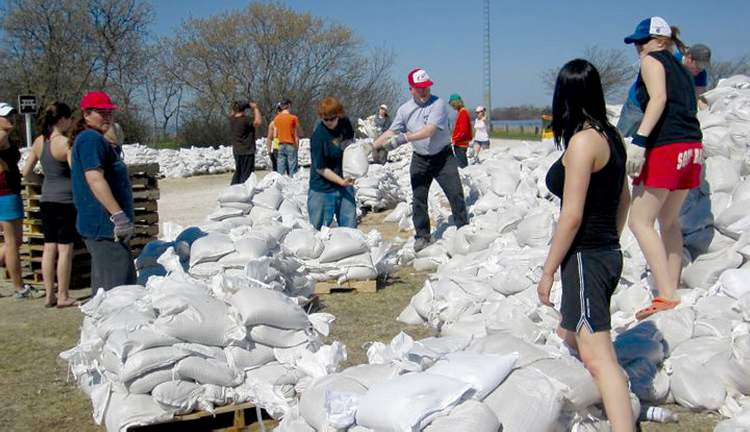
May 17 — The stress mounted as thousands of sandbags were stockpiled. Everyone volunteered and piled sandbags onto pallets that were delivered to both beaches. Trucks hauled these pallets and dropped them at our driveways where other volunteers built up dikes along the shore to protect the homes and cottages.
May 19 — As the water continued to rise, heavy equipment was called into action to hold back the water from inland. This was accomplished by building clay dikes to keep water back behind Maple Lane on the other side of the channel at Sugar Point. Now, we were able to pump the channel down to less-threatening levels. At Lundar Beach, clay dikes were built to keep the encroaching slough back from the road behind the cottages.
May 21 — As the water reached higher and higher levels, we recruited volunteers by the busload. Many of them came from our local high schools as well as from many surrounding areas. We made up groups to provide coffee and lunches for all the people who were helping us with the fight to hold back the water. People from Lundar and the larger community sent food and beverages and pitched in to help in whatever way they could.
May 25 — Meanwhile, the Portage Diversion was overwhelmed with water. It was designed to handle and pump a certain capacity but it began pushing unprecedented amounts of water into Lake Manitoba. Sandbagging continued to staggering new heights with every report of still more water coming. Some places required more protection than the sandbags could provide, so huge round bales were hauled in. In a final effort to keep the water out, dikes were made out of clay along the shoreline.
May 31 — Sleeping is becoming increasingly difficult. Whenever the winds begin to howl, I wake up and rush to the front room to see if the sand bags are intact and all I see in the windows is the black of the night and my reflection. Sometimes, I find it helps to step out to see if I can hear if the water has broken through. Stress fills our days and exhaustion weakens our bodies. Getting back to sleep is not easy. It wears you down. The flood is not abating. Emotions run high.
June 2 — I am not physically able to do the sandbagging and must not allow the stress to aggravate my health. I stood on the embankment overlooking the lake this morning and I knew it was time for me to go. The waves continued to roll onto the sand with a relentless force. I stood there for some time and absorbed the enormity of the problem. The lake is huge and the force of the water is powerful. The only reasonable choice was to lower the water and that was not one of our options. It was time for me to let go.
June 4 — Once I secured a place in Lundar to live, I began the task of moving. It was not an ordinary move by any stretch of the imagination. Every trip out of the area was undertaken on roads that were losing their stability from the encroaching water on both sides. We could no longer pass each other and only had the centre strip of the road to drive on. We took turns and often had to wait for the trucks that dumped gravel to reinforce the grade and level it before we could get through.
June 13 — The support of family and friends and neighbours was essential. The next step was to unpack and sort out things. Once I settled in my rental apartment, I began to sleep again at night. I was safe for now and I let it all go. There was nothing to be gained from going back; from wanting it to be otherwise. I would stay in my rental accommodations at least until spring.
Everyone has been evacuated. It comes as a shock even though we were aware of the situation. The water came over the dike. People got out in their vehicles but the roads were difficult to manoeuvre as everything was covered in water. Some had suitcases packed but little else. Everyone scrambled to find a place to stay. Some stayed in the local hotel while others moved in with friends or family. We are told that no one can go back until it is safe and that could be some time.
That’s the end of my journal entries, but it was not the last of my struggles.
Public information meetings were quickly set up in our community hall. We must all register with the Red Cross to receive temporary help. We must register with Water Stewardship if we need help in the future. We must register with the Financial Disaster department and we waited in line to be sure we were all accounted for. The trauma of the incident shook everyone to the core. The worst had happened.
The water gradually recedes as the wind dies down. People were allowed to go in to get things they needed. Only a short time later the road to Sugar Point was under water and closed. The only way to access our homes was by building a section onto the road that goes through the campground. Now, people begin to pack their things and search for someplace to live temporarily. Many people leave the area. Some folks want to return but the evacuation order stays in place. Emotions run high and once again there are no answers to our questions. We are drifting in unfamiliar territory and cut off from any solutions.
Once the evacuation order is in place, Emergency Measures Organization provides security at the entrance to the beaches. We can only enter if we have a cottage or a home. Trucks continue to haul sandbags and have priority for access to the road. We are often assigned a time from noon to six to pack stuff up and move. The sandbagging continues until the end of July.
An emergency ditch was built up north by Lake St. Martin and was touted as the solution to help lower Lake Manitoba. The media coverage was phenomenal. Our government stated they would be sure to look after all the people who were flooded. It was reported that everyone would be fully compensated for damages. All the stops were taken out to do the right thing for Lake Manitoba. The government had hired engineers to verify that all the steps taken would ensure the best possible solution. The ditch that was to help move the water out was successful only in lowering Lake St. Martin. This drier-than-usual spring confirms it was not an effective or efficient way to reduce the lake. We need another solution to deal with large amounts of spring water if the Portage Diversion remains in place.
We have experienced a unique situation around Lake Manitoba. Never have we had the enormous inflow that overwhelmed us from the Portage Diversion. This diversion had another phase to it that was never completed. A channel was to be built further north to allow the water to move out to the northern portion of Lake Winnipeg. The diversion captured all the water from the west and dumped it into a lake that had no outlet. When a river floods, it rises, crests and moves on within a matter of weeks. With our lake, water was pumped into it for months causing it to rise more than five feet and it has taken more than eight months to recede only three feet.
The present level provides us with no comfort. At any time we could be flooded again; a huge snowfall, a period of excess rainfall or even unpredictable weather from the western provinces will once again put the Portage Diversion into action. The rumour has it that much work has been done to reinforce the walls around the diversion and increase its capacity. This life-saving ring of protection around Portage la Prairie and the Assiniboine River, which also protects the City of Winnipeg, is deemed necessary and wonderfully successful. One cannot argue it has kept most of the population from experiencing the flood. The problem is only visible if you were to go north from the diversion. What is a blessing for the majority is a nightmare for all the people who live on the shores of Lake Manitoba, own a farm, dwell in adjacent municipalities or have a business in these areas. The present solution is obviously flawed. We keep one segment of the population safe while we plunge the population around Lake Manitoba into an unprecedented flood. We need to seek a solution that works for all Manitobans.
We are all familiar with the stories of cottages, homeowners, farmers, fishermen and others who are directly affected. The full story has to do with all the rippling effect the flood has on the lives of people who live in all the communities in the various municipalities. These communities provide a variety of services including schools, medical facilities, sporting facilities, libraries and many businesses. To run a municipality we need a solid tax base. When people lose their farms and homes they often relocate. And so, when you lose people we all lose. Many municipalities are struggling to survive.

My life has been on hold for a year now and we have not been contacted by those who are in charge of making crucial decisions. We wait — and wait — and the lake is still high. No solutions have been put forward, so we watch the lake levels, watch the winds as they shift from one direction to the next. We talk to one another. We ask the people working in temporary accommodations programs and the recovery program if they have heard any news. They are a component of the Manitoba Government’s Flood 2011: Building and Recovery Action Plan. The only people we have available tell us they do not know what is happening and they do not make the policies. I call my MLA and he has no answers.
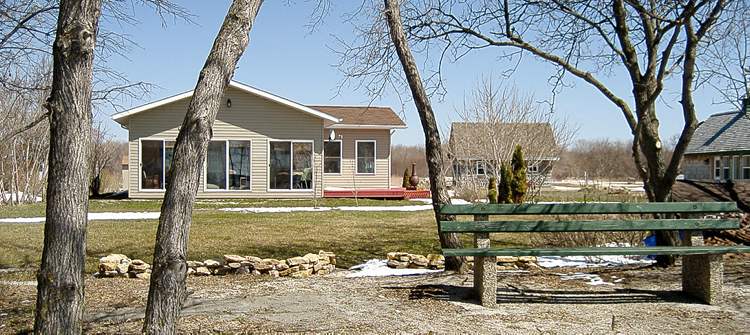
I call Water Stewardship and they tell me they have two options for me. I can raise my home to 821.7 feet. If I were to raise it to that height I would sit higher than the roads and I would have to look down onto my garage. Not to mention the wind velocity in the winter as the height would leave me no shelter from my trees.
The other option is that I can apply to move my house. If my application is accepted I would have to get quotes from people to do the work and submit them. If that is approved then I can begin the process. This option means I will have to come up with $14,000 as my part of the process. They need me to restore my lot at the lake to the natural state, at my expense. At that point they would place a caveat on my lake-front property so no one can build there again. They now consider the land to be a flood plain. My viable lake-front lot is no longer worth anything. Neither of these options works.
Who do we talk to? Neither municipalities nor various delegations can get answers. We remain in the dark and decisions are made behind closed doors. We hear stories of the tremendous cost of the flood. We see stacks of sandbags everywhere at the lake. We have not been acknowledged in any way. There is no glory in being sacrificed for the greater good. So we at Sugar Point and Lundar Beach have survived the flood. Now what? We are stuck in wait mode. We cannot get on with our lives. We need to be part of the process. We need to be compensated for the whole mess. I cannot even get an audience, never mind an offer. What happens to us next?
I still live in my temporary accommodations and have received no information to help move on. Today is May 31 and once more there’s water in my crawl space.