


Do horses get cavities?
Advertisement
Hey there, time traveller!
This article was published 11/07/2016 (3587 days ago), so information in it may no longer be current.
Horses, like people, have a large number of teeth that need to be looked after, but unlike people, the teeth in a horse grow continuously throughout their lives, as they constantly wear against each other as they grind their rough feed.
So do horses get cavities? Yes, but to a much lesser extent than people. The bigger concern for the horse is whether they can grind their feed properly (grass stalks, leaves, fibres and whole grains).
To eat, the horse uses its incisors and lips to grasp the grass and pull it from the ground, then the tongue moves the grass back into the grinding molars to break it down into a bolus to swallow. Horses also have canine teeth, which are throwbacks from primordial times, but can still be used by stallions in a fight to attack their opponent.
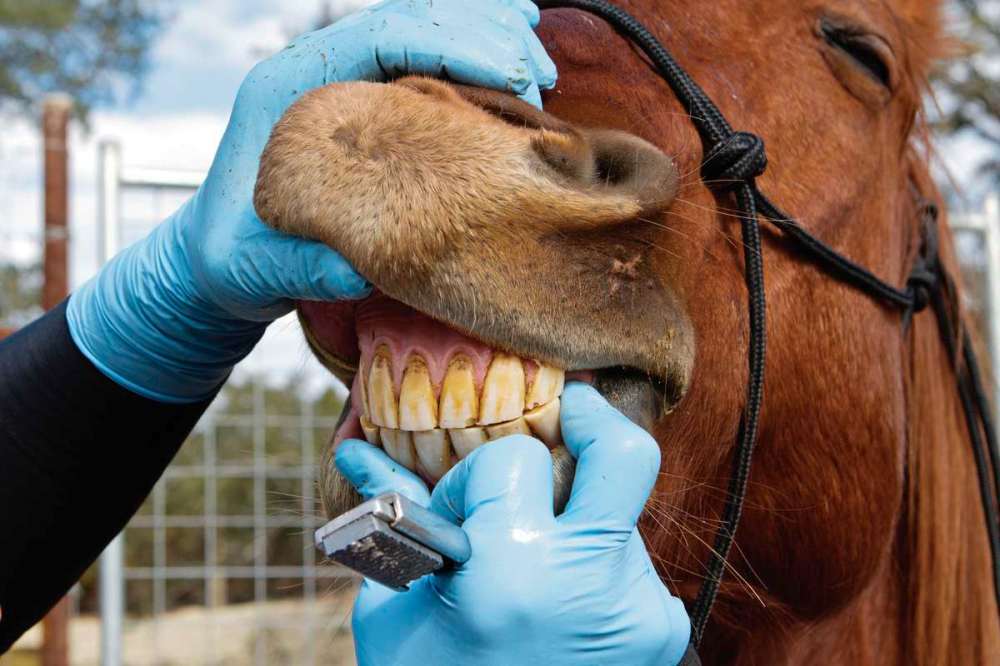
Problems arise when the side-to-side grinding motion of the jaw becomes restricted by the uneven wear of the molars as the teeth grow against each other. Usually sharp, restrictive points develop along the upper and outer margin of the molars towards the cheeks on the top molars, and the lower and inner margins of the molars towards the tongue on the bottom molars. These sharp points act to restrict the grinding motion side to side.
In addition, the forward and backward motion of the jaw can also become restricted by development of sharp hooks (which form on the leading edge of the front upper molars) or ramps (which form on the back edge of the last molars at the back of the mouth).
These four different types of sharp points are the primary reason for a poor grinding surface and are very common in all horses. Other issues such as fractured teeth, large cavities, lost teeth, incisor or canine tooth issues or tooth root abscesses can also affect the horse’s ability to grind its feed.
When a horse develops these sharp areas on the molars, it can become quite painful as the sharp points may dig into the tongue, gums or cheek.
A veterinarian can identify these issues and any other oral problems and address them properly. This usually involves ‘floating’ the teeth (using a file to grind the sharp point off the molars). This can be done with hand instruments or power-mechanized instruments.
Only a veterinarian should perform a floating or exam of the teeth. An equine veterinarian is specifically trained to properly examine, identify problems, make a diagnosis and provide treatment. Very importantly, only a veterinarian can use sedatives to perform an oral exam and floating. If you have questions, call your veterinarian.
Chris Bell is an equine veterinarian and surgical specialist who operates Elders Equine Veterinary Service, with clinics in Cartier and Winnipeg. See www.eldersequineclinic.com