


Manitobans starred at 1932 Winter Olympics

Advertisement
Hey there, time traveller!
This article was published 30/01/2018 (3104 days ago), so information in it may no longer be current.
Manitobans aren’t expected to make a major impact at the 2018 Winter Olympic Games in Pyeongchang, South Korea, that start Feb. 9.
That wasn’t the case in early February 1932 at the Winter Olympics in Lake Placid, N.Y., where Manitoba athletes played a very important role on the Canadian team.
The Winnipegs won the gold medal in hockey and Winnipeg speedskater Frank Stack won a bronze in the men’s 10,000 metres and took fourth place in the 500 and 1,500-metre races. This was Stack’s first Olympics and 20 years later, in 1952 in Oslo, Norway, he finished 11th in the 500 metres at age 46.
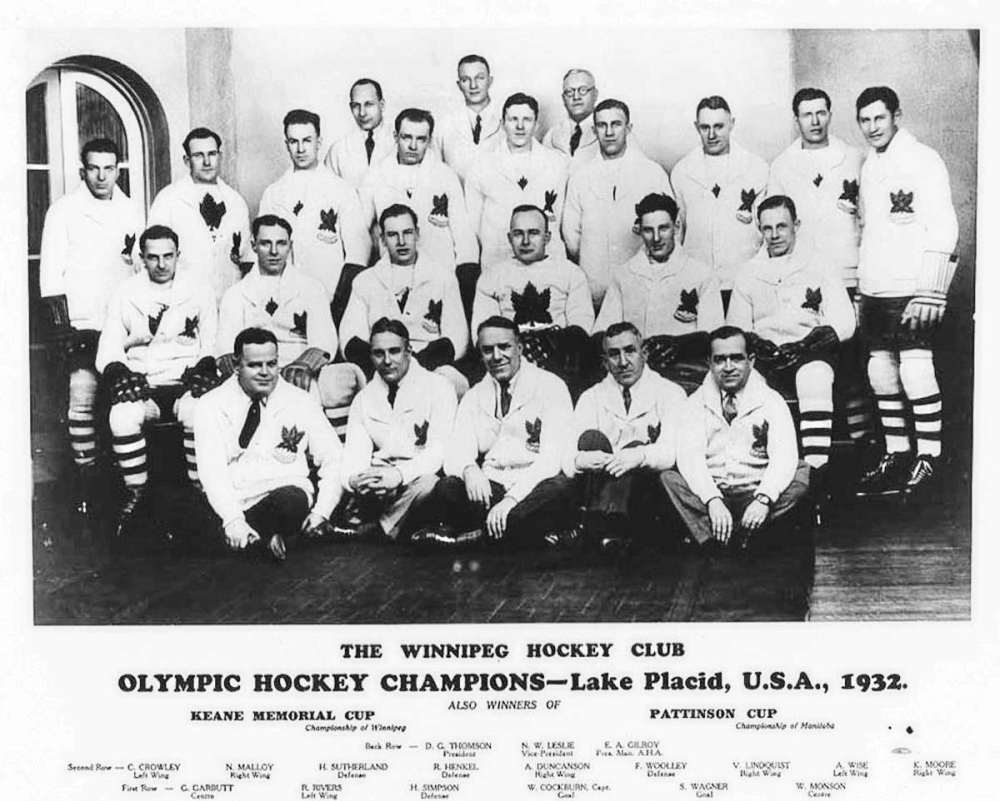
The Winnipegs had earned the right to represent Canada by winning the Canadian senior hockey championship in 1931. Four nations entered the Olympics, where they played a double round-robin tournament. Canada won five games with its only blemish a 2-2 tie with the U.S. in the final game. Romeo Rivers tied the game with 33 seconds left. The teams then failed to score in three 10-minute overtime periods. Having beaten the U.S. 2-1 in overtime in the first game on a goal by Vic Lindquist, the draw was good enough to ensure gold. The final was played in an arena, while most of other games were outside. The U.S. finished 4-1-1, Germany was 2-4 while Poland lost six straight.
Winnipegs iced a strong team with goalie and team captain Bill Cockburn and the forward line of Walter Monson, Lindquist and Rivers all future members of the Manitoba Hockey Hall of Fame. Monson led the team in scoring with seven goals and four assists.
Curling, dogsled racing and women’s speed skating were demonstration sports and Manitobans won the first two events plus bronze in the dogsled competition.
In curling, rinks (as they were known then) representing Manitoba, Northern Ontario, Ontario and Quebec played rinks from the states of Connecticut, Massachusetts, Michigan and New York. Three members of Parliament were on the Manitoba rink. Skip W. H. (Billy) Burns represented Portage la Prairie, third James Bowman was from Dauphin and lead Erick Willis, a future Manitoba Lieutenant-Governor, represented the Souris constituency. Second James Dow was from the Lakehead, which at the time was part of the Manitoba curling district. Manitoba was the only team to win four straight. Playing 16-end games, they beat Massachusetts 19-10, Michigan 22-12, New York 15-9 and Connecticut 15-14, when Burns needed his last rock for the victory. Curling had been a demonstration sport in 1924, when Great Britain beat Sweden and France.
The dog sled races were run two days in a row over a 25.1 mile course on an Adirondack Mountain trail. North America’s top musher, Emile St. Godard from The Pas, won both heats in a total time of just over four hours and 23 minutes. He and his team, headed by lead dog Toby, beat Leonhard Seppala from Alaska by nearly eight minutes. Shorty Russick of Flin Flon took bronze in the competition of five Canadian and seven U.S. teams.
Unlike 2018, when Olympic competitors receive strong financial support, a report out of The Pas just a couple of weeks before the Games suggested St. Godard might not have the finances needed to attend.
In 1925, Seppala became famous for his role in mushing 360 miles to get serum to his hometown of Nome when the community was hit with a diphtheria outbreak during the coldest winter in 20 years.
Memories of Sport appears every second week in the Canstar Community News weeklies. Kent Morgan can be contacted at 204-489-6641 or email: sportsmemories@canstarnews.com
T. Kent Morgan
Memories of Sport
Memories of Sport appears every second week in the Canstar Community News weeklies. Kent Morgan can be contacted at 204-489-6641 or email: sportsmemories@canstarnews.com
Our newsroom depends on a growing audience of readers to power our journalism. If you are not a paid reader, please consider becoming a subscriber.
Our newsroom depends on its audience of readers to power our journalism. Thank you for your support.
T. Kent Morgan
Memories of Sport
Memories of Sport appears every second week in the Canstar Community News weeklies. Kent Morgan can be contacted at 204-489-6641 or email: sportsmemories@canstarnews.com
Our newsroom depends on a growing audience of readers to power our journalism. If you are not a paid reader, please consider becoming a subscriber.
Our newsroom depends on its audience of readers to power our journalism. Thank you for your support.
Advertisement Advertise With Us
Advertisement Advertise With Us