


The Seine River has been ‘dumped up’

Advertisement
Hey there, time traveller!
This article was published 16/04/2018 (2973 days ago), so information in it may no longer be current.
I have had travelled throughout the Caribbean to teach teachers about wetlands. On many trips, I witnessed the age-old practice of using wetlands as dumps. Wetlands are seen as having little or no value. If they are filled in, the land can be developed later.
When Jamaicans are asked “what are wetlands good for?” many will say “we dump ’em up.” The phrase expresses an idea that is not unique to Jamaica or the Caribbean. In fact, the same idea applied to the urban Seine River for decades.
In the early years of Winnipeg’s growth, waterways were favourite dumping grounds for personal, commercial, and industrial waste. By 1973, the 26 kilometre Seine was called Winnipeg’s longest longitudinal garbage dump.
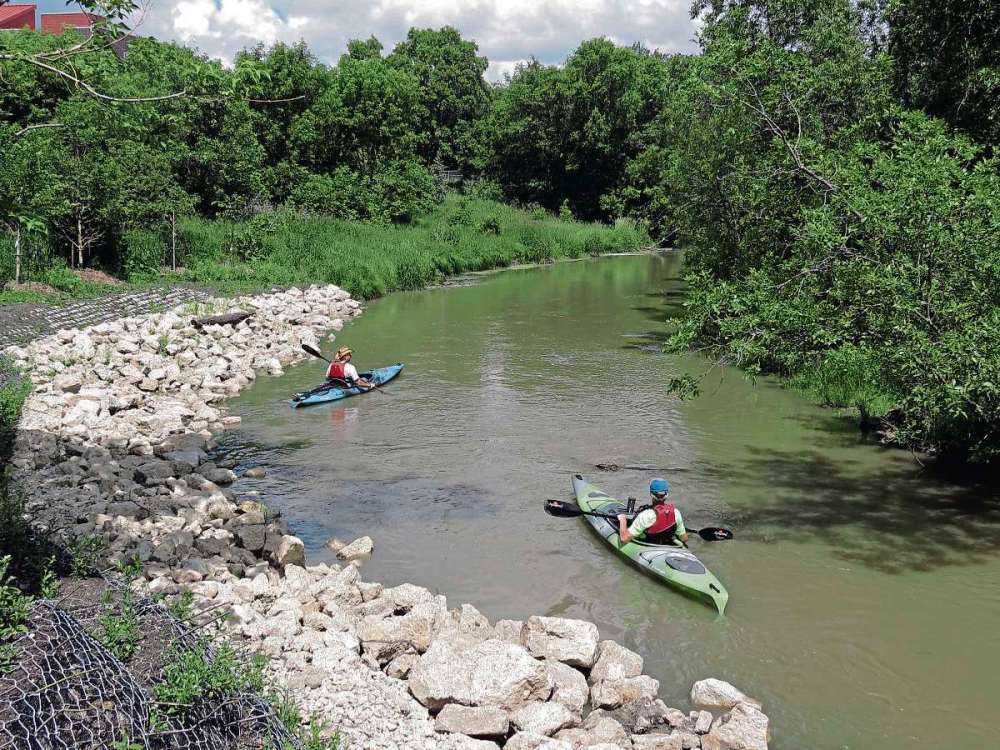
According to the Riverbank Characterization Study of the Seine River (1994), approximately 15.1 kilometres of riverbank along the urban Seine are considered “complex.” This means the bank has been modified by human activity. This includes depositing fill, regrading, or building retaining walls. Since the urban Seine has 52 kilometres of bank (east plus west), almost 30 per cent of its banks are complex.
Complex banks are most noticeable from the river or riverside trails. Look for large blocks of concrete masked by vegetation. A single block may weigh several tonnes.
Paddling up the Seine from the Red River, you will see complex banks on both sides for the first two kilometres up to the Westeel property. Historic maps show that part of the floodplain and river bed were filled in at some point prior to building on this site. The river was pushed to the east. This is a classic example of “dump ’em up” before development.
There are long stretches of complex banks from Westeel to Dubuc, Fermor to Hindley, beside the Morrow Gospel Church, and at “the Narrows” south of John Bruce Road.
The Beliveau Road Dump (Marlene Park) is the only official landfill site on the river. It accounts for 600 metres (or four per cent) of the river’s complex banks. This suggests that 96 per cent of the historic dumping along the river was unofficial and undocumented.
The reason for such extensive dumping in the Seine River is unclear. Some speculate the concrete blocks were a misguided effort to shore up the riverbanks. Or, perhaps it was just easier and cheaper to “dump it up.”
The Seine River’s complex banks are a reminder that the cheapest option is rarely the best choice.
Michele Kading is a community correspondent for St. Vital and the executive director of Save Our Seine.
Michele Kading
St. Vital community correspondent
Michele Kading is a community correspondent for St. Vital. She is also the executive director of the Association of Manitoba Museums.
Our newsroom depends on a growing audience of readers to power our journalism. If you are not a paid reader, please consider becoming a subscriber.
Our newsroom depends on its audience of readers to power our journalism. Thank you for your support.
Michele Kading
St. Vital community correspondent
Michele Kading is a community correspondent for St. Vital. She is also the executive director of the Association of Manitoba Museums.
Our newsroom depends on a growing audience of readers to power our journalism. If you are not a paid reader, please consider becoming a subscriber.
Our newsroom depends on its audience of readers to power our journalism. Thank you for your support.
Advertisement Advertise With Us