


Understanding reconciliation

Advertisement
Hey there, time traveller!
This article was published 28/03/2019 (2663 days ago), so information in it may no longer be current.
Before Sen. Murray Sinclair spoke at a Winnipeg Foundation event called Winnipeg’s Vital Signs at the University of Winnipeg on March 25, co-host Tanjit Nagra cautioned that some content may be triggering to those with memories of past trauma.
“We have members of the Bear Clan Patrol here tonight that can help,” Nagra said. She asked for Clan members to wave to let people know where they were.
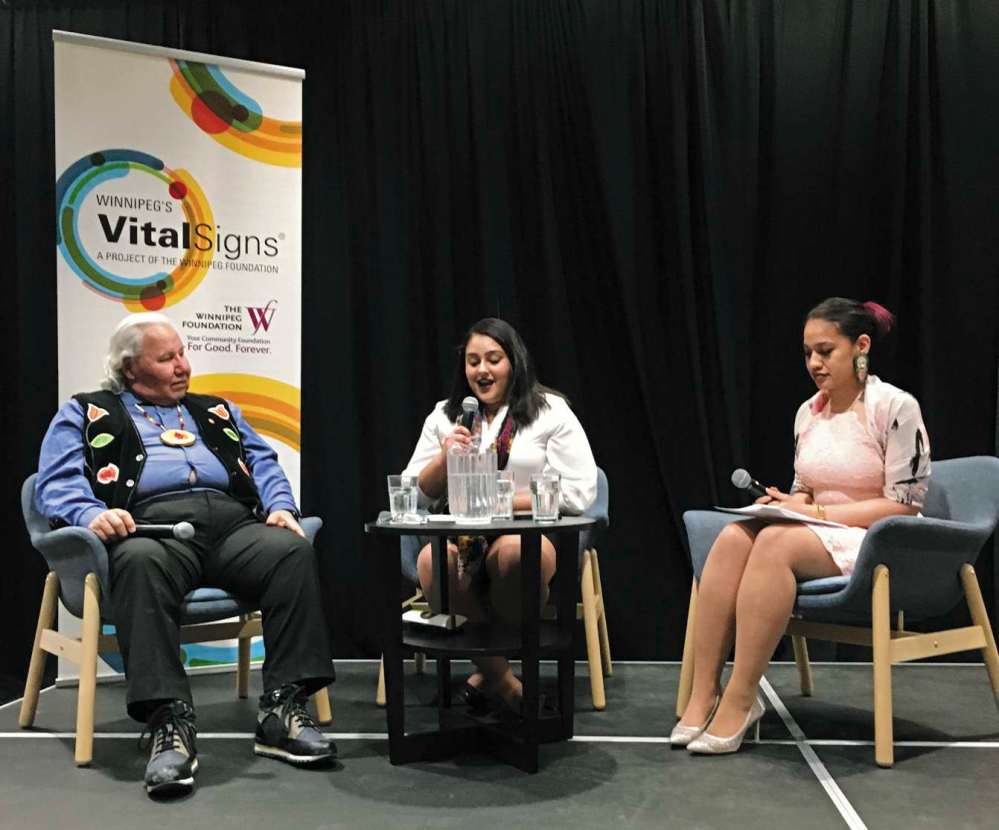
An atmosphere of safety and a rather exceptional sense of warmth could immediately be felt within the large room.
Sinclair took to the podium after traditional and other greetings.
“Reconciliation is founded upon a very simple concept — I want to be your friend, and I want you to be mine…. I want you to talk to and about me in a good and respectful way like you talk about your best friends — I want you to think of me when you need help I want you to think of me when I need help…” Sinclair said, explaining the concept.
“Reconciliation will help us create a relationship like that. But in order for that to happen, we have to address this long history that has evolved over the years because it has created a high degree of mistrust on both sides…
“Non-Indigenous leaders don’t trust us to be able to handle our own affairs and Indigenous people don’t trust the government to do the right thing because they have often done the wrong thing, and that permeates our relationship with each other at the neighbourhood level… we have not had an opportunity for good dialogue in our neighbourhoods.”
He said we need to teach our children how to trust and understand each other better.
He said historically schools have taught that Indigenous people were irrelevant — they were not mentioned at all in history curricula or were described as culturally inferior. This influenced conversations about each other for generations and into today.
He also used a comparison to a domestically abusive partnership that has lasted since Confederation, with government having its way without challenges, restriction or boundaries and believing that it had done nothing wrong, while Indigenous peoples were convinced of their inadequacy and responsibility for poor treatment.
“You cannot have a healthy relationship when you have two damaged people who will not recognize themselves the extent to which they are damaged,” he said.
Sinclair pointed out that each has an obligation to fix themselves in order to have a proper conversation in the future.
Sinclair more deeply described matters that were difficult, emotional, and complex with levelness and hope for the future.
Shirley Kowalchuk is a Winnipeg writer who loves her childhood home of East Kildonan where she still resides. She can be reached at sakowalchuk1@gmail.com
Shirley Kowalchuk
East Kildonan community correspondent
Shirley Kowalchuk is a Winnipeg writer who loves her childhood home of East Kildonan, where she still resides. She can be reached at sakowalchuk1@gmail.com
Our newsroom depends on a growing audience of readers to power our journalism. If you are not a paid reader, please consider becoming a subscriber.
Our newsroom depends on its audience of readers to power our journalism. Thank you for your support.
Shirley Kowalchuk
East Kildonan community correspondent
Shirley Kowalchuk is a Winnipeg writer who loves her childhood home of East Kildonan, where she still resides. She can be reached at sakowalchuk1@gmail.com
Our newsroom depends on a growing audience of readers to power our journalism. If you are not a paid reader, please consider becoming a subscriber.
Our newsroom depends on its audience of readers to power our journalism. Thank you for your support.
Advertisement Advertise With Us
Advertisement Advertise With Us