


4 D Farms a family affair
Dycks aim to produce high-quality eggs

Advertisement
Hey there, time traveller!
This article was published 01/04/2019 (2683 days ago), so information in it may no longer be current.
The next time you order a bacon and egger at A&W, you might be chowing down on an egg laid by one of Sandra and Eric Dyck’s chickens at 4 D Farms in Springstein.
The farm, which now includes an approximately 4,800-bird egg operation as well as grain, oilseed and forage crops grown on about 3,000 acres, was started by Eric’s great-grandfather in 1926 after he emigrated from Russia. The couple took over management of the farm’s egg production about seven years ago and run the business year-round with one full-time employee and a few seasonal staff. Eric’s mother Susan is also involved in the farm’s management.
Like all commercial egg producers in Manitoba, the Dycks get their egg quota from Manitoba Egg Farmers. They buy Lohman pullets when the birds are about 19 weeks old and ready to start laying. Each bird produces an average of 330 eggs each year and they are fully productive for about a year.
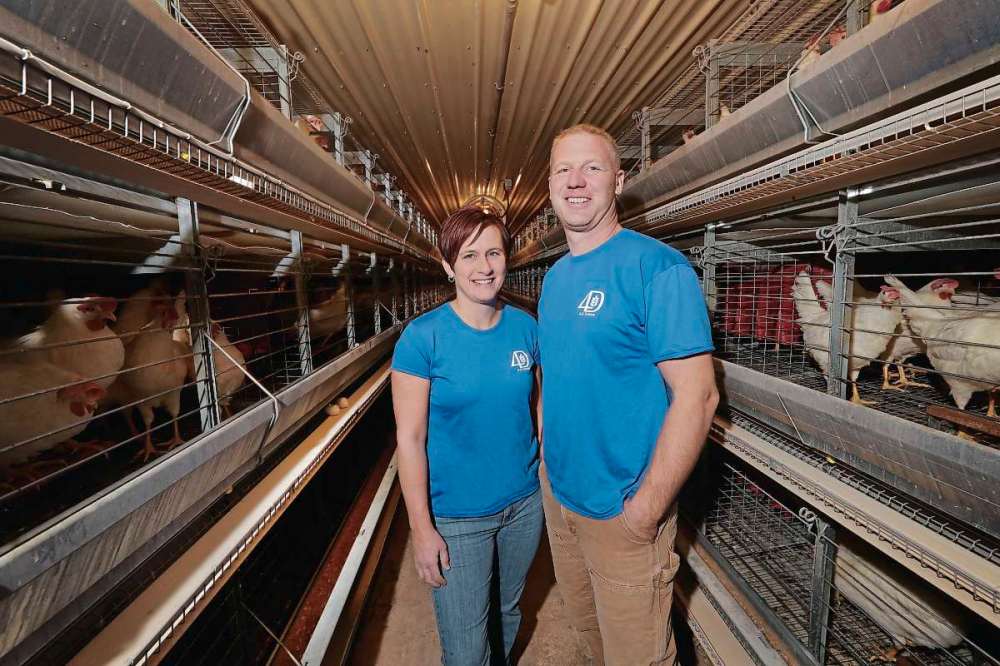
Just as A&W’s advertising promises, the chickens are fed a vegetarian diet.
The Dycks’ birds and the eggs they lay are weighed once every two weeks by a nutritional specialist with the company from which they purchase their feed. This allows them to adjust the feed quality if necessary. A higher protein feed is given in the morning and one with more calcium to help with shell strength in the afternoon.
“The birds’ diet has completely changed from when I was a kid,” Eric said. “We’re giving the birds what they need when they need it.”
The flock isn’t given any antibiotics or hormones.
The eggs are stored in a cooler and trucked off the farm once a week to a grading and sorting operation, and then shipped to A&W locations. The whole process takes no more than a week, ensuring the eggs stay fresh.
The Dycks’ flock is now housed in enriched housing that consists of a series of units that each contains up to 30 birds. Each unit has a sheltered nesting box, wooden bars for perching, a scratching pad, water and food. A computerized system allows the operator to program in feeding and egg collection times as well as daily manure removal. Eggs are moved onto a conveyor belt that transports them out of the barn and deposits them onto flats for storage.
The barn’s lighting, heating and ventilation is also computerized. Eric said the system can be accessed remotely and allows them to oversee operations, in conjunction with an employee’s daily inspections, when they are on holiday.
“The next step is installing cameras in the barn,” he said.
The Dycks had an array of solar panels installed on their property last June to eventually reduce their energy costs.
Eric and Sandra are committed to being open and transparent about what goes on at their farm. They have volunteered to represent Manitoba Egg Farmers at public events such as Agriculture in the City, held at The Forks in Winnipeg, and Ag Days in Brandon. They have also hosted tour groups from the FortWhyte farm program, the University of Manitoba’s agriculture program, and groups of recent immigrants to Canada.
“We really enjoy being ambassadors for egg farming,” Sandra said.
One of the most commonly asked questions is why some eggs are white and others are brown. The answer: it depends on the variety of chicken laying the egg. The Dycks’ Lohman birds are white chickens that lay white-shelled eggs.
Eric said Canadians’ egg consumption is growing annually as eggs are nutritious and an inexpensive source of protein. However this wasn’t always the case as consumers turned away from eggs in the 1990s due to a concern about high cholesterol levels being linked to eating eggs.
“We’re really glad that the science is better now,” he said.
Recent changes to Canada’s Food Guide urge people to swap animal-based protein for plant-based protein, but egg producers like the Dycks feel that the new guidelines are still supportive of including eggs in a balanced diet. As well, Eric said, the decision of restaurant chains like McDonald’s to offer all-day breakfast items helps to increase the demand for eggs.
Like all of the other approximately 155 Manitoba family farms that run egg operations, the Dycks’ farm is inspected and audited annually by the Egg Farmers of Canada. “They make sure we’re treating our birds well,” Eric said.
Canadian egg producers recently started to label egg cartons with an Egg Quality Assurance (EQA) logo to show that the eggs being sold are produced under properly monitored conditions.
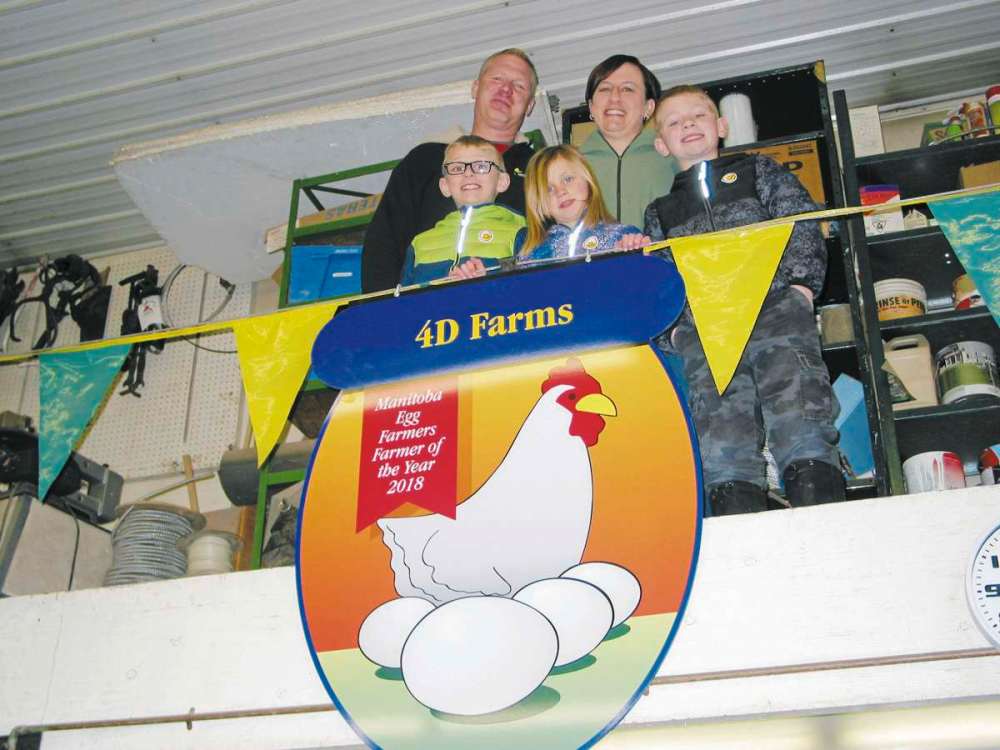
Sandra and Eric are proud of receiving the Manitoba Egg Farmers’ Egg Farmer of the Year award for 2018. They are working toward someday passing on the farm to their children, Jacob, 10, Levi, 8, and Rylee, 6.
Andrea Geary
St. Vital community correspondent
Andrea Geary was a community correspondent for St. Vital and was once the community journalist for The Headliner.
Our newsroom depends on a growing audience of readers to power our journalism. If you are not a paid reader, please consider becoming a subscriber.
Our newsroom depends on its audience of readers to power our journalism. Thank you for your support.
Andrea Geary
St. Vital community correspondent
Andrea Geary was a community correspondent for St. Vital and was once the community journalist for The Headliner.
Our newsroom depends on a growing audience of readers to power our journalism. If you are not a paid reader, please consider becoming a subscriber.
Our newsroom depends on its audience of readers to power our journalism. Thank you for your support.
Advertisement Advertise With Us
Advertisement Advertise With Us