


Fresh look for Transit
New master plan re-imagines routes throughout city

Advertisement
Hey there, time traveller!
This article was published 19/03/2021 (1874 days ago), so information in it may no longer be current.
The way Winnipeggers get around the northeast part of the city could look a lot different by 2045.
On March 11, the City of Winnipeg presented a new Transit master plan to the standing policy committee on infrastructure renewal and public works. The new plan proposes a “new transit network to better respond to residents’ needs, and recommends cost-sharing for eligible major capital projects through the Investing in Canada Infrastructure Program.” The plan is scheduled to be discussed again at the committee’s April 16 meeting.
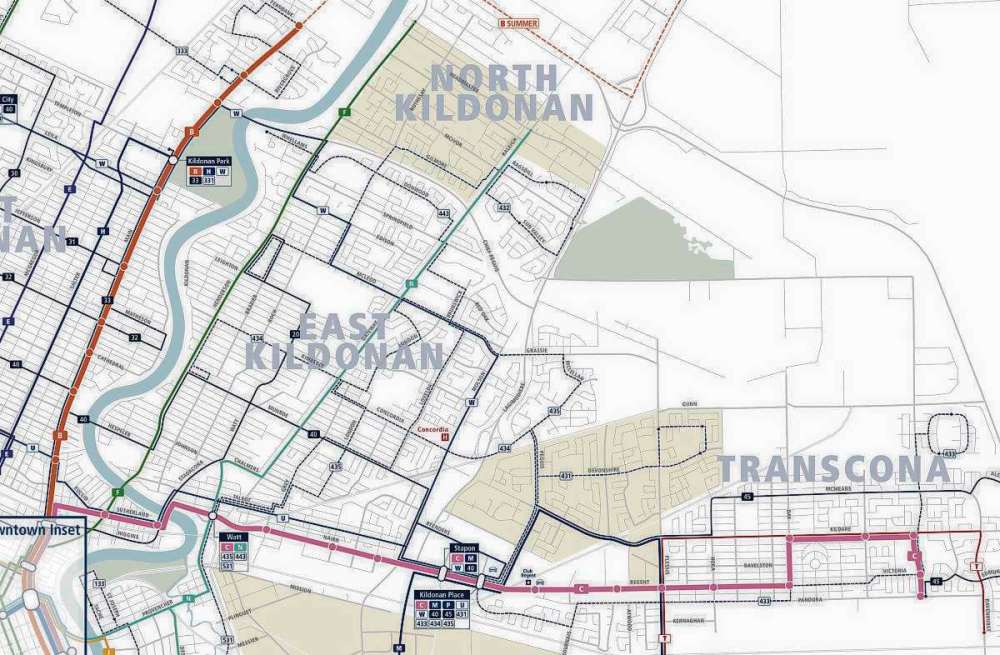
“Through the public engagement process, we heard that the existing route network was too complex, service was too infrequent, and it didn’t offer enough options for travel within and between neighbourhoods,” Greg Ewankiw, director of Winnipeg Transit, said in a statement. “The Winnipeg Transit Master Plan proposes changes to the transit route network to respond to the needs of residents of Winnipeg, and will enhance connectivity, frequency, and reliability.”
The plan hinges on a new network of routes, based on a frequent transit network concept, which proponents argue would “double the number of Winnipeg households within a short walk of frequent transit service once completed.”
Six Rapid Transit corridors, including one running along Regent Avenue, would form the core of the system, with routes feeding into it from other residential and commercial areas. Union Station downtown would be transformed into the heart of the system.
A summer route to Birds Hill Provincial Park is also included in the plan.
Should council approve the plan, its first phase, which includes six major projects, is estimated to cost $538.9 million. The city expects to cover $165.6 million of that, with the federal Investing in Canada Infrastructure Program and provincial funds covering the remaining 70 per cent.
Functional Transit Winnipeg, a grassroots group that advocates for “frequent, accessible and affordable” transit called the new master plan “a major improvement.”
Coun. Jeff Browaty (North Kildonan) noted that shifting the emphasis to higher frequency routes major streets is a positive aspect of the plan.
“(However) I’m concerned that more trips may require transfers, but I feel the high-frequency routes will improve the overall dependability, frequency and utility of Transit for more Winnipeggers,” Browaty said.
Coun. Jason Schreyer (Elmwood-East Kildonan) added he had “serious concerns” about the costs of the plan as proposed.
“They’re not realistic quotes,” he said. “Looking at the costs as given are very misleading.”
While Schreyer admitted that the new proposed rapid transit route along Nairn and Regent to Transcona is a more “realistic” option than a dedicated bus route like the Southwest Transitway. However, he noted that the fact it is not a priority route could push the cost up too high.
“Because of timeline and continuing rate of construction inflation, it’s still putting it in the realm of unaffordability,” Schreyer said. “How is it that we can magically afford more and more construction contracts? They’re the big ones.”
While Coun. Shawn Nason (Transcona) noted that the plan could, eventually, improve transit services, he was disappointed that the rapid transit route to Transcona was not a top priority within the new plan.
“I’m hopeful we get a replacement for Louise Bridge sooner rather than later, but it doesn’t look like we’ll see any improvements anytime soon,” Nason said. “My focus has always been that we have to have something reliable, affordable, and timely. It needs to meet the needs of Transcona residents, and we’re failing on all those fronts right now.”
For more information on Winnipeg Transit’s master plan, visit winnipeg.ca/transitmasterplan
Sheldon Birnie
Community Journalist
Sheldon Birnie is a reporter/photographer for the Free Press Community Review. Email him at sheldon.birnie@freepress.mb.ca or call him at 204-697-7112
Our newsroom depends on a growing audience of readers to power our journalism. If you are not a paid reader, please consider becoming a subscriber.
Our newsroom depends on its audience of readers to power our journalism. Thank you for your support.
Sheldon Birnie
Community Journalist
Sheldon Birnie is a reporter/photographer for the Free Press Community Review. Email him at sheldon.birnie@freepress.mb.ca or call him at 204-697-7112
Our newsroom depends on a growing audience of readers to power our journalism. If you are not a paid reader, please consider becoming a subscriber.
Our newsroom depends on its audience of readers to power our journalism. Thank you for your support.
Advertisement Advertise With Us
Advertisement Advertise With Us