


Awe-inspiring architecture
Advertisement
Hey there, time traveller!
This article was published 24/03/2021 (2000 days ago), so information in it may no longer be current.
Architect Michael Maltzan was unanimously selected to design what has become Qaumajuq through an international juried competition.
In 2013, WAG director and CEO Stephen Borys and Maltzan travelled together to the Canadian Arctic, and the experience proved definitive in the design of Qaumajuq.
For Maltzan, his design inspiration stemmed from three aspects.
“The first was the experience of going to the North and seeing the artists and the extraordinary landscape in places where they live and work,” he said.
The second was the recognition that forms of contemporary Inuit art are constantly evolving in medium and scale, which presents an ongoing challenge for displaying these works.
“The third was the question of what building form would both be a strong and distinct presence on its own and also be in a genuine dialogue with the original Winnipeg Art Gallery designed by Gustavo da Roza in 1971,” Maltzan explained via Zoom from Los Angeles.
“We began by studying many shapes and forms in the design process, searching for the right one that would create two unique buildings that also seem to strengthen each other.”
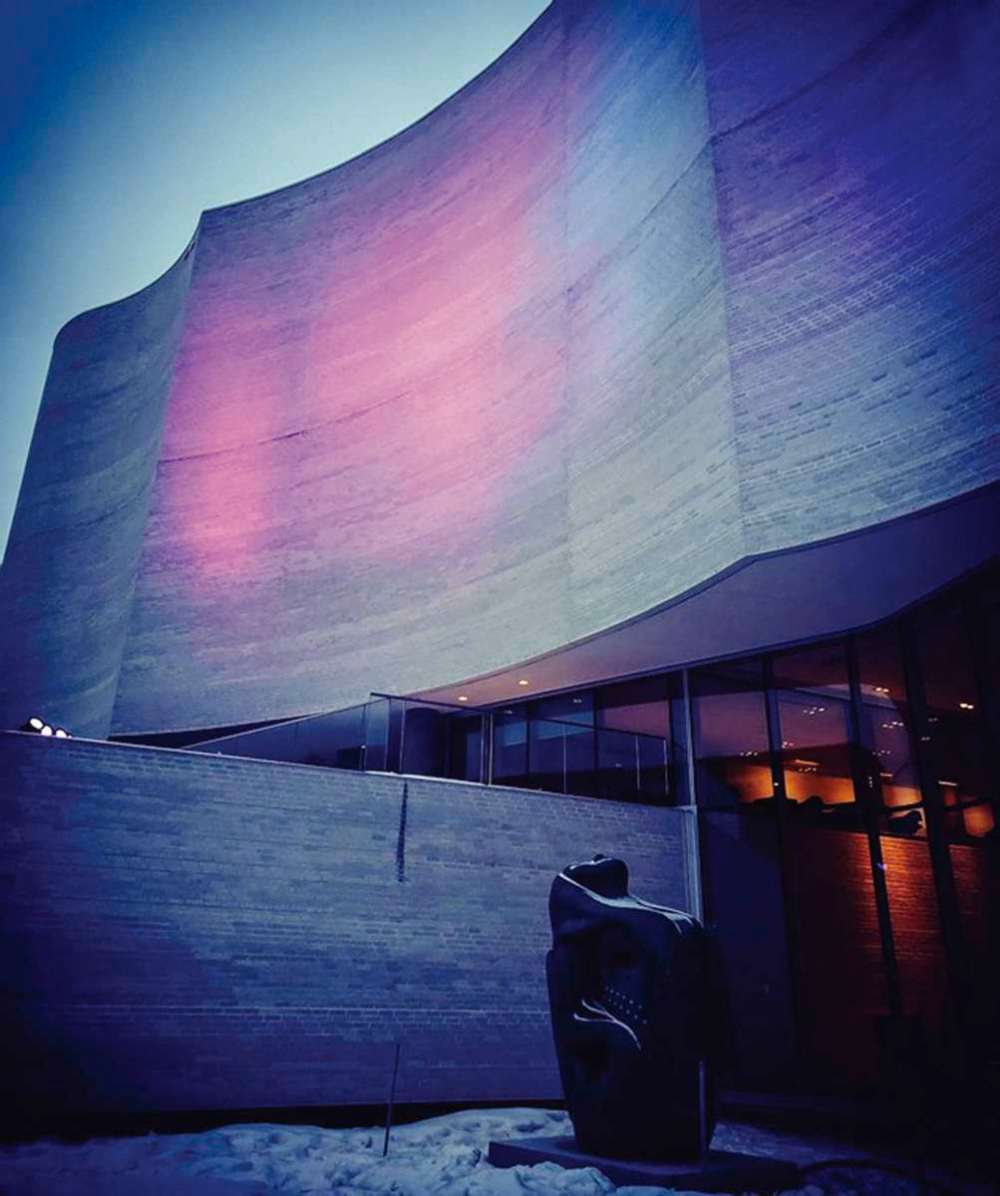
The final design creates a dynamic presence for Qaumajuq that, through its scalloped and fluid forms, contrasts with the triangular geometries of the existing da Roza building, Maltzan added. Together, he said, the two buildings form a complete assemblage with strong urban and public fronts on every side of the block.
“From the very beginning, I was fascinated by the quality of light in Winnipeg. It has such an incredible presence and beauty, just like the light that I found in the North,” Maltzan said.
“The scallops of Qaumajuq’s facade allow the light and shadows to animate the façade, while the white granite’s colour and texture were chosen very specifically to interact with the range of colour and quality of light across the year.”
In addition, the design is defined by a continuous street-level glass façade.
“It makes the stone gallery above almost seem to float,” said Maltzan. “It’s meant to create a transparency to the collection.”
As a result, the art within Qaumajuq is visible before visitors even enter the building, Maltzan said, which helps to break down barriers.
“The visible vault is really the centrepiece of this ground-floor space. Fluid in its glass form with areas of glass floor around it, you’ll get the impression that the art comes all the way from the foundations of the buildings and rises up to support the gallery above,” he said.
“The concave and convex shapes of the vault give many opportunities to experience the art up close, like you’re enveloped and surrounded by the collection.”
In the main gallery, visitors will be greeted by a space of truly magnificent scale, he added.
“I kept reflecting on the scale of the North here. Really, since the beginning of the display of art began, there’s been an argument that art looks the best and feels the most alive in a space that’s similar to the studio space in which the artist created it,” he said.
“For Inuit art, the studio has been the North itself in its vastness, its scale, its light. It’s a fascinating juxtaposition — the scale of that studio and the fact that many of the pieces, especially many of the traditional pieces, are so physically small.”
The exhibition space insinuates the scale of the northern landscape, he noted.
“The ambition is to create a type of space where the characteristics of light, scale and undulating form and vastness are in a true dynamic dialogue with the power of these exquisite objects,” Maltzan said.
“It’s a strategy that counts on the belief that the extraordinary intensity, beauty and spirit of the culture and art of the North cannot only hold itself within the abstraction and awe of its own landscape but that quality in this new setting can travel and thrive as a real bridge between ideas, traditions, ambitions — linking cultures as the best of art always does.”