Hey there, time traveller!
This article was published 05/11/2021 (1595 days ago), so information in it may no longer be current.
Residents of the RM of Cartier are raising concerns about the long-term viability of their farmland after Manitoba Hydro recently announced a newly planned Portage Area Capacity Enhancement (PACE) project.
“It’s a way of life that has been for hundreds of years, it’s some of the best land in Canada for farming and it is irrigational land,” said Christa Vann Mitchell, reeve of the RM of Cartier.
“These are people’s livelihoods and businesses we’re talking about.”
Manitoba Hydro is looking to build a substantial, 230-kV transmission line connecting the Dorsey Converter Station near Rosser with the Wash’ake Mayzoon Station in Portage La Prairie by 2025 to meet growing electricity needs for a growing industrial park in Portage.
Hydro is currently evaluating several planned routes that affect different communities based on the connecting extensions.
A few weeks ago, the crown corporation began notifying a handful of farmers in the St. Eustache community about the project, while leaving others in the dark.
“I received this card like a postage stamp, and if you look at it very carefully you’ll notice it affects you,” said Claude Lachance, a St. Eustache farmer.
“I learned that they had only placed cards in St. Eustache mailboxes. My ears pricked up at that one, I thought that was a clear evasion of giving the public adequate warning. It should have been for sure contacting all of the affected landowners no matter where they lived.”
“That’s been one of the biggest issues; we weren’t notified by Hydro at all,” said Lars Meilleur, general manager of Itzke River Farms who lives minutes away from Lachance.
“Just yesterday we had a phone call from Claude Lachance and he gave us more of a rundown of the different routes.”
Lachance told The Headliner that the card was very difficult to read, as it contained writing in English, French and a map of the planned potential transmission line routes with a numbering system that did not effectively convey how much land would be put in jeopardy for each farmer.
“I think the larger issue is when you come from a place of misinformation or no information, you can’t make a good decision,” said Michael Lackmanec, chief administrative officer of the RM of Cartier.
“Because there is a lack of information, how can residents make a decision? Will this affect future generations of my own family?”
A spokesman for Manitoba Hydro declined comment, choosing instead to issue a statement.
“We’re aware some customers in the RM of Cartier did not receive a mail-out notification regarding possible route options for the Dorsey to Wash’ake Mayzoon transmission line, and we are taking steps to correct it,” the statement read.
“We’ve extended the Round 1 engagement process until Dec. 1, 2021 and (are) in the process of sending project information postcards to the residents we missed. We have also added two virtual information sessions (on_ Nov. 16 at 7 p.m. and Nov. 17 at noon.”
Those information sessions are in addition to two others which were scheduled for Nov. 9 10 at noon.
To register for a session, email LEAprojects@hydro.mb.ca or call 1-877-343-1631.
“To be clear, no final decision has been made on a final route for the new transmission line,” the Hydro statement said.
“We are still in the early stages of engaging with landowners, Indigenous communities, interested parties, and the public to help us select a preferred route for the new line as part of the regulatory approval process under The Environment Act. Simply, we need as much input as possible so we know the concerns of all parties.”
Lachance farms alfalfa and anticipates up to 60 acres of his property in one section and another 150 acres of his nearby acreage could be put at risk if a transmission line is built through his land.
“Before you laugh at that, irrigated alfalfa you can cut up to four times and it’s worth 150 dollars a bale,” Lachance said.
The lack of information and speculation about the final route has farmers worried.
“They are going to cut my yard in half if they build the southernmost line,” said Paul Lachance, Claude’s brother.
For farmers like Lachance and Meilleur, farmland in the RM of Cartier is valued for its potential to have successful irrigation-based vegetable crops based on the rich soil and proximity to the Assiniboine River.
Itzke River Farms, one of the largest vegetable growers in western Canada has farmland on both sides of the Assiniboine in the RMs of Cartier and St. François Xavier. The family grows cauliflower, broccoli, cabbage and sweetcorn and is 100 per cent irrigation based according to Meilleur.
After finding a version of Hydro’s map online, the general manager was concerned that potential transmission lines stretched south of the Assiniboine over other creeks and water sources, which could devaluefarmers’ land.
Farmers are also concerned about the transmission line creating EMF interference that can disrupt the GPS signals pivotal for the growing season.
“Who says your low wattage communication is still going to work with your equipment,” Lachance said.
“It all depends on the satellites, but the closer you get, you can get zapped out a quarter of a mile away.”
“We’re using GPS for high precision planting and cultivating, where everything is in very tight rows and spacing,” Meilleur said.
“If we lose that signal for a second, you can take out a lot of crop by your machinery swaying over even by an inch or two. When I look at the amount of acres in the vicinity of these lines, it could cause some pretty major interruptions that we can’t afford to have.”
As a suggestion to Manitoba Hydro, Meilleur and Lachance would like to see the transmission line built using the northernmost route, north of the Assiniboine.
“The most northern route would be a best case scenario, there’s obviously still people farming up that way but that is a high saline soil, it’s a very rocky terrain, better used for livestock operations, not high value crops like the vegetables or potato farmers in the area,” Meilleur suggested.
“In terms of not interrupting any of the agricultural land with more southern routes, I think they need to take that into consideration.”
To learn more about the project and complete a survey towards the future planning, see hydro.mb.ca/projects/expansion/portage_la_prairie/pace/ for more information.
Residents of the RM of Cartier are raising concerns about the long-term viability of their farmland after Manitoba Hydro recently announced a newly planned Portage Area Capacity Enhancement project.
JOSEPH BERNACKI
Nov. 2, 2021 - Lars Meilleur, general manager of the Itzke River Farms family takes pride in each of the vegetable crops grown on their acreage. With farmland in both the RMs of St. Francois Xavier and Cartier, Meilleur does not want to see their land occupied by Manitoba Hydro's upcoming Portage area capacity enhancement transmission line. (JOSEPH BERNACKI/CANSTAR COMMUNITY NEWS/HEADLINER)
“It’s a way of life that has been for hundreds of years, it’s some of the best land in Canada for farming and it is irrigational land,” said Christa Vann Mitchell, reeve of the RM of Cartier.
“These are people’s livelihoods and businesses we’re talking about.”
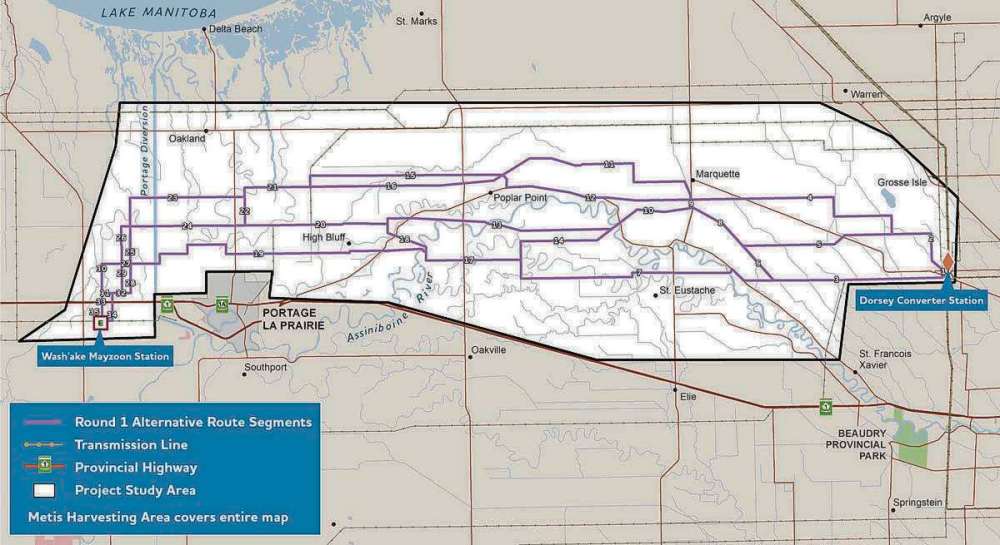
Manitoba Hydro is looking to build a substantial, 230-kV transmission line connecting the Dorsey Converter Station near Rosser with the Wash’ake Mayzoon Station in Portage La Prairie by 2025 to meet growing electricity needs for a growing industrial park in Portage.
Hydro is currently evaluating several planned routes that affect different communities based on the connecting extensions.
A few weeks ago, the crown corporation began notifying a handful of farmers in the St. Eustache community about the project, while leaving others in the dark.
“I received this card like a postage stamp, and if you look at it very carefully you’ll notice it affects you,” said Claude Lachance, a St. Eustache farmer.
“I learned that they had only placed cards in St. Eustache mailboxes. My ears pricked up at that one, I thought that was a clear evasion of giving the public adequate warning. It should have been for sure contacting all of the affected landowners no matter where they lived.”
“That’s been one of the biggest issues; we weren’t notified by Hydro at all,” said Lars Meilleur, general manager of Itzke River Farms who lives minutes away from Lachance.
“Just yesterday we had a phone call from Claude Lachance and he gave us more of a rundown of the different routes.”
Lachance told The Headliner that the card was very difficult to read, as it contained writing in English, French and a map of the planned potential transmission line routes with a numbering system that did not effectively convey how much land would be put in jeopardy for each farmer.
“I think the larger issue is when you come from a place of misinformation or no information, you can’t make a good decision,” said Michael Lackmanec, chief administrative officer of the RM of Cartier.
“Because there is a lack of information, how can residents make a decision? Will this affect future generations of my own family?”
A spokesman for Manitoba Hydro declined comment, choosing instead to issue a statement.
SUPPLIED
Nov. 4, 2021 - An overview of the planned Portage Area Capacity Enhancement project outlying the proposed transmission line routes connecting the Wash'ake Mayzoon Station in Portage La Prairie with the Dorsey Converter Station in Rosser. Manitoba Hydro is currently in the early stages of the engagement process with potentially affected landowners, with round one ending on Dec. 1. (SUPPLIED PHOTO)
“We’re aware some customers in the RM of Cartier did not receive a mail-out notification regarding possible route options for the Dorsey to Wash’ake Mayzoon transmission line, and we are taking steps to correct it,” the statement read.
“We’ve extended the Round 1 engagement process until Dec. 1, 2021 and (are) in the process of sending project information postcards to the residents we missed. We have also added two virtual information sessions (on Nov. 16 at 7 p.m. and Nov. 17 at noon.”
Those information sessions are in addition to two others which were scheduled for Nov. 9 at 7 p.m. and Nov. 10 at noon.
To register for a session, email LEAprojects@hydro.mb.ca or call 1-877-343-1631.
“To be clear, no final decision has been made on a final route for the new transmission line,” the Hydro statement said.
“We are still in the early stages of engaging with landowners, Indigenous communities, interested parties, and the public to help us select a preferred route for the new line as part of the regulatory approval process under The Environment Act. Simply, we need as much input as possible so we know the concerns of all parties.”
Lachance farms alfalfa and anticipates up to 60 acres of his property in one section and another 150 acres of his nearby acreage could be put at risk if a transmission line is built through his land.
“Before you laugh at that, irrigated alfalfa you can cut up to four times and it’s worth 150 dollars a bale,” Lachance said.
The lack of information and speculation about the final route has farmers worried.
“They are going to cut my yard in half if they build the southernmost line,” said Paul Lachance, Claude’s brother.
For farmers like Lachance and Meilleur, farmland in the RM of Cartier is valued for its potential to have successful irrigation-based vegetable crops based on the rich soil and proximity to the Assiniboine River.
Itzke River Farms, one of the largest vegetable growers in western Canada has farmland on both sides of the Assiniboine in the RMs of Cartier and St. François Xavier. The family grows cauliflower, broccoli, cabbage and sweetcorn and is 100 per cent irrigation based according to Meilleur.
After finding a version of Hydro’s map online, the general manager was concerned that potential transmission lines stretched south of the Assiniboine over other creeks and water sources, which could devaluefarmers’ land.
JOSEPH BERNACKI
Nov. 2, 2021 - Claude Lachance was one of several farmers and residents of St. Eustache to receive a postage card outlying the PACE project from Manitoba Hydro. According to Lachance, many of his neighbours never initially received the card and the legibility of the print made it difficult to understand which properties would be affected by the planned transmission line options presented by Manitoba Hydro. (JOSEPH BERNACKI/CANSTAR COMMUNITY NEWS/HEADLINER)
Farmers are also concerned about the transmission line creating EMF interference that can disrupt the GPS signals pivotal for the growing season.
“Who says your low wattage communication is still going to work with your equipment,” Lachance said.
“It all depends on the satellites, but the closer you get, you can get zapped out a quarter of a mile away.”
“We’re using GPS for high precision planting and cultivating, where everything is in very tight rows and spacing,” Meilleur said.
“If we lose that signal for a second, you can take out a lot of crop by your machinery swaying over even by an inch or two. When I look at the amount of acres in the vicinity of these lines, it could cause some pretty major interruptions that we can’t afford to have.”
As a suggestion to Manitoba Hydro, Meilleur and Lachance would like to see the transmission line built using the northernmost route, north of the Assiniboine.
“The most northern route would be a best case scenario, there’s obviously still people farming up that way but that is a high saline soil, it’s a very rocky terrain, better used for livestock operations, not high value crops like the vegetables or potato farmers in the area,” Meilleur suggested.
“In terms of not interrupting any of the agricultural land with more southern routes, I think they need to take that into consideration.”