


Kelvin students embark on expedition to Churchill
Program enables students to research climate change, endangered polar bears

Advertisement
Hey there, time traveller!
This article was published 13/12/2023 (966 days ago), so information in it may no longer be current.
These teens have a lot to bear in mind.
Each year for the past decade, 10 students from Kelvin High School have travelled north to Churchill, Man., to conduct real conservation research alongside professionals and explore the sociological and natural environment of the town and surrounding tundra. The trip is part of the school’s NorthSTAR (student-led Arctic research) program.
In the years since the program began, student researchers have been studying and logging the state of Churchill’s polar bears — monitoring the annual health and state of the critically endangered species. Their findings are then analyzed extensively and presented to professionals at a conference. This year’s trip took place from Dec. 3 to 8.
Supplied photo
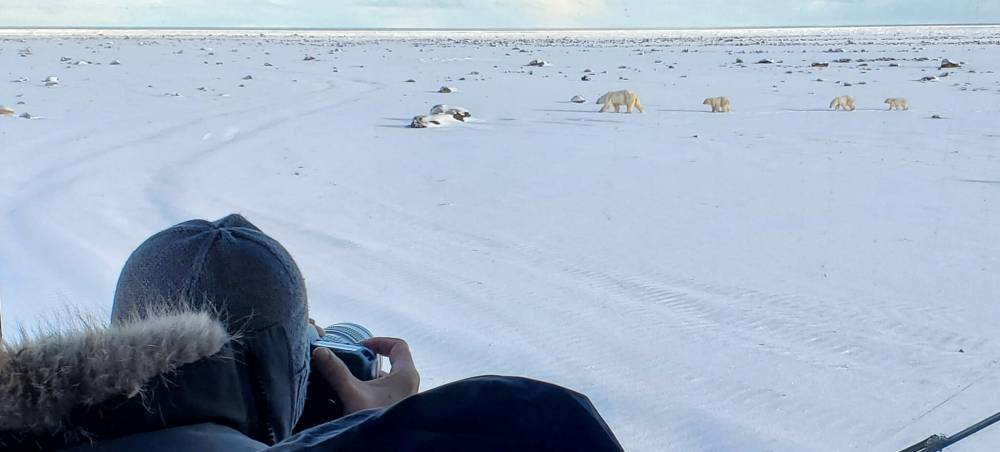
A group of 30 students — from Winnipeg and Churchill — spent two days photographing bears on the tundra buggy, where they were able to watch a mother polar bear and her three cubs, a rare sight for the endangered species.
“Each year we do a different research project,” explained Natasha Frost, 17. “So last year we were actually looking at methods of determining body condition index, we had two methods … two techniques, and we were doing a comparative analysis to see if they gave the same results. We found that it’s different for females and males. So using a different method for a male might not work for a female because they have different proportions.
“We also took that research project to a scientific conference … which was really cool because it’s a bunch of the university students and people (doing) their master’s degrees.”
The Kelvin teens, along with students from Nelson McIntyre Collegiate and Elmwood High School, were accompanied by students from Churchill, and stayed at the Churchill Northern Study Centre.
They spent two days traveling on the centre’s tundra buggy, studying bears with high-quality equipment they learned to use during their time there.
As in previous years, students on this year’s trip were accompanied and mentored by Dr. Jane Waterman and Dr. Emily McKinnon, professors at the University of Manitoba. They were also accompanied by Kelvin science teachers Donna Labun and Szandra Temesvari, who have been attached to the NorthSTAR program since it began.
“It was one of the things that I was really looking forward to, coming to Kelvin,” said Joshua Cook, 17. “It’s just a really cool opportunity.”
Not only did it give the teens a look into on-the-ground scientific work, it also gave them a chance to contribute in a real, impactful way. It was a far cry from school labs, said Oskar Krause, 17, who went for the first time this year.
“(At first) it felt really scary,” Krause said. “But (the scientists) really nice, and it was a really great time. (We) got to see the insides of how science works, and it’s not always just writing notes.”
“It’s pretty relaxed,” Frost said. “The stuff we’re looking at is serious, but you kind of talk about it with (the scientists) and it’s not scary. You’re kind of like friends with everyone. It’s really nice.”
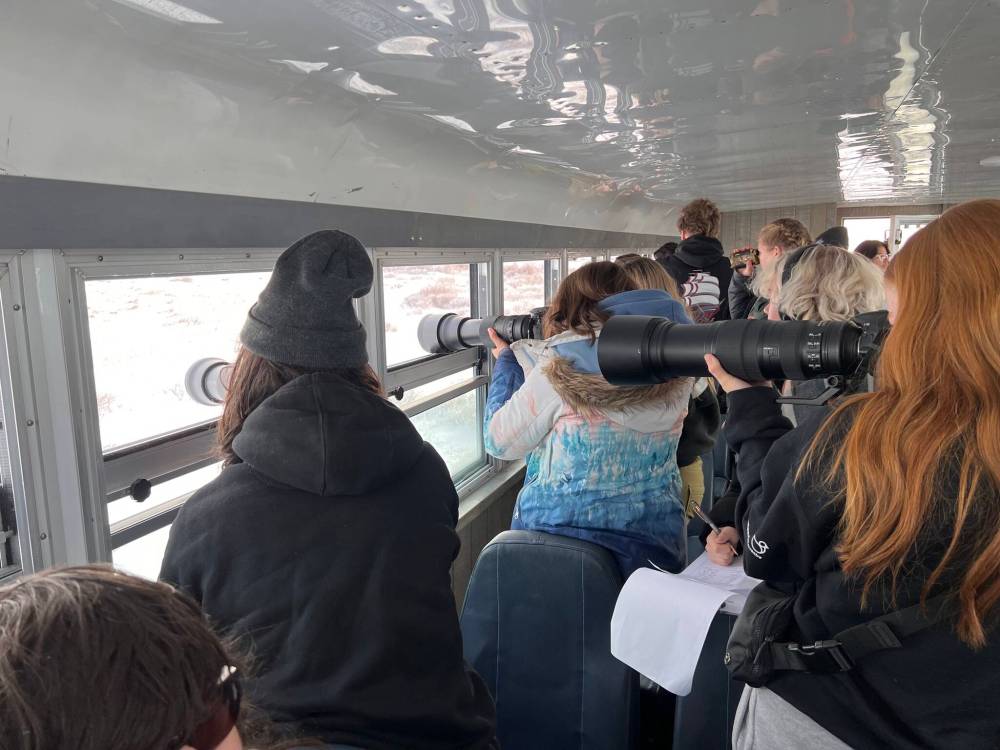
The students’ research is used as a way to monitor climate change throughout the past 10 years, Temesvari explained.
“We can compare the body condition of the bears that we’ve seen, (and) the data that we’ve collected, and see how that relates to the sea ice,” she said. “And so that is a very direct correlation that we’re looking for … actually using the bears as something to monitor (climate change). We’re not (just) studying, we’re using them as an indicator of what is happening in the arctic.”
Additionally, in a time of climate crisis, it’s rewarding to see when things are going well. Contrary to what they were expecting, the team spotted a mother bear with three cubs — which is extremely rare, as the body mass of the bears has been decreasing because their habitat and hunting grounds are melting.
“It really gave me a taste of what real science was like,” Cook said. “And how it’s not so strict. It’s OK to make a mistake. It’s OK to take a blurry picture, just make sure you’ve got a clear one eventually, right? And it’s just working kind of cumulatively together as a group and less of, ‘Oh, did you put the right amount of salt in your lab?’”
For more information on NorthSTAR, visit www.northstarscience.ca
Our newsroom depends on a growing audience of readers to power our journalism. If you are not a paid reader, please consider becoming a subscriber.
Our newsroom depends on its audience of readers to power our journalism. Thank you for your support.
Our newsroom depends on a growing audience of readers to power our journalism. If you are not a paid reader, please consider becoming a subscriber.
Our newsroom depends on its audience of readers to power our journalism. Thank you for your support.
Advertisement Advertise With Us
Advertisement Advertise With Us