


Writing through grief

Advertisement
Hey there, time traveller!
This article was published 10/04/2024 (786 days ago), so information in it may no longer be current.
During the hardest times, sometimes the only way out is just to keep going.
Nearly a decade ago, local writer Gonzalo Riedel’s life was playing out in a way that could almost be seen as cliché. He was married to his high school sweetheart, Erica. The couple had a young son, Elliot, and another on the way. But then, everything changed.
“When she was pregnant, they found something metastasized inside of her,” explained Riedel, an alumnus of Sisler High School and the University of Winnipeg. “It was appendix cancer, which produces cancerous cells by the thousands.”
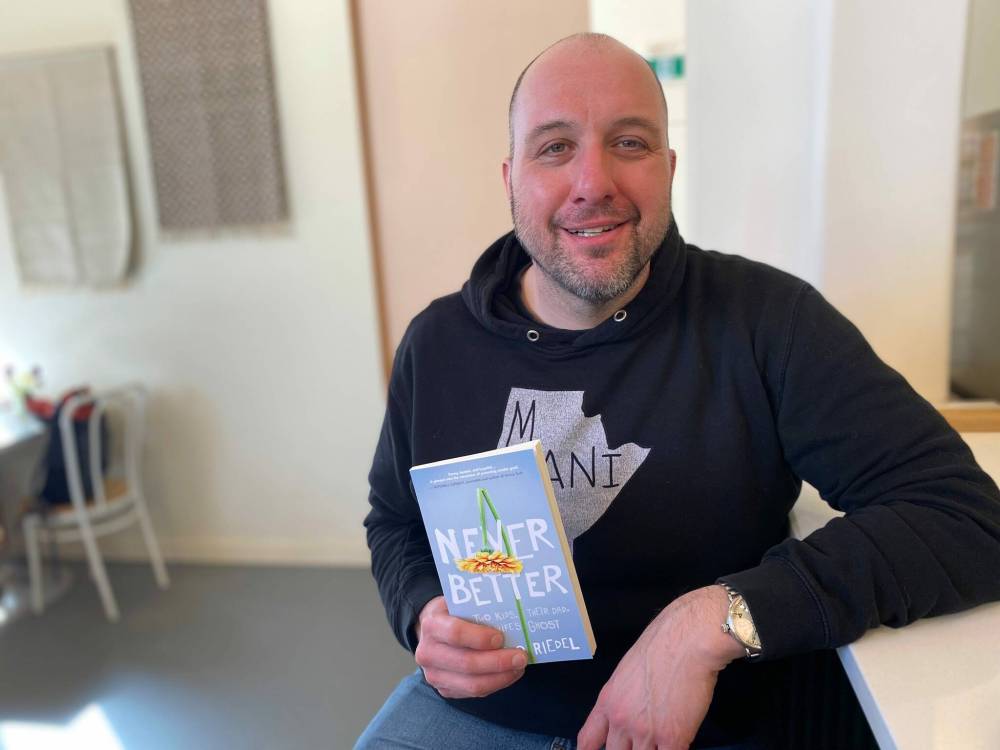
Photo by Sheldon Birnie
Gonzalo Riedel is the author of Never Better: Two Kids, Their Dad, and His Wife’s Ghost, which is out now from Dundurn Press.
Their son, Charlie, was born, happy and healthy. Doctors did what they could for Erica’s cancer. But it was too little, too late.
“She had surgery,” Riedel said. “There was this high of hope that it was going to get better to this low of realizing how it was going to go.”
Before Charlie’s first birthday, Erica died, and Riedel was left to raise their two kids alone.
“I was grieving, I had anger issues,” the Wolseley resident admitted. “I did that classic dad thing, where when we were together, I figured I was half the glue of what holds us all together. But then I realized I wasn’t even close to half.”
Still, as he and his children grieved and went on with their day-to-day lives, Riedel was writing. With a master’s in English from Concordia University and a lifelong habit of creative writing — including a collection of short fiction, Behaving This Way Is All I Have Left (Insomniac Press) — it is what he’d always done. Earlier this year, Dundurn Press published Riedel’s memoir Never Better: Two Kids, Their Dad, and His Wife’s Ghost.
“I tried to capture her as a person in the book, but I realize a lot of when you capture people it’s the teller’s perspective of that person. That gave me a lot of anxiety, and I just had to let it be,” he said.
In the end, it was attention to the little things that moved the project along.
“It was the small things, the details about how I was feeling or observed, or something the kids had said or she had said, those little moments were the thing I started capturing, carrying around a literal pocketbook-sized notebook and jotting them down when they came to me,” Riedel said. “I thought, at some point, I’d arrange them in a way where the seams would be gone. But eventually I realized I’d keep the seams.”
Once he had the story down in his notebooks, Riedel typed them up as he’d put them down, then cut each section up and re-arranged them until he had them in an order that made sense of the chaos of grief.
“Then I could see what was missing and what was repeated. I realized, in doing that, that I had skimped out on the really difficult stuff, while repeating other things to make my point. That was the hard part, to put those difficult pieces in. But it seemed to work,” Riedel said. “Part of my way of getting through this all, is I’m the kind of guy who loves making mixtapes and mix CDs, sequencing everything, figuring out what part goes after what part. The flow of it all is so important.”
While Never Better is a book he’d never wanted to have to write, Riedel is proud of the work, and hopes it will help encourage those who have a story to tell, but may be too anxious about how to tell it.
“I had to understand that even if I’m telling a story about Erica, it’s always my story, too,” he said. “It’s her story through my eyes. It’s like that with any story that gets told. I just had to be OK with understanding that that anxiety is important.”
With the book out in the world, and available at major retailers everywhere, Riedel said he is finally able to enjoy writing again, and is already at work on new creative projects.
“Now that this story is told and the anxiety of it is over, it’s like the world is open again, in terms of writing,” he said.
Sheldon Birnie
Community Journalist
Sheldon Birnie is a reporter/photographer for the Free Press Community Review. Email him at sheldon.birnie@freepress.mb.ca or call him at 204-697-7112
Our newsroom depends on a growing audience of readers to power our journalism. If you are not a paid reader, please consider becoming a subscriber.
Our newsroom depends on its audience of readers to power our journalism. Thank you for your support.
Sheldon Birnie
Community Journalist
Sheldon Birnie is a reporter/photographer for the Free Press Community Review. Email him at sheldon.birnie@freepress.mb.ca or call him at 204-697-7112
Our newsroom depends on a growing audience of readers to power our journalism. If you are not a paid reader, please consider becoming a subscriber.
Our newsroom depends on its audience of readers to power our journalism. Thank you for your support.
Advertisement Advertise With Us
Advertisement Advertise With Us