


Malt plant dominates South Transcona skyline

Advertisement
Hey there, time traveller!
This article was published 06/11/2024 (570 days ago), so information in it may no longer be current.
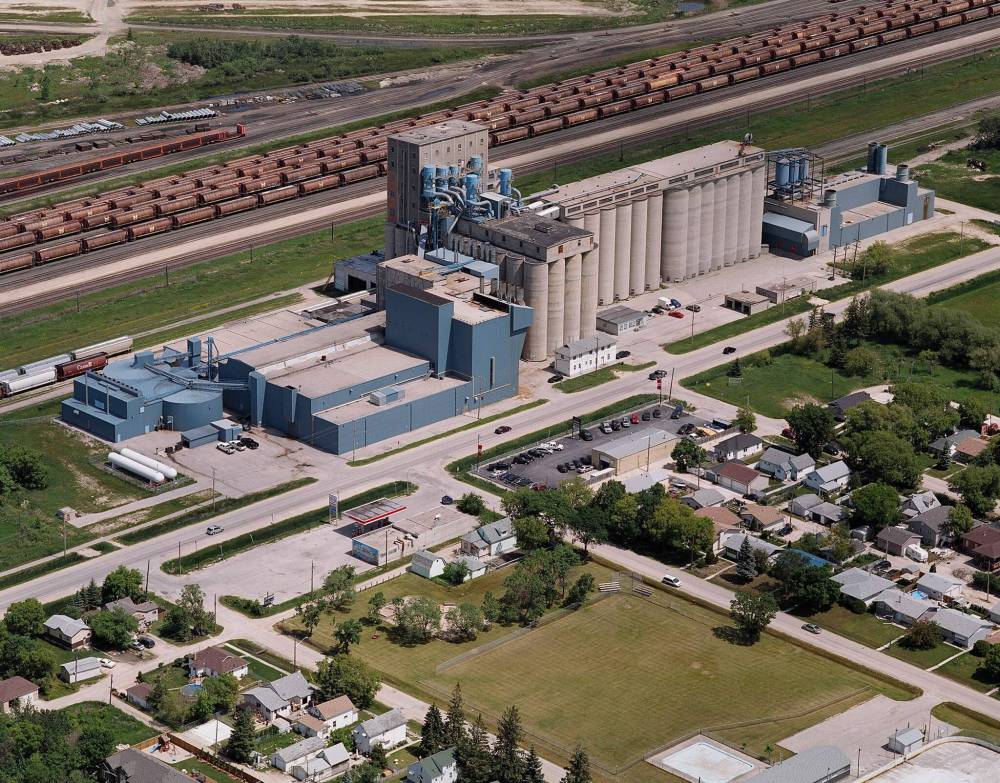
Have you ever wondered what that big building with the large silos is on Dugald Road, near south Transcona? You can see it peeking out behind the CN shops from downtown Transcona, and from the other side as far as the Trans-Canada Highway. It is the Malteurop malt production plant.
Growing up, I remember visiting my Nana’s little white house with the blue trim on McFadden Avenue, right next to the Dominion Malting Company Limited (which we just called, “the malting plant”) on 3001 Dugald Rd. In the ’70s, I remember Nana cursing the dust that would sometimes emanate from the plant and drift onto her clean laundry on the clothes line. Thankfully, with modern environmental controls, the plant’s dust collection system has since resolved this issue.
The Dominion Malting Company, built in 1928, was a multi-story malthouse connected to a grain elevator and silos. The output was about 3,500 bushels of malted barley daily. In the 1940s, it expanded with additional concrete silos.
Supplied photo courtesy of Malteurop
The old Dominion Malting Company plant on Dugald is now owned by Malteurop, and most of its product is sold to Canadian brewers.
In 1998, Archer Daniels Midland (ADM) and International Malting Co. based in Milwaukee took over the plant but kept the same name. Its most recent owner, Malteurop, purchased it in 2008. The malt plant is the only one in Canada owned by Malteurop, and the only malt plant in Manitoba. Malteurop also own two malt plants in the U.S., and one in Mexico, as well as other countries. The Winnipeg plant employs 40 people.
I spoke with Kevin Kull, plant manager, who shared a bit of information about the process of making the malt. The barley, first dried in fields to dormant husks, is purchased directly from farmers in Manitoba and Saskatchewan. The plant requires 130,000 tonnes of barley annually. The silos hold about 20,000 tonnes of barley, and another 20,000 tonnes of the final malt product.
After being dried in the field, the transformation from barley to malt requires two more steps. The barley is put under water to germinate (called steeping). This converts the starch to sugar in the kernels and takes about four days. After that, it is put into a kiln for up to two days to halt germination and dry it until it has about four per cent moisture. There are various roast levels – the more roasted, the darker the colour. The level is dictated by what the customer wants.
Most of the malt is sold to Canadian beer brewers. Some is sold and shipped to markets as far as South Korea and Japan. Malteurop also sells malt to whiskey producers in the United States.
Next time you sit down to enjoy a nice cold Canadian beer, appreciate the fact the important ingredient was likely locally grown barley that was transformed to malt right here in Winnipeg.
Suzanne Hunter
Transcona community correspondent
Suzanne Hunter is a community correspondent for Transcona.
Our newsroom depends on a growing audience of readers to power our journalism. If you are not a paid reader, please consider becoming a subscriber.
Our newsroom depends on its audience of readers to power our journalism. Thank you for your support.
Suzanne Hunter
Transcona community correspondent
Suzanne Hunter is a community correspondent for Transcona.
Our newsroom depends on a growing audience of readers to power our journalism. If you are not a paid reader, please consider becoming a subscriber.
Our newsroom depends on its audience of readers to power our journalism. Thank you for your support.
Advertisement Advertise With Us