


Peer support an important resource
Peer Connections Manitoba offers programs, workshops, and more

Advertisement
Hey there, time traveller!
This article was published 16/07/2025 (400 days ago), so information in it may no longer be current.
Peer support has been becoming more popular than ever, and for good reason. What better way to find assistance — and even healing — than to work with someone who has been there, who understands the struggles and hardships from their own first-hand experience.
Peer Connections Manitoba, formerly the Manitoba Schizophrenia Society, is a charitable, provincial non-profit organization offering programs, workshops and support groups that empower individuals to exchange knowledge, share stories and offer emotional support.
Adam Milne, Peer Connections’ director of peer services, came to the position five years ago with an extensive background in community mental health.
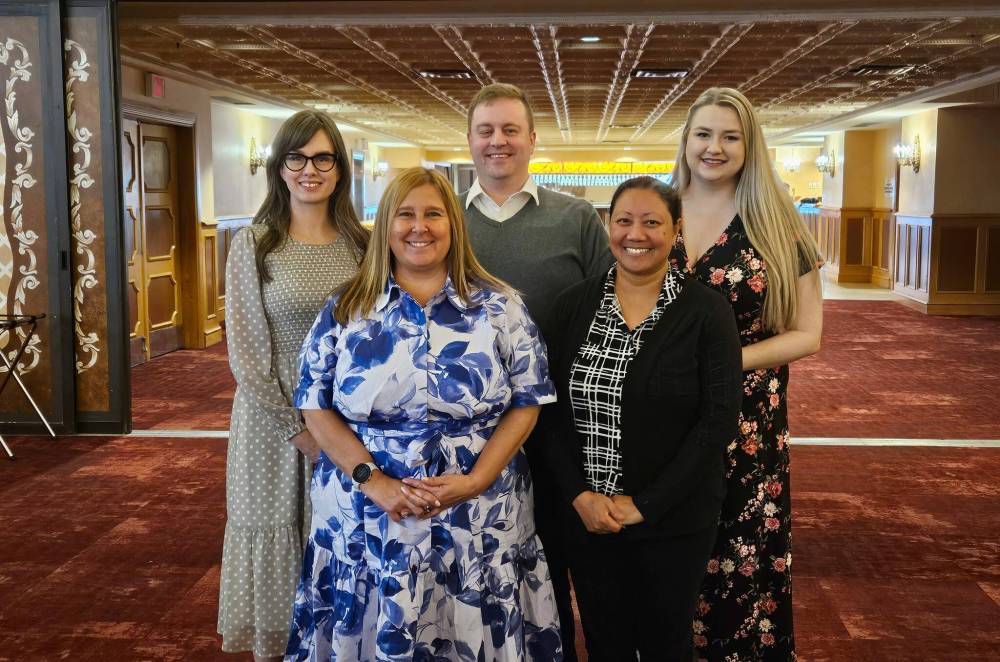
Supplied photo
(From left) Peer Connections Manitoba’s Julia Hoeppner, executive director; Monique Levesque-Pharoah, director of development; Adam Milne, director of peer services; Kitana Degen, peer support manager; and Adriana Rajcher, office manager.
“What we do is different from what is being done in other places. Our teams of people with lived experience work in hospitals and crisis response centres across the province,” Milne said, explaining his belief in peer support as a profession in the mental health field. “Experience and education can have the same value. It really matters to us. That’s kept me in the field.”
Since 2020, the organization with 40 staff has been offering peer support programming. There are teams of peer supporters in crisis response centres, clinics, action centres, hospitals, in Winnipeg and in various communities throughout the province. What many may not realize is that all services and resources are free and available to those struggling with a mental health or substance use issue.
“There’s no limitation on who has access,” said Milne, adding that an official diagnosis is not required to get help.
“They can come in, or call. Everyone who works for us — the board — everyone has to be a person with lived experience. That’s the base function of peer support: people who gained their knowledge from their own experience, not their education. That person has had to recover from something, has had to go through something hard. It’s conversational. It’s a relationship guided by professional standards.”
According to Milne, the stigma of reaching out and talking openly about mental health issues has decreased significantly, especially over the last few years, with accommodations being made for people at school and at work. Those 30 and under grew up with that reality, but challenges remain for others.
“It’s getting a lot better. That said, I think that the stigma is just as bad for the family members,” he said, pointing to the numbers of parents who didn’t grow up in that same era and are still facing complicated emotions.
Experience and education can have the same value. It really matters to us.
“The pandemic changed how people saw themselves. We spent all that time alone or with a small group of people. We found that there were gaps. The more awareness, the more needs for services like this. The reality of the pandemic is that people weren’t willing to suffer in silence.”
With substantial demand for services from Peer Connections Manitoba, the organization put a number of service options in place to ensure that there’s support for everyone seeking it.
“We have a wait list for one-on-one peer support: between three and six months,” said Milne. “We have a drop-in service, so people aren’t stuck. There are support groups. We are open to everybody. Everything we do is free. You don’t even need a health card. I think the thing about our program is that it’s the relationship you need when you need it, without taking away from the relationships you have. We are not your doctor, therapist, or social worker, we are here to be with you,” he said about the services for anyone 16 and up, living anywhere in the province.
The Mental Health Education Resource Centre (MHERC) is another program of Peer Connections Manitoba, which offers a comprehensive selection of mental health resources and workshops accessible both online and in-person to all Manitobans.
The physical and online library is open to everyone. Visitors can walk in and borrow books, and talk to a resource coordinator to learn more about available services. Helpful online materials include fact sheets, wellness tips, short video wellness presentations, and workshops.

Supplied photo
(From left) Peer Connections Manitoba’s Sia Yamba, peer supporter; Adam Milne, director of peer services; Monique Levesque-Pharoah, director of development; and Julia Hoeppner, executive director.
Milne has a message to anyone thinking about reaching out: “Getting help is a strength not a weakness.”
Visit peerconnectionsmb.ca/mherc/ for more information.
Janine LeGal
Wolseley community correspondent
Janine LeGal is a community correspondent for Wolseley. Know any interesting people, places and things in Wolseley? Contact her at: janinelegal@gmail.com
Our newsroom depends on a growing audience of readers to power our journalism. If you are not a paid reader, please consider becoming a subscriber.
Our newsroom depends on its audience of readers to power our journalism. Thank you for your support.
Janine LeGal
Wolseley community correspondent
Janine LeGal is a community correspondent for Wolseley. Know any interesting people, places and things in Wolseley? Contact her at: janinelegal@gmail.com
Our newsroom depends on a growing audience of readers to power our journalism. If you are not a paid reader, please consider becoming a subscriber.
Our newsroom depends on its audience of readers to power our journalism. Thank you for your support.
Advertisement Advertise With Us
Advertisement Advertise With Us