



Back to the future

Advertisement
In a week’s time, the first quarter of the first century of the common era’s third millennium will be put to rest.
As milestones go, the turn of a millennium is a special thing to experience. Having recently come across the Dec. 31, 1999, and Jan. 1, 2000, editions of the Free Press, it was interesting to look back at a snapshot of that time in history.
The world hadn’t ended, as some had predicted it might, but neither had it become an advanced technological utopia. Still, the particular mix of optimism and anxiety definitely skewed towards the positive.
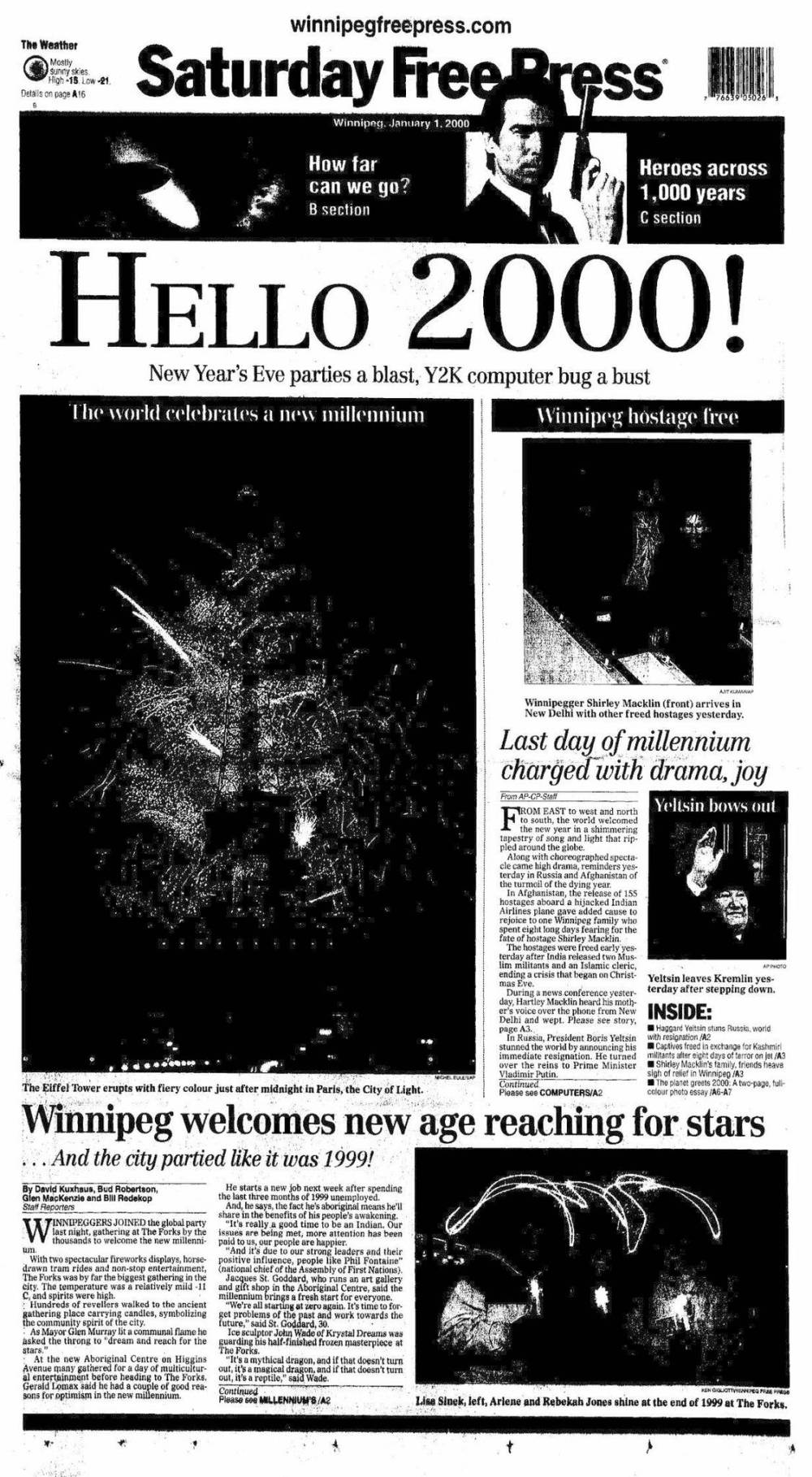
Free Press archives
The Jan. 1, 2000 edition of the Free Press welcomed a new millennium and looked ahead to the future.
A Prairie Research Associates poll from the time showed Manitobans were optimistic across every economic sector, from richest to poorest, after the “turbulent” economic times of the ’80s and early ’90s.
That optimism apparently spanned age groups; as one contributor wrote, “us gloomy, pessimistic twentysomethings” – those who came of age during the turbulent years – “wound up with jobs and started earning salaries far beyond our wildest dreams.”
“It wasn’t supposed to be this way,” they continued, for a generation that expected Canada to be absorbed by an aggressive United States and the huge, faceless “McCorporations” that were going to take over the world.
Some of the headlines are also noteworthy. Among them: “Food fast, easy, cheap now,” and “Cut taxes, don’t spend, more Winnipeggers say.”
With the benefit of hindsight, the most interesting reads are the predictions.
The Free Press ran a dedicated section on Jan. 1 called “Manitoba’s 2020 Vision.” It is, in every sense, a look “back at the future,” but without having foreseen the disruptions caused by a global pandemic, the staff who contributed to it deserve some leeway.
In any case, if the subheading makes one thing clear, it is that all contributors agreed on one thing about Winnipeg in 2020: “It’s going to be a lot different, but the bottom line is grow or die.”
Examining demographic trends, and looking at three different sources – two of which projected Winnipeg’s population to shrink – Free Press staff predicted Winnipeg’s population would increase to 720,000 by 2020, up from around 630,000 in 2000.
They also cited urban planners who felt the city should aim for 750,000 residents – an apparent critical mass whereby unit costs for virtually all public services start to fall and can be delivered more efficiently thanks to economies of scale.
In terms of economic growth, the low-cost of real estate, labour, and electricity in Winnipeg were acknowledged as natural advantages, but it was predicted growth would rely on whether then Mayor Glen Murray would make good on his pledge to reduce civic taxes by 10 per cent.
Taxes were gradually cut and then frozen, and by 2021 the city’s population had grown to 749,607 people, according to statistics Canada.
In a week’s time it’ll be 2026, and according to the city’s own projections another 100,000 people call Winnipeg home. Meanwhile, the city can barely afford to provide basic services, and the economic benefits have been uneven, or unrealized.
I wonder if it was supposed to be this way.
Andrew Braga
South Osborne community correspondent
Andrew Braga is a community correspondent for South Osborne.
Our newsroom depends on a growing audience of readers to power our journalism. If you are not a paid reader, please consider becoming a subscriber.
Our newsroom depends on its audience of readers to power our journalism. Thank you for your support.
Andrew Braga
South Osborne community correspondent
Andrew Braga is a community correspondent for South Osborne.
Our newsroom depends on a growing audience of readers to power our journalism. If you are not a paid reader, please consider becoming a subscriber.
Our newsroom depends on its audience of readers to power our journalism. Thank you for your support.
Advertisement Advertise With Us
Advertisement Advertise With Us