


Storytelling and language learning
Video series aims to leave online legacy

Advertisement
As education slowly continues to shift into the digital space — and language-learning along with it — a new way to learn, listen, and understand First Nation languages has entered the digital sphere.
The foundational language acquisition video series — produced by the Manitoba First Nation Education Resource Centre — is a series of 160 videos in the five different First Nation languages of Manitoba.
The languages featured in the videos are Anishinaabemowin, Ininīmowin, Denesuline, Anisininimowin, and Dakota.
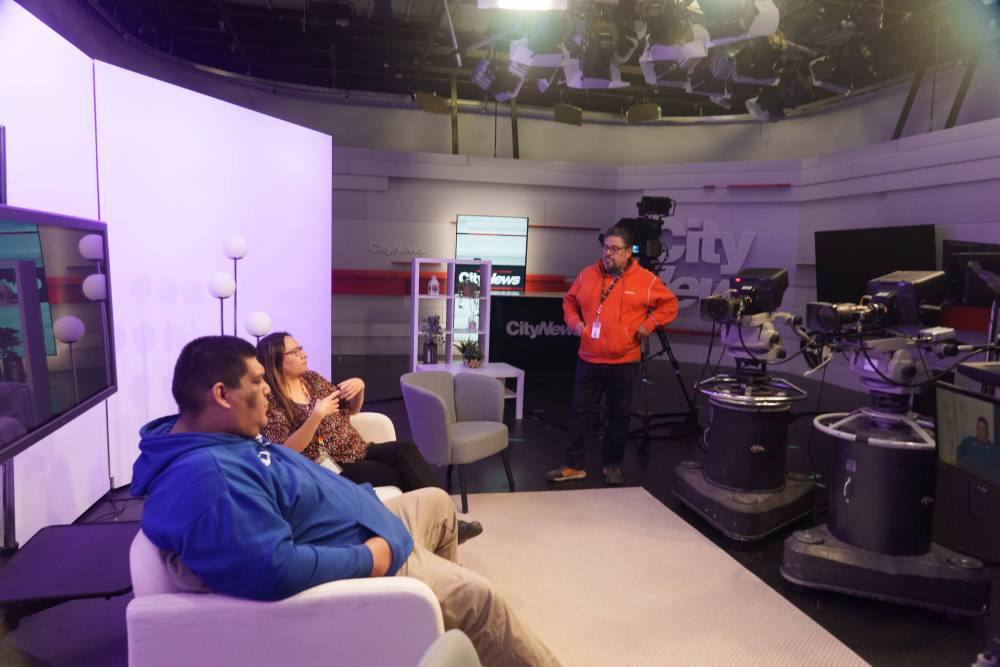
Supplied photo.
The filming set and production of the foundational acquisition Indigenous language video series.
“The wonderful thing about it is they’re everyday conversations and storytelling,” said Jennifer Williams, director of language and culture at MFNERC.
“They’re stories that need to be told to help Indigenous identity,” she said, adding that there’s emotion, humour, symbolism and rich family histories in the videos.
Each video ranges from seven to 13 minutes long.
Topics range from how to answer everyday questions like ‘What are you doing?’ or ‘Where are you going?’ to other videos that use a role-playing format to simulate what a conversation between a student and teacher or a parent and child might sound like.
“We’re really proud of this project,” Williams said. “It’s a digital record and permanent visual record that will always be there. This is the legacy we want to leave behind in languages,” she said.
Many videos are cultural teachings, such as one on the stories behind ribbon skirts or another on traditional Anishinaabe knowledge that could help predict the weather.
“Our language is so much more than just listening, it’s expression and hand movements,” said Davin Dumas, associate executive director of MFNERC. “The main importance is to hear the language.”
“The whole idea was to put out videos speaking our languages,” said Dumas.
Some words written can look and sound very similar, Dumas said. The video format helps provide proper pronunciation and accentuation.
Along with the video series, MFNERC announced last week the launch of a new Indigenous language video game called Turtle Island Trials: Manajiiwewin Mino Bemaadiziwin.
The game is built inside Fortnite, a popular video game, but instead of the typical combat-style game, Turtle Island Trials uses story-driven exploration and problem solving relying on Anishinaabe elders and teachings to advance.
“The connection is being with young people and online formats,” Dumas said. “When I see children learning their language, it helps them find their identity and their place in the world.”
The video series is still ongoing, with 40 to 60 new videos released per year, according to Williams.
You can find and watch the videos on the Manitoba First Nation Education Resource Centre website, mfnerc.org
Rylee Gerrard
Community Journalist
Rylee Gerrard is a reporter/photographer for the Free Press Community Review. Email her at rylee.gerrard@freepress.mb.ca or call her at 204-697-7150.
Our newsroom depends on a growing audience of readers to power our journalism. If you are not a paid reader, please consider becoming a subscriber.
Our newsroom depends on its audience of readers to power our journalism. Thank you for your support.
Rylee Gerrard
Community Journalist
Rylee Gerrard is a reporter/photographer for the Free Press Community Review. Email her at rylee.gerrard@freepress.mb.ca or call her at 204-697-7150.
Our newsroom depends on a growing audience of readers to power our journalism. If you are not a paid reader, please consider becoming a subscriber.
Our newsroom depends on its audience of readers to power our journalism. Thank you for your support.
Advertisement Advertise With Us