


Preserving a unique history within Winnipeg

Advertisement
Transcona has a unique history that many are working to preserve for future generations. One of Winnipeg’s fastest-growing communities, its story is still being written.
Transcona was incorporated as a town on April 6, 1912, to support workers employed by the National Transcontinental Railway and Grand Trunk Pacific Railway, its name a combination of Trans-Canada and Strathcona. Transcona became a city on June 10, 1961, and joined Unicity on Jan. 1, 1972.
“It was truly a melting pot of people who came to Transcona from all over the world to start a new life,” said area historian Peter Martin, whose father, Paul, was Transcona’s mayor in the late 1950s.
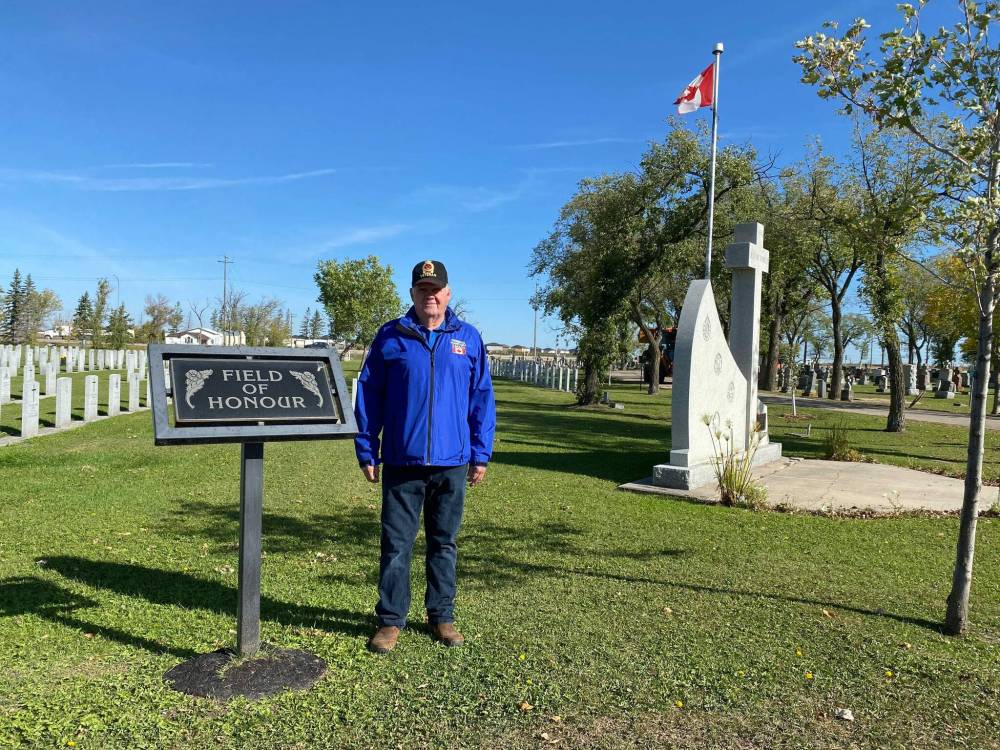
File photo
Area historian Peter Martin, pictured here in a file photo at Transcona Cemetery’s Field of Honour. In total, 133 people from Transcona gave their lives during the First and Second World Wars.
People from different countries formed cultural pockets throughout the community. That gave rise to corner stores offering tastes of the old country. Within a few short blocks, shoppers could get a taste of both the familiar and the new. United by the desire to build better lives, the different cultures supported each other.
“The opportunity to create a community doesn’t come along too often,” Martin said. “They took what was bush and farmland and, beginning around 1909, came with their skills and trades to build the CNR Shops.
“It took the hard work of so many people from all over the world. That was unique in Winnipeg and created a love for community that they strove to keep vibrant.”
At no point was that commitment to their new home reflected more than during both World Wars, as many Transcona residents rushed to enlist, with some returning to their countries of origin wearing the maple leaf. In total, 133 people from Transcona gave their lives to that effort.
“They left those they loved because they were called to something greater, but they never came home,” Martin said.
Growth has been a constant for more than a century, blessed by available land and wise decisions, like building the Red River Floodway that kept the town dry. In the 2001 Canadian census, 30,255 people called Transcona home. Two decades later, that number has surged to 43,025. Since 2011, Transcona’s population growth has far outpaced Winnipeg’s as a whole; in 2021, Transcona’s population grew 18.6 per cent, nearly three times Winnipeg’s 6.3 per cent clip.
Amidst all the new people, Transcona has maintained its uniqueness. While 4.4 per cent of Winnipeggers identify as Catholic, 23.4 per cent of Transcona residents do. Still a family-oriented community, 61 per cent of adults say they are married, compared to the Winnipeg average of 54.4 per cent.
The number of children below the age of 15 is also above the city average. This prompted the River East Transcona School Division and the Province of Manitoba to announce a new, 800-student K-8 school in the Devonshire Park neighbourhood.
“The River East Transcona School Division community is rapidly growing, and we have needed to use every seat in every classroom in every school to ensure environments that support learning and well-being for all our students and staff,” Colleen Carswell, River East Transcona School Division board chair, said. “The new school will accommodate a student population of 800. This means that students currently being transported out of the neighbourhood, as well as others within the growing Devonshire community, will have the opportunity to learn closer to home.
“But the board of trustees can’t stop with this school,” Carswell added. “Schools across the Transcona area are already at or near capacity, and three large housing developments are planned within the division, which will further increase demand.”
The Waters Urban Village on Dugald Road proposes 3,000 residential units, while a 154-unit affordable housing project could rise on Transcona Boulevard. The South Transcona Secondary Plan envisions housing for up to 20,000 more.
For decades, Transcona’s undisputed commercial centre was on Regent Avenue. Growth has brought other contenders like Plessis Road, boosted by development and an influx of new Canadians.
“Thousands of new residents from all over the world have come to Transcona,” Martin said. “Those people are learning about Transcona and the community. Our history also includes the cultural history of the people moving here.”
Tony Zerucha
East Kildonan community correspondent
Tony Zerucha is a community correspondent for East Kildonan. Email him at tzerucha@gmail.com
Our newsroom depends on a growing audience of readers to power our journalism. If you are not a paid reader, please consider becoming a subscriber.
Our newsroom depends on its audience of readers to power our journalism. Thank you for your support.
Tony Zerucha
East Kildonan community correspondent
Tony Zerucha is a community correspondent for East Kildonan. Email him at tzerucha@gmail.com
Our newsroom depends on a growing audience of readers to power our journalism. If you are not a paid reader, please consider becoming a subscriber.
Our newsroom depends on its audience of readers to power our journalism. Thank you for your support.
Advertisement Advertise With Us
Advertisement Advertise With Us