



Parks, historic sites you can visit for free

Advertisement
Hey there, time traveller!
This article was published 10/04/2017 (3288 days ago), so information in it may no longer be current.
You know how you’ve always wanted to take that trip with family or friends to someplace special in Canada?
Or maybe there are different destinations you’ve wanted to visit, and would like to cross a few of them of your bucket list at once? Well, this might be the ideal year to do it.
In honour of Canada’s 150th birthday, Parks Canada is giving Canadians a birthday present — free Discovery Passes. Valid throughout 2017 (until Dec. 31) these passes grant unlimited access to national parks, national marine conservation areas, and national historic sites from coast-to-coast-to-coast.
National marine conservation areas are special coastal locations designed for sustainable use and ecological integrity. National parks are natural areas considered to be of significance to preserving Canada’s diverse landscapes and species. Back in 1885, Banff National Park was the very first designation. Today there are more than 40 national parks and park reserves, including mountainous ranges, untamed forests, diverse grasslands, and sprawling tundra.
Here in Manitoba, we have two.
Riding Mountain National Park was established in 1930. It covers 3,000 square kilometres, and preserves Manitoba’s escarpment rising up 500 metres from the lowlands. Riding Mountain is a hilly forested jewel surrounded by neighbouring farmlands, with lakes, meadows, sandy beaches, and more than 400 kilometres of trails. Explore landmarks like the historic log cabin where renowned naturalist Grey Owl once resided, and the East Gate, a rustic log entrance constructed by skilled craftsmen during the Great Depression.
More remote, and a lot further north, is Wapusk National Park. This protected wilderness locale in the transition zone between boreal forest and Arctic tundra, and part of North America’s largest expanse of muskeg and peat bog, is over 11,000 square kilometres in size. It is home to arctic foxes, hares, wolves, caribou, wolverines, and one of the prime polar bear denning areas in the entire world. No roads or trails lead into this massive park, and tourists can only visit via commercial tour operators out of Churchill.
National historic sites are places of importance that reflect the rich heritage and cultures that make up Canada. The first one, Fort Anne in Nova Scotia, was designated in 1917. Today there are more than 970 national historic sites. Manitoba holds 57, and from these, nine are administered by Parks Canada.
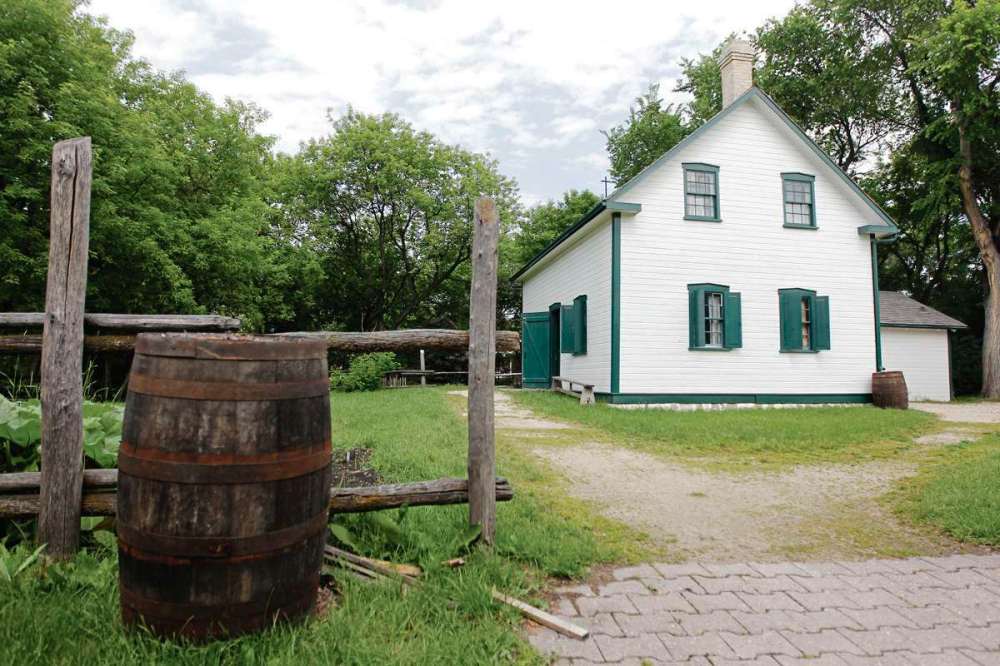
Riel House in south Winnipeg was the home of Métis leader Louis Riel. It has been restored to 1886 authenticity, giving a glimpse into daily life at the end of the 19th century — a turbulent time that eventually lead to the creation of the province of Manitoba. The house remained in the Riel family until the late 1960s, when it was acquired by the Winnipeg Historical Society, and designated a National Historic site in 1976.
One of the best kept archeological secrets in our region is the Linear Mounds near Melita, which were formally recognized as a national historic site in 1973. At first glance, they look like random bumps oddly protruding from the flatlands. But take time to learn about them, and you’ll discover they are burial mounds that date back to 900 to 1400 AD, and part of a network of complex constructions stretching from southern Manitoba and Saskatchewan, to Montana and North and South Dakota.
RoseAnna Schick is an avid traveller who seeks inspiration wherever she goes. Email her at rascreative@yahoo.ca
RoseAnna Schick
Travelations
RoseAnna Schick is an avid traveller and music lover who seeks inspiration wherever she goes. Email her at rasinspired@gmail.com
Our newsroom depends on a growing audience of readers to power our journalism. If you are not a paid reader, please consider becoming a subscriber.
Our newsroom depends on its audience of readers to power our journalism. Thank you for your support.
RoseAnna Schick
Travelations
RoseAnna Schick is an avid traveller and music lover who seeks inspiration wherever she goes. Email her at rasinspired@gmail.com
Our newsroom depends on a growing audience of readers to power our journalism. If you are not a paid reader, please consider becoming a subscriber.
Our newsroom depends on its audience of readers to power our journalism. Thank you for your support.
Advertisement Advertise With Us
Advertisement Advertise With Us