


The hidden glory of Spirit Sands

Advertisement
Hey there, time traveller!
This article was published 14/06/2021 (1862 days ago), so information in it may no longer be current.
One of the most intriguing places in our province has to be Spirit Sands in Spruce Woods Provincial Park – often referred to as “Manitoba’s desert”.
As glacial Lake Agassiz retreated from this region more than 15,000 years ago, it left behind an expansive abundance of sandy deposits. Today, approximately four square kilometres of sands remain, forming shifting dunes, nestled in a diverse landscape of mixed-grass prairie, river-bottom forests, and spruce parklands.
The sands have an aquifer quality, meaning that huge amounts of groundwater naturally store here. Although the area looks and feels very dry, moisture exists at shallow depths just below the surface. One of the most interesting sites is the Devil’s Punch Bowl, a blue-green oasis created by a spring-fed pond. Wooden walkways span it, allowing you to get close to the surface and feel the coolness that radiates from the waters.
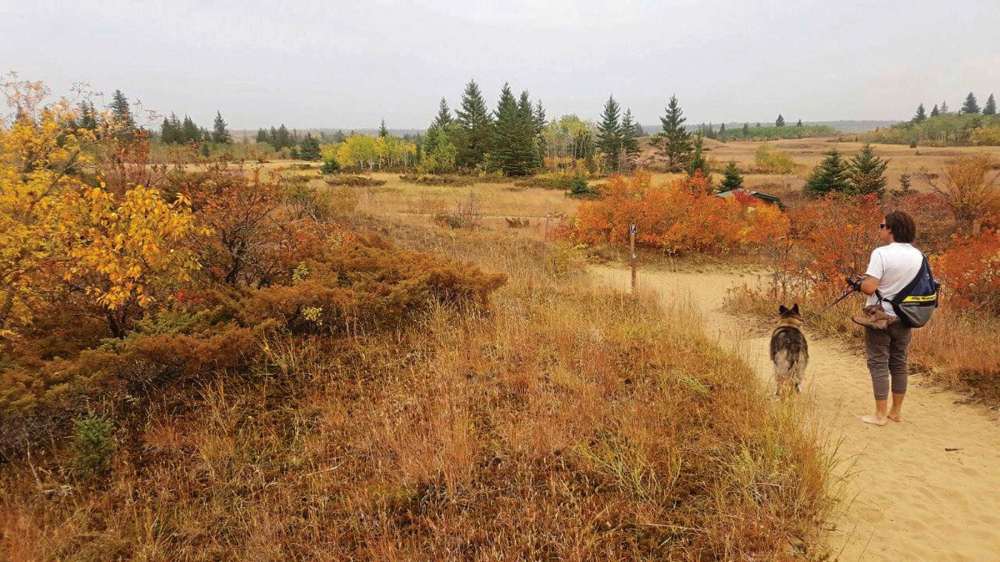
Because the region gets nearly double the rain as an actual desert, the unique ecosystem supports a rich variety of flora and fauna. There are pincushion and spinystar cacti, hognose snakes, prairie skinks (Manitoba’s only lizard), plains spadefoot toads, and several species of small endangered moths. Larger animals, such as elk and deer, and sometimes even wolves and bears, can also be seen in Spruce Woods.
A popular place for hiking, the established trail system offers several loops of differing lengths to suit different abilities. It’s a good idea to take a photo of the self-guiding map in case you happen to miss a turn along the way or your chosen route turns out to be more arduous than anticipated.
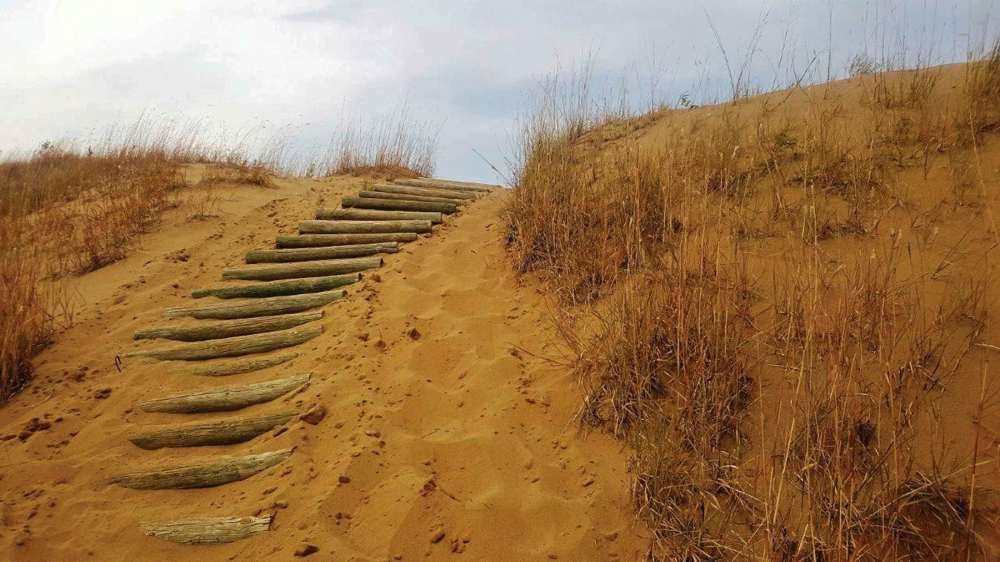
Keep in mind you will be trekking on mostly sandy surfaces, which takes substantially more effort than strolling on solid ground. The sandy hills – and there are lots of them – can also be challenging to ascend, even with the helpful ‘dune ladders’ in place.
An interpretive centre at the trailhead gives an overview of the area’s cultural, natural, and historical features. It’s worth stopping here before heading out on the trails, to learn about the evolution of this fascinating area. Archeological explorations have discovered artifacts such as spear tips dating back 11,000 years, proving evidence of the presence of early Indigenous Peoples. In 1895, a forest reserve was created to conserve the land, with permits issued in the early 1900s to allow for grazing by horses and cows.
Canada’s national defence department leased the western portion of the forest reserve in 1915 for tank and artillery combat training at what was known as Camp Hughes, before Camp Shilo emerged in the 1930s. The eastern portion was eventually designated a provincial park, which officially opened in 1970. In 1975, part of the military lease was returned to the provincial government and developed into the Spirit Sands we know today.
I hiked the nearly 10-kilometre trail last fall with my nephew Chad and his dog Brody (on leash) and we all enjoyed the adventure of discovering this place for the first time. It was a hot day, and we walked much of the trails barefoot to feel the coolness of the silky sands beneath our feet. We also packed a picnic lunch and took a nice break to refuel our bodies along the way – and I certainly needed it. Hiking through all that sand was tiring, and 10 kilometres was plenty enough.
But when we realized we had missed the trail that led to Devil’s Punch Bowl, of course we had to go back. So we ended up hiking a total of 14 kilometres on that beautiful Sunday afternoon.
I’ll admit to being exhausted by the end of it. I will also admit to being pretty happy being able to just sit on my butt and do nothing for the next two hours as we drove back to Winnipeg, with good music, and great company.
A privilege worth every step.
RoseAnna Schick
Travelations
RoseAnna Schick is an avid traveller and music lover who seeks inspiration wherever she goes. Email her at rasinspired@gmail.com
Our newsroom depends on a growing audience of readers to power our journalism. If you are not a paid reader, please consider becoming a subscriber.
Our newsroom depends on its audience of readers to power our journalism. Thank you for your support.
RoseAnna Schick
Travelations
RoseAnna Schick is an avid traveller and music lover who seeks inspiration wherever she goes. Email her at rasinspired@gmail.com
Our newsroom depends on a growing audience of readers to power our journalism. If you are not a paid reader, please consider becoming a subscriber.
Our newsroom depends on its audience of readers to power our journalism. Thank you for your support.
Advertisement Advertise With Us
Advertisement Advertise With Us