


Bringing Sudbury Saturday Night to life

Advertisement
Hey there, time traveller!
This article was published 26/07/2023 (1090 days ago), so information in it may no longer be current.
As a kid growing up on the prairies with access to a large record collection, my early knowledge of geography often came from music. From the stories told in songs. Because of song lyrics, I knew where Moose Jaw, Moosomin and Saskatoon all were. I knew they grow potatoes on Prince Edward Island. That you could paddle all the way from Mattawa to Ottawa. And that Sudbury was the place to be on Saturday night.
As an adult, finding myself in the town that Canadian icon Stompin’ Tom Connors sang about made me wonder what exactly it was about Sudbury that made him want to memorialize it in song. Was it because he already knew something about it?
After all, the city was already famous by the Sudbury Basin, a unique geological impression formed by one of the largest and oldest impact craters on the planet. As an ongoing source of mineral extraction, the region is home to nine mines, two smelters and one nickel refinery — all of which means Sudbury has the honestly-earned nickname of ‘hard rock’ capital of the world.
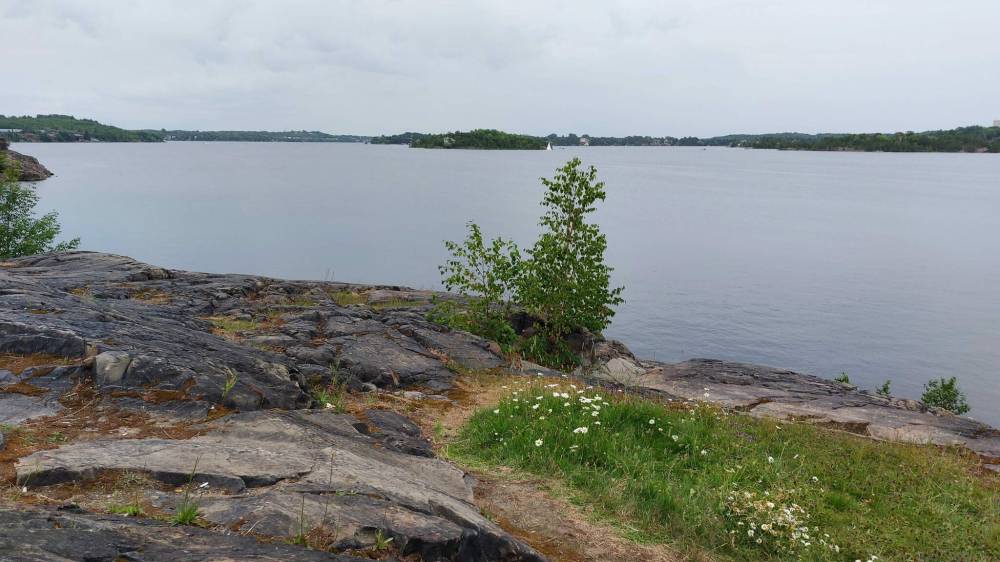
Photo by RoseAnna Schick
Ramsey Lake, next to Sudbury’s downtown, is one of 330 lakes in the Greater Sudbury area.
The city is also smack dab in the middle of lake country. With an official count of 330, Greater Sudbury boasts more lakes than any other municipality in Canada. Ramsey Lake borders much of downtown and is both a scenic and recreational haven for swimming, sailing, paddling, and boating. Bell Park, named after local lumber baron William Joseph Bell, features a boardwalk, gazebos, sitting spaces, and an amphitheatre for live shows such as those put on by the Northern Lights Festival Boréal annual celebration of music.
Sudbury more than lives up to the phrase ‘go big or go home’. In more ways than one. The Big Nickel, one of the Ontario’s most recognized landmarks, is nine metres tall, weighs 13,000 kilograms, and is said to be the largest coin in the world. Officially finished in 1964, it was created to be an exact replica of the 1951 nickel – a design that symbolized both economic wealth generated through nickel production, and the 200th anniversary of nickel being named an element.
Another notable distinction to Sudbury’s skyline is the 381-meter Inco Superstack. Equivalent to the height of the Empire State Building, Canada’s tallest chimney is this second tallest anywhere, after one in Kazakhstan, as well as the second tallest free-standing Canadian structure after Toronto’s CN Tower. It was built in 1972, and the idea back then was to spread emissions over a broader area to more quickly dissolve concentrations. It was permanently closed in 2020, but remains standing while awaiting demolition. For now, you can still see the long-time landmark looming familiar on the horizon from miles around.
The largest mural in Canada decorates the defunct walls of one of Sudbury’s most recognized community sites. The old St. Joseph’s Hospital – birthplace to most regional residents – had stood abandoned in Sudbury’s central waterfront for nearly a decade. In 2019, Up Here festival initiated a large-scale artistic project with west coast graffiti artist Kelly Graval (a.k.a. Risk). He transformed the six-storey concrete canvas into nearly 6,900 square metres of art, using bright colour-washed palettes in progressive layers, with abstract elements, and occasional delicate butterflies.
With so many big sites, it’s no surprise that Sudbury leaves big impressions on people.
For me, being there was like another little piece of musical geography come to life. Taking me back to those days as a kid growing up on the prairies with access to a large record collection. Learning about Canada through the stories told in song — one Sudbury Saturday Night at a time.
RoseAnna Schick
Travelations
RoseAnna Schick is an avid traveller and music lover who seeks inspiration wherever she goes. Email her at rasinspired@gmail.com
Our newsroom depends on a growing audience of readers to power our journalism. If you are not a paid reader, please consider becoming a subscriber.
Our newsroom depends on its audience of readers to power our journalism. Thank you for your support.
RoseAnna Schick
Travelations
RoseAnna Schick is an avid traveller and music lover who seeks inspiration wherever she goes. Email her at rasinspired@gmail.com
Our newsroom depends on a growing audience of readers to power our journalism. If you are not a paid reader, please consider becoming a subscriber.
Our newsroom depends on its audience of readers to power our journalism. Thank you for your support.
Advertisement Advertise With Us
Advertisement Advertise With Us