


‘Winnipeg’s Sweetheart’ captivated audiences

Advertisement
Hey there, time traveller!
This article was published 03/12/2025 (327 days ago), so information in it may no longer be current.
Edna Mae Durbin was born in Winnipeg on Dec. 4, 1921, to James and Ada Durbin, who came to Winnipeg from England in 1912. They settled on Gallagher Avenue in the city’s Weston neighbourhood.
Like most of his neighbours in Weston, then nicknamed “CPR Town,” James worked at the nearby CPR Weston Shops. His poor health couldn’t handle Winnipeg’s winters, so in 1923, before Edna Mae’s second birthday, the family relocated to Los Angeles.
Edna Mae loved to sing with her rich, mature, soprano voice. By the age of 12, she was a favourite on the L.A. recital scene and appeared semi-regularly on Eddie Cantor’s syndicated radio show heard on stations throughout North America, including Winnipeg. It wasn’t long before Hollywood came calling.

Supplied photo
Deanna Durbin, pictured in this undated publicity still.
In 1936, Edna Mae signed a contract with MGM Studios, alongside another young prodigy named Frances Gumm. The studio renamed them Deanna Durbin and Judy Garland. There was room for only one young female star on the payroll, and MGM eventually went with Garland.
Durbin was quickly snapped up by Universal Pictures and cast in a film called Three Smart Girls (1936). This low budget “B movie” became a smash hit and earned nearly $1 million worldwide for the studio, which had been teetering on bankruptcy.
Durbin was then cast in the feature film On Hundred Men and a Girl (1937). It proved that the B-movie’s success wasn’t an accident. The moviegoing public loved Deanna Durbin.
One Hundred Men opened at the Capitol Theatre in October 1937 and was the first chance for Winnipeggers to see Durbin on the big screen. Despite her brief time here, she was considered a local phenomenon and dubbed “Winnipeg’s Sweetheart”.
Durbin was riding high by her late teens. After a string of hit movies, popular records, and merchandising deals for everything from dolls to clothing, she was one of the highest-paid stars in Hollywood and known around the world. At the 11th Academy Awards ceremony in 1939, she and Mickey Rooney were awarded juvenile Oscars for their contribution to the industry.
Durbin stayed connected to Winnipeg through her grandmother and uncle, who lived here, and she visited at least once during the 1930s. Her studio biography referred to her as a St. Vital girl, where her relatives lived, rather than mention her CPR Town roots.
In the 1940s, Durbin suffered the fate of many child stars. She was growing up, but many fans and her studio wanted her to remain the cheery, singing adolescent. One exception was Christmas Holiday (1944) with Gene Kelly, a rare heavily dramatic role in a film noir.
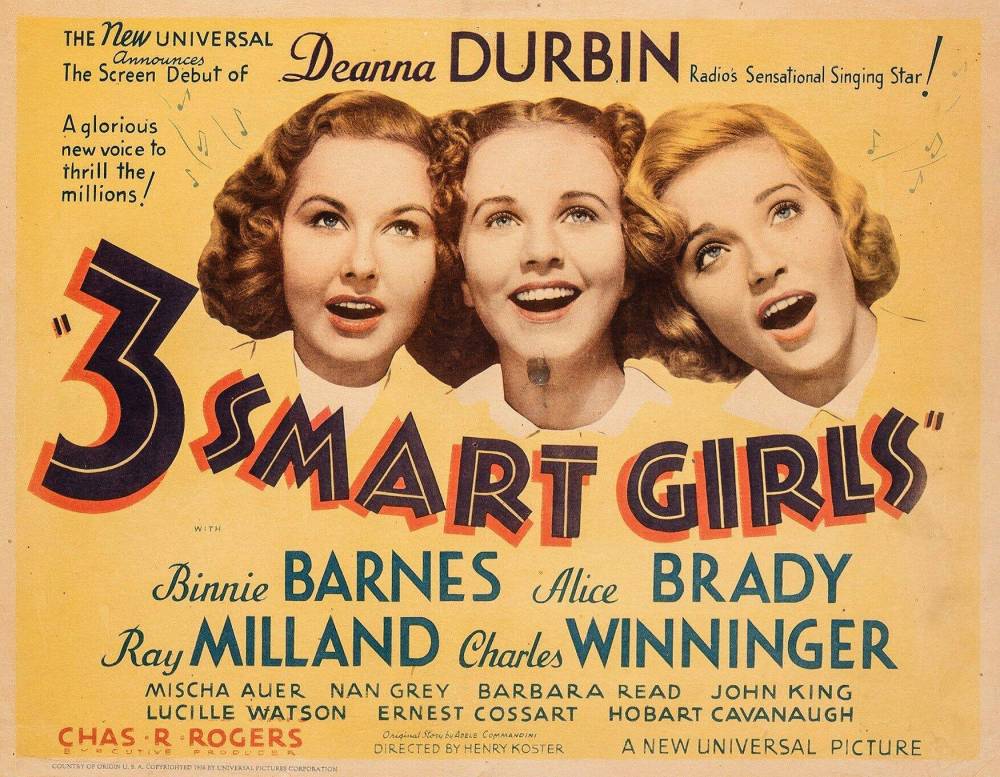
Supplied image
A lobby card for 3 Smart Girls, the movie that launched Deanna Durbin’s career.
The strain between Durbin and Universal led to a series of walkouts and suspensions. When her contract ended in 1949, there was no talk of renewal.
Durbin was married three times — first to assistant director Vaughn Paul, then producer Felix Jackson, with whom she had a daughter. She married for a third time in 1950 to French producer Charles Henri David, had a son, and retired to France at the age of 28 to raise her family.
Winnipeg’s Sweetheart never appeared on screen again and died on April 20, 2013, at Neauphle-le-Château, France.
Christian Cassidy
Christian Cassidy is a Manitoba Historical Society council member and a proud resident of the West End. He has been writing about Winnipeg history for more than a decade on his blog, West End Dumplings.
Our newsroom depends on a growing audience of readers to power our journalism. If you are not a paid reader, please consider becoming a subscriber.
Our newsroom depends on its audience of readers to power our journalism. Thank you for your support.
Christian Cassidy
Christian Cassidy is a Manitoba Historical Society council member and a proud resident of the West End. He has been writing about Winnipeg history for more than a decade on his blog, West End Dumplings.
Our newsroom depends on a growing audience of readers to power our journalism. If you are not a paid reader, please consider becoming a subscriber.
Our newsroom depends on its audience of readers to power our journalism. Thank you for your support.
Advertisement Advertise With Us
Advertisement Advertise With Us