



Poplars popular with Seine River beavers

Advertisement
Hey there, time traveller!
This article was published 18/04/2016 (3553 days ago), so information in it may no longer be current.
The beaver is one of the few species on Earth that modifies the environment to suit its needs. Unfortunately, the beaver’s needs sometimes bring them into conflict with people — especially in cities.
Beavers cut down trees for one reason — survival. They use large branches to build dams across streams. This creates a beaver pond, where the water becomes deep enough for the beaver to survive the winter. They use some branches and mud to build a lodge. The lodge has a central chamber where they are safe from predators.
Beavers also eat the trees’ inner bark. They stockpile branches in a food cache at the bottom of the pond. While beaver eat many aquatic plants during summer, their main winter food is the inner bark of trees. Their favourites are aspen, poplar, cottonwood, willow, birch and alder. Beaver do not hibernate, so the pond must be deep enough for them to swim from the lodge to their food cache beneath the ice.
In the wilderness, beaver can cut trees without much interference from people. In an urban environment, beavers sometimes cut down a beloved tree on private property or in parks along the river.
This makes people angry. We are not very tolerant of our fellow engineers. When the trees begin to fall, the phones begin to ring.
“A beaver just cut down the new tree I planted. It cost $140. Can’t something be done about this?”
Wildlife managers used to relocate beavers but soon realized this just created problems somewhere else. It was also difficult for the relocated beaver to complete its vital work before winter.
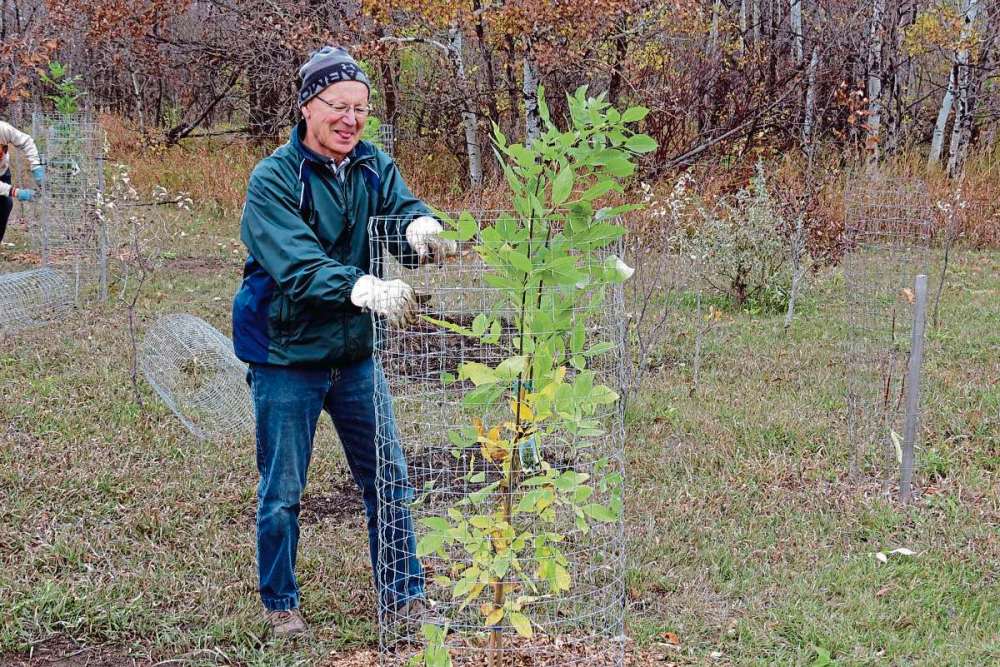
My advice to anyone living near the river is to wrap the bases of the trees that you treasure. A few dollars of mesh can protect your $140 tree. Hardware cloth (with a square mesh) is tough enough to deter beavers.
Don’t wrap every tree. Wrap some of the larger trees and newly planted trees of all sizes. Leave the rest for the beavers. After all, the beaver is a Canadian icon.
This year, let’s celebrate the beavers that share our urban rivers. Take pictures of the amazing river engineer that we commemorate on the “tail” of our nickel. Post them on the Save Our Seine Facebook page. Volunteer to wrap some trees or join the SOS team as a 2016 River Keeper (job posting on the SOS Web site).
Michele Kading is a community correspondent for St. Vital and the executive director of Save Our Seine, www.saveourseine.com
Michele Kading
St. Vital community correspondent
Michele Kading is a community correspondent for St. Vital. She is also the executive director of the Association of Manitoba Museums.
Our newsroom depends on a growing audience of readers to power our journalism. If you are not a paid reader, please consider becoming a subscriber.
Our newsroom depends on its audience of readers to power our journalism. Thank you for your support.
Michele Kading
St. Vital community correspondent
Michele Kading is a community correspondent for St. Vital. She is also the executive director of the Association of Manitoba Museums.
Our newsroom depends on a growing audience of readers to power our journalism. If you are not a paid reader, please consider becoming a subscriber.
Our newsroom depends on its audience of readers to power our journalism. Thank you for your support.
Advertisement Advertise With Us