



Perimeter interchange by the numbers
Advertisement
Hey there, time traveller!
This article was published 24/11/2017 (3058 days ago), so information in it may no longer be current.
Flatiron Constructors Canada is the company responsible for the PTH59 – PTH 101 Interchange construction project, a state-of-the-art undertaking that began in the summer of 2015 and is scheduled to be completed in the fall of 2018.
This interchange has been designed to make travel faster and safer for everyone. Part of this project includes increasing Highway 202, from Birds Hill to Highway 59, from two lanes to four lanes. The specifications call for asphalt for this section, I suppose because the road has a lower traffic volume.
From the junction of 202 and 59 south to the interchange, Highway 59 has been increased to six lanes from the previous four. This is being done with concrete as the traffic volume is expected to be heavy.
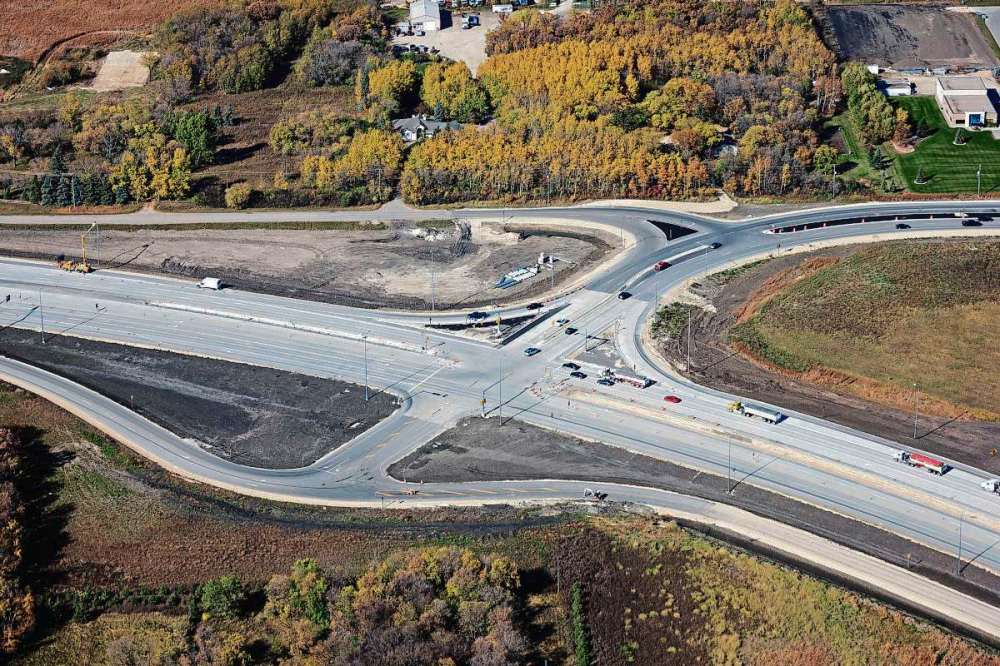
Since I live just south of the interchange and I travelled to Birds Hill several times a week over the summer, I saw the progress made day after day. It was amazing to watch that amount of earth being moved around and how much work was completed in just a week’s time.
The equipment being used was also amazing. There were several bulldozers, dump trucks, graders, excavators, concrete trucks, road lorries and many, many more types of vehicles. I was interested in finding out some of the numbers involved and so contacted Kris Maranchuk, project manager for Manitoba Infrastructure. He gave me some numbers that spell out just how huge the project is.
The amount of earth moved to date is over 1.6 million cubic metres. That’s enough earth to cover 4,000 CFL football fields or, to further put this into perspective, over 107,000 truckloads.
Nelson River Construction is the sub-contractor looking after all of the roadwork and paving and so far it has used 250,000 metric tonnes of gravel for road base. If you lined up all of the re-bar used, in a straight line, it would measure over 625 kilometres., which is greater than the distance from Winnipeg to Regina. The new roads built for Highways 202 and 59 have used over five kilometres of concrete culvert piping and enough concrete to cover 28 CFL fields, or 230,000 square metres.
The arrival of November weather has slowed things down until spring arrives. There is still some work being done to the bridges as the contractors use ‘FastCover,’ a fabric-covered steel structure that offers protection from the elements.
This past summer allowed Flatiron to work 24/7 most weeks, so much was accomplished. Providing we have similar weather conditions next summer, the target date of fall 2018 should be attainable.
Rick Sparling is a community correspondent for North Kildonan. Email him at ricksparling@shaw.ca