


McPhillips Street named for family of surveyors

Advertisement
Hey there, time traveller!
This article was published 01/02/2023 (1344 days ago), so information in it may no longer be current.
McPhillips Street is one of Winnipeg’s busiest traffic corridors, but when it was named in the 1870s it was a surveyor’s line that marked Winnipeg’s city limits. It commemorates the McPhillips family of surveyors and mapmakers.
George McPhillips Sr. was an Irish-born Dominion Land Surveyor (DLS) and civil engineer who came to Manitoba from Ontario around 1870. According to the 1892 booklet A short history of the surveys performed under the Dominion lands system, his first survey was of the St. Francois Xavier, Baie St. Paul and Headingley districts in 1871.
Two of McPhillips’ sons, Francis and teenager Robert, travelled west to assist him. Another son, George Jr., stayed in Ontario where he was a teacher before deciding to join the others in 1872. He received his DLS designation in 1875.
Supplied photo
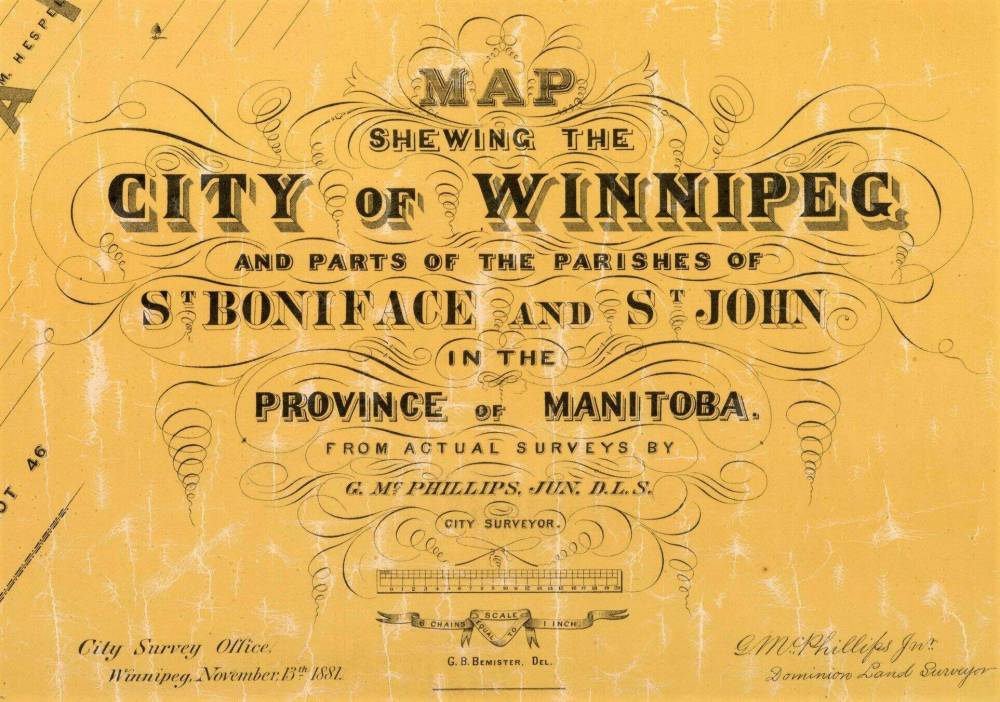
The nameplate of the 1881 McPhillips’ Map Shewing the City of Winnipeg, and Parts of the Parishes of St. Boniface and St. John in the Province of Manitoba.
With McPhillips Sr. past retirement age, the three sons opened McPhillips Bros., Dominion Land Surveyors, Civil Engineers, and Draughtsmen on Main Street in August 1875. It appears that George Jr., who had both his DLS and a civil engineering degree, led the company, as Robert didn’t get his land surveyor’s degree until 1880 and Francis was initially just a civil engineer.
The brothers were kept busy creating plans and maps of districts around southern Manitoba. This included a lucrative 1876 contract from the fledgling City of Winnipeg to draw up a survey of its lands.
The company produced the first McPhillips’ Map Shewing the City of Winnipeg, and Parts of the Parishes of St. Boniface and St. John in the Province of Manitoba in 1881. It was a commercial success and periodically updated and sold until around 1913.
George McPhillips was appointed city surveyor for Winnipeg in 1882 but left the following year after being contracted to create a map of Windsor, Ont. In 1906, he became chief surveyor for the Canadian Pacific Railway and the family firm continued under Francis and Robert.
Both George and Francis died in their mid-sixties in 1913. Robert continued working until his death on his 84th birthday, in 1939.
As for the McPhillips Street name, different sources provide a variety of years and speculation about which family member it was named for. Winnipeg Free Press columnist Harry Shave appears to have set the record straight in a 1965 interview with one of George McPhillips’ sons, also named George.
McPhillips told Shave there was a line known as the “two-mile limit” that ran from Upper Fort Garry to north of Selkirk, Manitoba that dated back to the time river lots were distributed to the Selkirk Settlers. Landowners could farm and construct buildings on the first two miles of their property, but anything beyond that had to remain open pasture.
When George McPhillips was doing the 1876 survey for the City of Winnipeg, a road allowance was granted for the two-mile line, which was the western city limits north of Notre Dame Avenue. He named it McPhillips Street after the family. In that same survey, Duncan Sinclair, who assisted McPhillips, named Sinclair Street, and Flora Avenue was named for George McPhillips’s wife.
Christian Cassidy
Christian Cassidy is a Manitoba Historical Society council member and a proud resident of the West End. He has been writing about Winnipeg history for more than a decade on his blog, West End Dumplings.
Our newsroom depends on a growing audience of readers to power our journalism. If you are not a paid reader, please consider becoming a subscriber.
Our newsroom depends on its audience of readers to power our journalism. Thank you for your support.
Christian Cassidy
Christian Cassidy is a Manitoba Historical Society council member and a proud resident of the West End. He has been writing about Winnipeg history for more than a decade on his blog, West End Dumplings.
Our newsroom depends on a growing audience of readers to power our journalism. If you are not a paid reader, please consider becoming a subscriber.
Our newsroom depends on its audience of readers to power our journalism. Thank you for your support.
Advertisement Advertise With Us