


From The Mall to Memorial Boulevard

Advertisement
Hey there, time traveller!
This article was published 01/03/2023 (1187 days ago), so information in it may no longer be current.
A blockbuster land deal announced in 1925 spurred Winnipeg’s largest development project since the start of the First World War and created a new street called Memorial Boulevard.
“The Mall project”, as it was known in the early 1920s, was primarily a traffic corridor proposal.
The city wanted to extend Osborne Street, which crossed the Assiniboine River and ended at Broadway, through to Portage Avenue to create a “crosstown highway.” Opening this land would also allow St. Mary and York avenues to pass beyond Vaughan Street into the west end of the city. The crowning glory, in terms of street creation, would be a 132-foot-wide “capitol approach” called The Mall, which would extend from Portage Avenue south to the Legislature building.
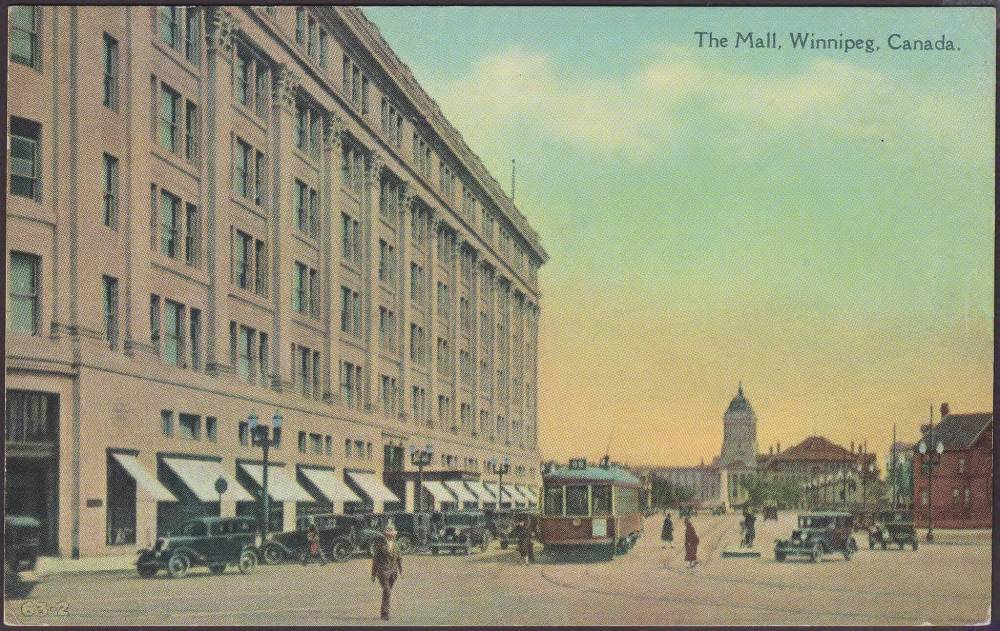
Rob McInnes postcard collection
Memorial Boulevard as it appeared in the late 1920s, after the unveiling of the cenotaph in 1928 but before the construction of the Civic Auditorium in 1931.
What helped push this project to the top of the city’s agenda was a promise by the Hudson’s Bay Company, which owned land in the area, that if it could amass a large enough lot it would build a modern department store at the intersection of The Mall and Portage Avenue.
A development bylaw was passed in 1921 that created a city council subcommittee tasked with completing a complex series of land purchases, donations and expropriations involving as many as a dozen landowners and then sorting out who would pay for what improvements.
The provincial government, for instance, would need to permit the new streets to cross some of its University of Manitoba land. Businessman Alexander Macdonald agreed to donate his large lot, providing that the city compensated him for a pickle factory that would have to be torn down. All Saints Church took time to warm to the idea of vacating its 1880s-era church and rebuilding further west.
The subcommittee quickly became bogged down in logistics and debates about project costs but active negotiations resumed in the spring of 1925 with city officials now desperate for their crosstown highway and the HBC growing impatient about breaking ground on a new store.
There was a new addition to the project after the city’s cenotaph committee short-listed The Mall as a possible location for the city’s main war memorial. Perhaps hoping that a rebranding might help the stalled project, a new bylaw was passed that changed any reference to The Mall to Memorial Boulevard.
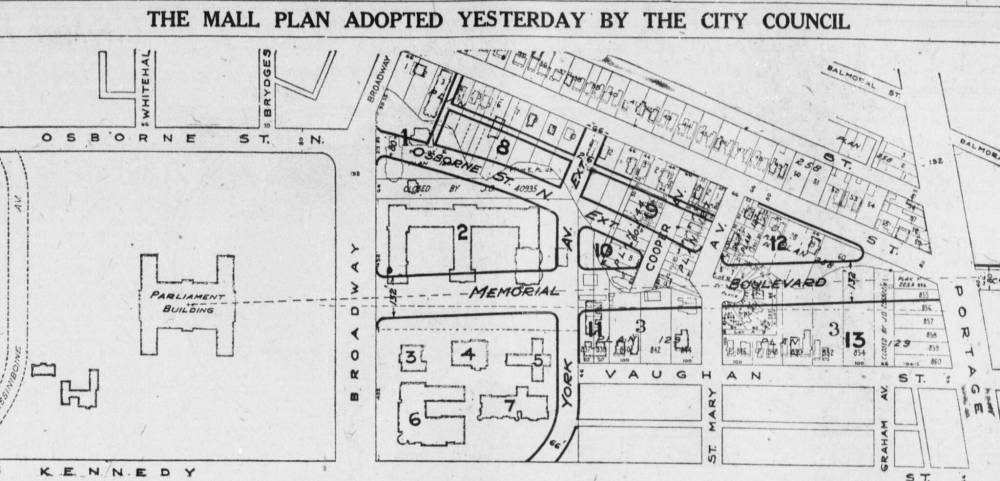
Supplied image
The original Memorial Boulevard plan, as published in the Winnipeg Tribune, Aug. 1, 1925.
On Sept. 8, 1925, a land agreement between the city, HBC, Alex Macdonald, and the provincial government was signed that gave each party to get what they needed for their respective projects, including a spot for a cenotaph. The agreement was passed onto private surveyor Leo Warde who was tasked with drawing up the complicated plan of streets and building lots.
It took decades for the Memorial Boulevard district to reach its full potential as a public space. The Civic Auditorium, now provincial archives building, was constructed in the 1930s. The Broadway campus of the University of Manitoba was demolished in the 1960s and the land became a provincial park. The Winnipeg Art Gallery, built on a triangle of land left over from the Macdonald property, opened in 1972.
Christian Cassidy
Christian Cassidy is a Manitoba Historical Society council member and a proud resident of the West End. He has been writing about Winnipeg history for more than a decade on his blog, West End Dumplings.
Our newsroom depends on a growing audience of readers to power our journalism. If you are not a paid reader, please consider becoming a subscriber.
Our newsroom depends on its audience of readers to power our journalism. Thank you for your support.
Christian Cassidy
Christian Cassidy is a Manitoba Historical Society council member and a proud resident of the West End. He has been writing about Winnipeg history for more than a decade on his blog, West End Dumplings.
Our newsroom depends on a growing audience of readers to power our journalism. If you are not a paid reader, please consider becoming a subscriber.
Our newsroom depends on its audience of readers to power our journalism. Thank you for your support.
Advertisement Advertise With Us
Advertisement Advertise With Us