



Protecting our night sky from light pollution

Advertisement
Hey there, time traveller!
This article was published 08/03/2023 (1110 days ago), so information in it may no longer be current.
My most memorable view of the northern lights (aurora borealis) was when I worked in the Whiteshell. I had just arrived at Nutimik long after midnight. As I got out of my car, the northern lights began to dance all around me. The stars had been replaced with a shimmering curtain of light that appeared to surround the entire planet. An invisible drawstring drew the curtain together overhead. There was one small circle of clear, dark sky with a single star shining brightly. The curtain undulated as if blowing in a gentle breeze. I wanted to wake everyone up to share the incredible sight but was afraid that it would not last. So, I lay on the warm hood of my car – marvelling at this once-in-a-lifetime sight.
Manitoba has some of the best displays of northern lights in the world. Unfortunately, Winnipeg produces so much light pollution that we rarely see them. Apps such as My Aurora Forecast can predict when the chance of seeing them is high but we must get away from the city lights.
I was shocked when I realized that Winnipeg’s lights can be seen from over 130 kilometres (80 miles) away. I had just left Nutimik in the middle of the night. I thought I could see the lights of Beausejour in the distance – but it was actually Winnipeg.
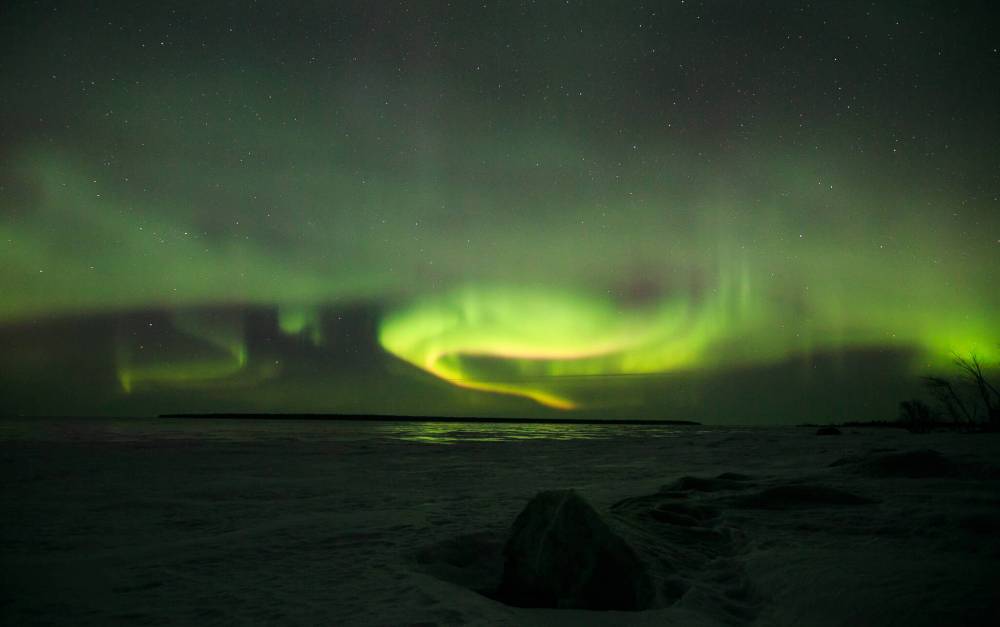
Winnipeg Free Press file photo
The aurora borealis, as pictured over Lake Winnipeg in 2015.
We use (and waste) a lot of artificial light – for streets, parking lots, construction sites, and nighttime recreation (hockey rinks). Much of the light shines uselessly up into the sky. It then bounces back to Earth. Artificial light is brighter than starlight so it hides the stars. It is estimated that 80 per cent of people on Earth now live under artificial skyglow. They never see the natural night sky, the Milky Way, or the northern lights.
This lack of darkness at night is unhealthy. It interferes with our circadian rhythms, hormone production, eating habits, body temperature, and sleep. It disrupts wildlife and it wastes money.
This is easy to fix. The International Dark-Sky Association (IDA) and the Illuminating Engineering Society provide five principles for responsible outdoor lighting (www.darksky.org). In brief, use warm artificial light where you need it, when you need it, in the amount needed, and no more. This will improve health, reduce greenhouse gases, and save money. And, in future, everyone may be able to enjoy the northern lights without leaving Winnipeg.
Michele Kading
St. Vital community correspondent
Michele Kading is a community correspondent for St. Vital. She is also the executive director of the Association of Manitoba Museums.
Our newsroom depends on a growing audience of readers to power our journalism. If you are not a paid reader, please consider becoming a subscriber.
Our newsroom depends on its audience of readers to power our journalism. Thank you for your support.
Michele Kading
St. Vital community correspondent
Michele Kading is a community correspondent for St. Vital. She is also the executive director of the Association of Manitoba Museums.
Our newsroom depends on a growing audience of readers to power our journalism. If you are not a paid reader, please consider becoming a subscriber.
Our newsroom depends on its audience of readers to power our journalism. Thank you for your support.
Advertisement Advertise With Us