


August a good month for astronomy

Advertisement
Hey there, time traveller!
This article was published 23/08/2023 (993 days ago), so information in it may no longer be current.
Ever since I installed a stargazing app on my cell phone last fall, I’ve been regularly getting updates on social media about astronomical events. If it’s a clear night and you’re up late, you should take a few minutes to see what’s happening above you this month.
I didn’t know this, but August is one of the best months to see meteor showers in the northern hemisphere; primarily due to the Perseid meteor shower, but also due to the Kappa Cygnid meteor shower. The very best time to see them was in the first part of the month, when the moon was less bright, but they both continue into early September.
Meteor showers occur when the earth passes through debris from a comet or asteroid. The meteoroids are usually small, from dust particle to boulder size, and the bright light and visible tail forms as they burn up in our atmosphere. There’s some ambiguity about the source of the Kappa Cygnid shower, but the Perseids are part of the tail of the Swift-Tuttle comet, a massive 25-kilometre-wide comet that circles the sun every 133 years. They’re named for the closest constellation during the peak of the shower, at the location where they seem to appear in the sky (the radiant point).
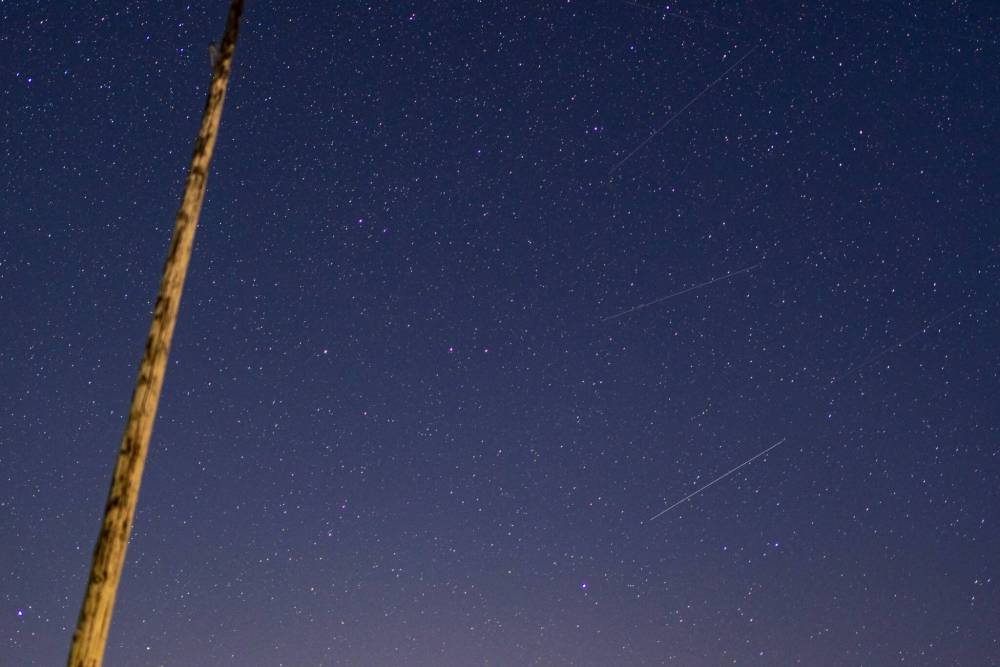
Dreamstime
Perseid meteor showers streak in the night sky in August.
The Perseid meteor shower is named after the Perseus constellation. In Greek mythology, Pereius was the son of Zeus, the slayer of Medusa and rider of the winged horse, Pegasus. Apparently, the radiant point is to the northeast and when the showers are at their peak in mid-August, you could see two to three meteors each minute between midnight and dawn.
As the Perseid shower begins to wane, the Kappa Cygnid meteor shower begins. Its name is derived from the Cygnus constellation, a name associated with swans in Greek mythology. Rather than two or three meteors a minute, you can see about two each hour this year, with the radiant point also being to the northeast.
Towards the end of August things apparently get interesting with Saturn. On Aug. 27 it will be particularly bright, as it will be “at opposition” with the sun, with each lined up either side of the earth. Even with binoculars you should be able to see the rings. On Aug. 30 it will be very close to the moon, which will also be very bright and almost full – with the nearest full supermoon of 2023 occurring at the end of the month. A supermoon is a full moon that comes close to the Earth in its elliptic orbit, making it slightly larger and brighter than typical. Keep those binoculars out to see the craters.
Nick Barnes
Whyte Ridge community correspondent
Nick Barnes is a community correspondent for Whyte Ridge.
Our newsroom depends on a growing audience of readers to power our journalism. If you are not a paid reader, please consider becoming a subscriber.
Our newsroom depends on its audience of readers to power our journalism. Thank you for your support.
Nick Barnes
Whyte Ridge community correspondent
Nick Barnes is a community correspondent for Whyte Ridge.
Our newsroom depends on a growing audience of readers to power our journalism. If you are not a paid reader, please consider becoming a subscriber.
Our newsroom depends on its audience of readers to power our journalism. Thank you for your support.
Advertisement Advertise With Us