


Japanese Canadians housed at Transcona plant

Advertisement
Hey there, time traveller!
This article was published 22/05/2024 (829 days ago), so information in it may no longer be current.
In my last article about the cordite munitions plant that was built in Transcona during the Second World War (“Cordite Trail a fascinating glimpse into the past,” Free Press Community Review East, April 10, 2024), I mentioned the destruction of the site, which began almost as soon as the war ended.
However, the plant’s staff office was left intact for a short while. It was used as a temporary internment camp for some of the Japanese Canadians forced out of British Columbia during the war.
Internment is the imprisonment of large groups of people, particularly during war times, without having been charged with any crime. On Dec. 7, 1941, Japan attacked Pearl Harbor in Hawaii and declared war on the U.S., an act which was the catalyst for our government’s unfounded reaction to the Japanese who resided in Canada, including citizens who were born here.
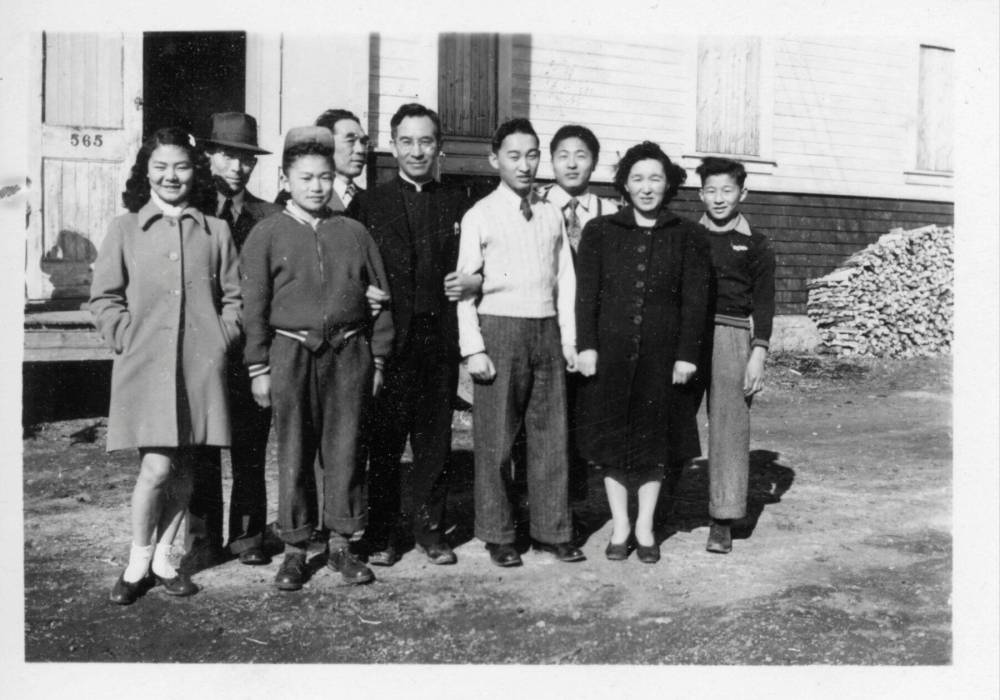
Supplied photo
(From left) Irene Sakamoto, aged 14, and her cousin Minoru Izumi, 12, are pictured in 1946 with Father Peter Katsuno, and a woman identified only as Mrs. Yamasaki, surrounded by her three sons. Sakamoto was the mother of Pamela Okano, adminstrator at the Japanese Cultural Association of Manitoba.
The British Columbia government declared that no Japanese person would be permitted to live within 100 miles of B.C.’s west coast. The RCMP enforced curfews, confiscated cars, radios, cameras and firearms. Homes and businesses were taken over by the government. People were forced to leave and live in camps such as at Hastings Park in Vancouver, where unsanitary stables and buildings were used as temporary holding places for up to 8,000 people. Others were dispersed across Canada, with some coming to Manitoba to work on sugar beet farms. Single men were sent to bush camps, such as in Jelico, Ont., and the government tracked where each person went.
In Manitoba, Japanese people were not allowed to live in the city of Winnipeg. They could live in the outlying areas, like Transcona, or on farms. Many landlords refused to rent to them.
In July 1946, 70 families from B.C. were moved to the former Transcona Munitions Plant staff office. On Sept. 14, 1946, the Winnipeg Tribune ran a story with the headline “Japs lose hostel.” It went on to read: “Demolition of the Cordite plant at Transcona has cut off water and other facilities from the large frame building where 180 Japanese have lived during the summer… The BC Japs will be placed on farms in Manitoba by the local branch of the department of labor dealing with Japanese workers.” Calling it a hostel rather than what it was, an internment building, made it sound like a holiday stay. “Japs”, a racist term, was allowed in the newspaper as a headline.
I recently visited the Japanese Cultural Association of Manitoba where I was greeted by a woman I recognized from my Transcona school days – Pamela Okano. Okano, administrator at the JCAM, graciously shared her family’s history.
Her mother, Irene Sakamoto, four sisters and their parents, from Vancouver, were interned in Greenwood, B.C. At the end of the war, they were placed on a farm in Manitoba near what is now Parkdale Road in St. Andrews. Her father’s family went to a sugar beet farm near Middle Church. Sugar beet farming was arduous work.
Connie Kanaye Matsuo (nee Sakamoto), Okano’s aunt, went to a sugar beet farm near Lockport. They lived in a shack where you could see the light through holes in the walls. Also living in the area were many veterans and family members of the Winnipeg Grenadiers, many of whom fought against the Japanese in the Battle of Hong Kong and had been imprisoned. Bitter from their experiences, some did not accept the Japanese residents, and the racism made life unbearable for Okano’s aunt, so the family had to move elsewhere.
I’ll bring you more on this topic in a few weeks.
Suzanne Hunter
Transcona community correspondent
Suzanne Hunter is a community correspondent for Transcona.
Our newsroom depends on a growing audience of readers to power our journalism. If you are not a paid reader, please consider becoming a subscriber.
Our newsroom depends on its audience of readers to power our journalism. Thank you for your support.
Suzanne Hunter
Transcona community correspondent
Suzanne Hunter is a community correspondent for Transcona.
Our newsroom depends on a growing audience of readers to power our journalism. If you are not a paid reader, please consider becoming a subscriber.
Our newsroom depends on its audience of readers to power our journalism. Thank you for your support.
Advertisement Advertise With Us
Advertisement Advertise With Us