


Homelessness… it’s everywhere

Advertisement
Hey there, time traveller!
This article was published 30/10/2024 (620 days ago), so information in it may no longer be current.
Two months ago, I met a homeless man who was living with his girlfriend under a porch in the back of a building. I gave him some trail mix every time I saw him. Not too long ago, I ran into the couple again and they were really happy because they found a new place – someone had given them a tent and they “found a great spot under a bridge.”
Nearly 35 years ago (March, 1987), I visited Jamaica for the first time and was shocked by the poverty. Families of four or five lived in sheds much like the ones in which we keep our snowblowers, lawnmowers and garden tools. Sure, there were the glitzy tourist areas and resorts and beautiful mansions owned by rich people but, for the most part, most of the locals lived in poverty. It was a major culture shock because,e in spite of not having much, most of the people seemed happy. That was a real life-changing experience for me – w hat do we really need to be happy? People down there made do with what they had.
When I got back to Canada, I bought books about Jamaica and read about the people’s history. Most Jamaicans were brought over on slave ships from Africa by British colonists, who took the land by force… well, most of the land anyway. Some of the original inhabitants, the Arawak, were quite resourceful and the British soldiers were no match for them, especially in the jungle. Eventually the British gave the Arawak own land and they were exempt from most of the British laws, except murder.
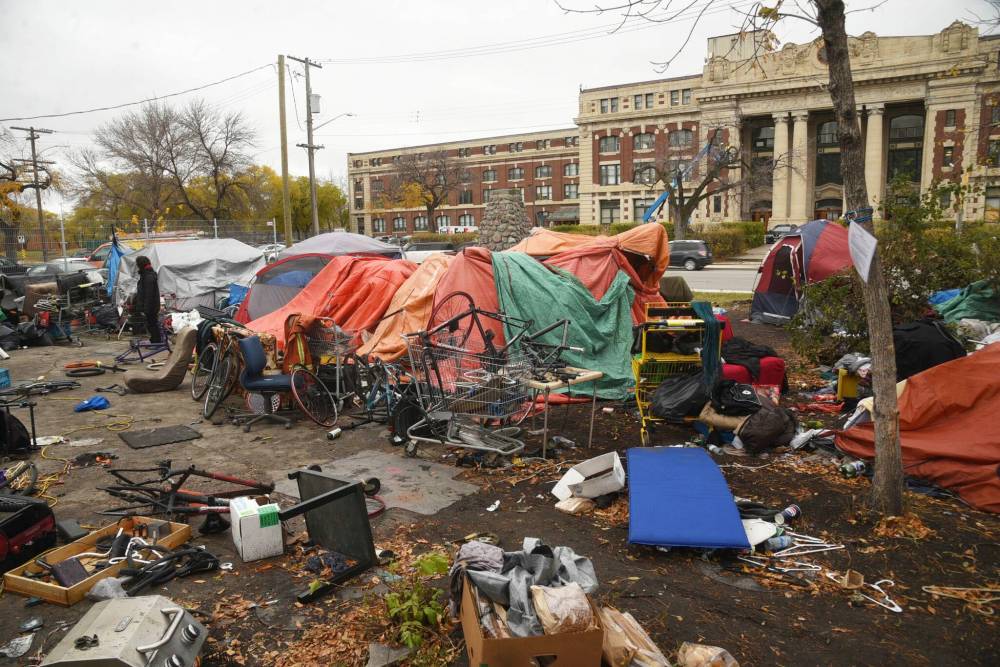
Photo by Doug Kretchmer
A homeless encampment in Winnipeg, near the intersection of Higgins Avenue and Maple Street.
I met some amazing people in Jamaica and visited again two years later. I rented a car with three friends and a Rastafarian local who was a good friend of one of our touring party. We drove around the whole island and visited Kingston, the capital, where we drove right into the ghetto, which was basically a shanty town deep down a pit. Thank goodness we were with our Rasta friend, because, based on the dirty looks we received, I don’t think we would have made it out of there. It wasn’t exactly a tourist area and these people weren’t exactly a tourist attraction, just regular people struggling to survive… so how dare we.
About 10 years later, while visiting my sister in Toronto, I cycled around Toronto with my brother-in-law down by the Cherry Street beaches and came across Canada’s version of a shanty town. It was a huge area full of thousands of tents with homeless people living in them. The real ironic thing was that the Toronto Yacht club wasn’t far away.
When I lived in Vancouver in the ’90s, I also saw lots of homeless people living in the streets, many of whom openly used drugs as a way of coping.
In the last decade, it seems as if most cities in North America have their own shanty towns, tent cities and homeless encampments. I have spoken with many residents of such places here in Winnipeg. A lot of them were fine upstanding, hard-working people until some unfortunate circumstances befell them such accidents, trauma or mental health issues. With rising inflation and long waiting periods for mental-health help, many people fall through the cracks and feel let down by the system.
It’s said that many people are one or two pay cheques away from being homeless or down and out. So what is the solution?
I’d say, how about investing more in mental-health facilities, job training and feeding and housing the poor. We seem to spend lots of our tax dollars funding foreign wars and the military industrial complex – why not use more of that money to actually help people?
Doug Kretchmer
North End community correspondent
Doug Kretchmer is a freelance writer, artist and community correspondent for The Times. Email him at dk.fpcr.west@gmail.com
Our newsroom depends on a growing audience of readers to power our journalism. If you are not a paid reader, please consider becoming a subscriber.
Our newsroom depends on its audience of readers to power our journalism. Thank you for your support.
Doug Kretchmer
North End community correspondent
Doug Kretchmer is a freelance writer, artist and community correspondent for The Times. Email him at dk.fpcr.west@gmail.com
Our newsroom depends on a growing audience of readers to power our journalism. If you are not a paid reader, please consider becoming a subscriber.
Our newsroom depends on its audience of readers to power our journalism. Thank you for your support.
Advertisement Advertise With Us
Advertisement Advertise With Us