



The school drop-off

Advertisement
Hey there, time traveller!
This article was published 13/11/2024 (496 days ago), so information in it may no longer be current.
The school drop-off
Autumn is an exciting time for families as the school year begins, bringing fresh opportunities for learning and connection. It’s also when schools share important reminders about drop-off and pick-up zones, encouraging families to consider alternative ways for students to get to school. Many schools promote walking, biking, or scootering to reduce traffic congestion.
There are so many wonderful reasons why active commuting benefits our children and our community. It not only helps reduce greenhouse gas emissions but also boosts kids’ physical activity — a much-needed addition to their daily routines. Active transportation can also ease the time and financial demands on families. As a parent and a teacher, I’ve seen first-hand how excited kids are to walk and bike to school.
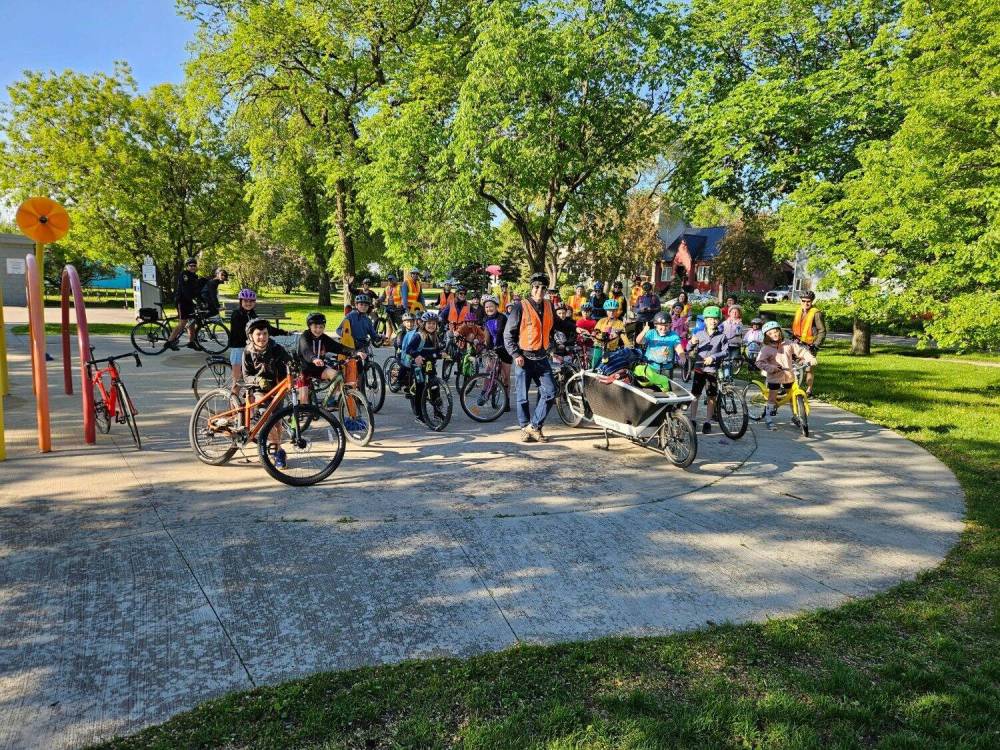
Supplied photo
As a teacher, Ward 1 Louis Riel School Division trustee Ian Walker led a daily ‘bike bus’ of students to and from École Provencher.
Of course, walking or biking to school won’t be possible for every family. Busy work schedules, childcare needs, or long distances can make driving necessary. However, there are many children who live close enough to walk, scoot, or bike but are still being driven. So how can we encourage more kids to actively commute?
I’ve seen some inspiring examples in our community. At École Provencher, I helped lead a bike bus in the spring of 2023 and 2024, with tremendous support from the school administration and Madame Simpson, Provencher’s teacher-librarian. Families gathered at a designated time and place, joining the bike bus for a safe and social ride to school. At École Henri-Bergeron, M. Levesque teaches my children how to ride through the Bike Education and Skills Training (BEST) program. The school also offers a scooter program, using scooters purchased through teacher-applied grants, where students learn to navigate safely on wheels. These initiatives make active commuting practical, fun, and engaging for kids.
The other key to increasing active commuting is ensuring our streets are safe for children. This means building separated bike lanes, providing safe crossing points on busy streets, and lowering speed limits in residential areas to 30 km/h, where children are walking or biking alongside vehicles.
The solutions are in reach if we want to reduce traffic congestion, improve our young people’s mental and physical well-being, and create a more sustainable community. By working together, we can make active commuting safe and accessible for everyone. Let’s continue taking steps to implement these changes and support our children’s health and happiness.
Our newsroom depends on a growing audience of readers to power our journalism. If you are not a paid reader, please consider becoming a subscriber.
Our newsroom depends on its audience of readers to power our journalism. Thank you for your support.
Our newsroom depends on a growing audience of readers to power our journalism. If you are not a paid reader, please consider becoming a subscriber.
Our newsroom depends on its audience of readers to power our journalism. Thank you for your support.
Advertisement Advertise With Us