


The legacy of Cuthbert Grant

Advertisement
Hey there, time traveller!
This article was published 25/06/2025 (455 days ago), so information in it may no longer be current.
I learned about Cuthbert Grant while researching an exhibit called The Story of Oak Hammock Marsh.
My first stop was the Manitoba Archives to look for maps, documents, and photos. The archivist donned white gloves before bringing out several very old maps. One map showed the original marsh, called St. Andrews Bog, stretching between Selkirk, Stony Mountain, and north Winnipeg. “Frog Plain” was written across its southern extent. I had just bought a house in that area and had noticed an abundance of shallow wetlands and frogs (grenouilles).
Another map showed the route travelled by Cuthbert Grant on June 19, 1816. Grant, at age 23, led a band of 60 Métis and First Nations people that had seized a shipment of pemmican headed for the Hudson Bay Company (HBC) at the Red River Colony. They planned to deliver the pemmican to its rival, the Northwest Company.
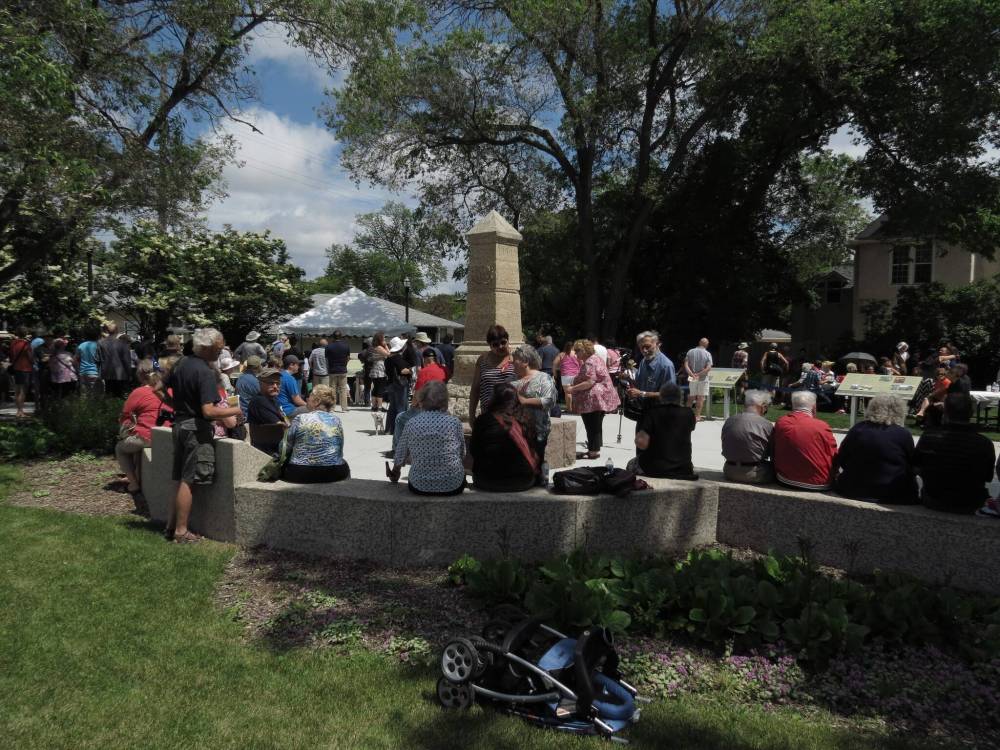
Supplied photo
In 2016, Parks Canada refurbished the Seven Oaks Historic Site with interpretive signs as part of reconciliation with the Métis. The Seven Oaks Memorial is the oldest historic marker in Western Canada.
They took the shipment off the Assiniboine River, loaded it into carts, and tried to sneak past Fort Douglas to get to their camp on Frog Plain (la Grenouillère). They were spotted. Governor Semple and about thirty HBC officers and colonists confronted them at Seven Oaks (Sept-Chênes). A brief battle left the governor and 20 of his men dead along with one Métis.
They camped on Frog Plain that night and Pierre Falcon wrote a song recounting their victory. La chanson de la Grenouillère became a Métis anthem that was sung across Canada.
Cuthbert Grant’s legacy did not end there. In 1829, he built the first water-powered mill in Western Canada on the banks of Sturgeon Creek. There are a number of ways you can learn more about Cuthbert Grant and Métis heritage.
Attend the 50th Anniversary of Grant’s Old Mill (2777 Portage Ave.) on Saturday, July 12 from 11 a.m. to 5 p.m. The mill is a working replica of Grant’s original mill that is operated by the St. James-Assiniboia Pioneer Association. Costumed interpreters from St. Boniface Museum will be there. Sign up by June 30 to volunteer.
Celebrate Manitoba Day on July 15th with a self-guided tour of:
● Seven Oaks National Historic Site (Main Street at Rupertsland);
● Frog Plain Historic Site (Frog Plain Way);
● Seven Oaks House Museum (50 Mac St.).
Visit the St. Boniface Historical Society (https://shsb.mb.ca/). It is the French counterpart to the Archives of Manitoba. Its mission is to acquire, preserve and promote the Francophone and Métis heritage of Western Canada, with a focus on Manitoba.
Michele Kading
St. Vital community correspondent
Michele Kading is a community correspondent for St. Vital. She is also the executive director of the Association of Manitoba Museums.
Our newsroom depends on a growing audience of readers to power our journalism. If you are not a paid reader, please consider becoming a subscriber.
Our newsroom depends on its audience of readers to power our journalism. Thank you for your support.
Michele Kading
St. Vital community correspondent
Michele Kading is a community correspondent for St. Vital. She is also the executive director of the Association of Manitoba Museums.
Our newsroom depends on a growing audience of readers to power our journalism. If you are not a paid reader, please consider becoming a subscriber.
Our newsroom depends on its audience of readers to power our journalism. Thank you for your support.
Advertisement Advertise With Us