


Celebrating Black women in Manitoba

Advertisement
Black women’s resilience was on display front and centre at Government House on March 17, where Manitoba Lt.-Gov. Anita Neville welcomed members and friends of the Congress of Black Women of Manitoba at a special reception to honor the organization’s 45th anniversary.
When the going gets tough, the tough get going, and so it was with the women who started the organization 45 years ago, when multiculturalism and human rights policies were not fully in place and systemic discrimination and blatant interpersonal discrimination were the order of the day.
The chosen symbol for CBW is the cactus, a plant symbolic of the strength and resilience of Black women. No matter how arid the soil, the cactus survives and bears fruit. Despite the ups and downs of the Congress of Black Women of Manitoba, it continues to bear fruit in every season.
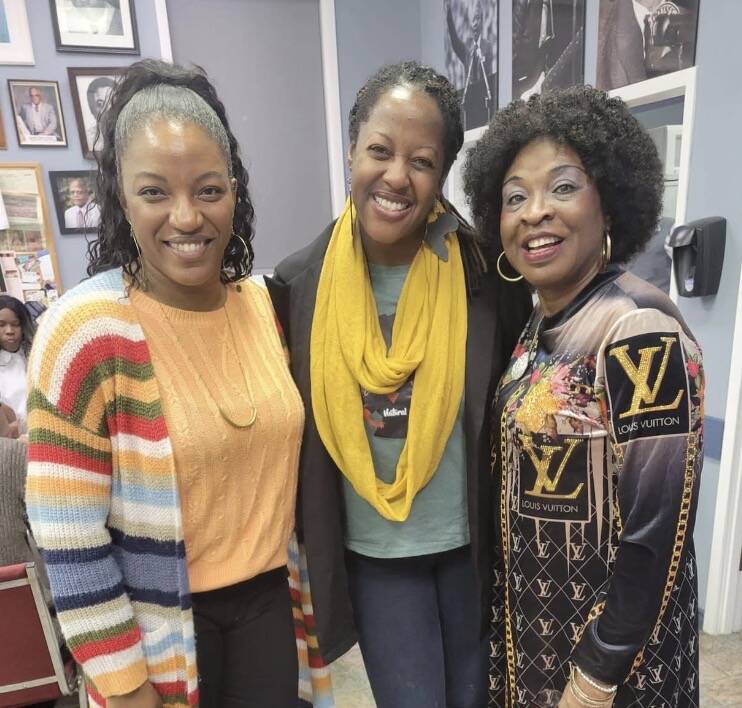
Supplied photo
(From left) Natalie Bell, current president of the Manitoba chapter of the Congress of Black Women, is pictured with past-presidents Rhonda Thompson and Kenny Daodu.
Founded in Ontario in 1973, the CBW, formerly known as the Canadian Negro Women’s Association, saw chapters formed in Montreal and Halifax in the years following. The Manitoba chapter began in 1981 with the goal of improving the lives of Black women and their families without regard for class or creed, while also bringing recognition to the role Black women play in our society.
Black women, many of whom were heads of households, faced racism and discrimination in public service, employment, housing, and access to decent jobs, which placed them in a highly marginalized position in society. I have heard stories from many who said they were told, to their faces, that “We do not rent to Blacks” or “we do not hire Blacks.” Such comments were made with impunity. Many newcomer Black families settled in the inner city and worked as domestic workers, cleaning, or in sewing factories where working conditions were stressful because of discrimination. Caribbean teachers filled school positions when Canada faced shortages and when teaching was not the highly paid job it is today. Many Black women who were teachers in the Caribbean became teachers here. Esme Stewart became the first Black principal in the Winnipeg School Division No 1.
The Manitoba Chapter of the CBW was founded by Dr. Beryle Mae Jones, Norma Walker, Cynthia Manswell, Joan Lloyd, Kathy Huggins, Dr. Claudia Wright, Dr. June James, Dr. Lois Stewart Archer, Antoinette Zloty, and others who provided leadership over the years. These women worked tirelessly to support Black Women as they navigated a new and sometimes hostile world.
According to anecdotal evidence, ordinary Black women initially saw the CBW as an organization for educated, upper-class women – teachers, nurses and others with advanced education. By organizing outreach initiatives, conferences, workshops, and partnering with the Immigrant Women’s Association of Manitoba, CBW successfully connected with grassroots women who experienced severe exploitation in their workplaces and suffered from domestic violence in the home.
IWAM and CBW joined forces to support immigrant women. While IWAM offered services, CBW advocated on behalf of domestic workers who faced exploitation and sexual abuse in the workplace. They undertook research and made recommendations to the government for change based on the findings. Annual national and provincial conferences brought attention to the challenges and issues affecting Black and immigrant women.
IWAM is no longer active, however, the counselling service it created with help from the Congress of Black Women – which offers culturally sensitive counselling and support to immigrant women and their families – continues.
At the reception in March, Lt.-Gov. Neville thanked the CBW for helping to make this province a better place through its advocacy.
The current CBW president, Natalie Bell, an independent businesswoman and popular influencer, expressed gratitude to the women upon whose shoulders she now stands and shared that the organization had just completed a strategic planning session that has mapped out the direction of the organization for the next few years. She also announced a new scholarship, the Cynthia Manswell Scholarship, for Black women in pursuit of higher education.
Beatrice Watson
Fort Rouge community correspondent
Beatrice Watson is a community correspondent for Fort Rouge.
Our newsroom depends on a growing audience of readers to power our journalism. If you are not a paid reader, please consider becoming a subscriber.
Our newsroom depends on its audience of readers to power our journalism. Thank you for your support.
Beatrice Watson
Fort Rouge community correspondent
Beatrice Watson is a community correspondent for Fort Rouge.
Our newsroom depends on a growing audience of readers to power our journalism. If you are not a paid reader, please consider becoming a subscriber.
Our newsroom depends on its audience of readers to power our journalism. Thank you for your support.
Advertisement Advertise With Us
Advertisement Advertise With Us