


Winnipeg’s 110-year history with daylight time

Advertisement
According to Manitoba premier Wab Kinew, the daylight saving time era in Manitoba could soon be over. For Winnipeg, it will be just another chapter in its 110-year history with the time change.
Winnipeg’s first taste of DST came in 1916. The city wanted to join many European countries and some North American cities in a wartime scheme that was intended to save power, increase productivity, and provide an extra hour of daylight in the evenings.
City council initially voted against a motion to introduce DST but, in subsequent weeks, a coalition of 42 of the city’s largest employers and the trades and labour council came out in favour of it.
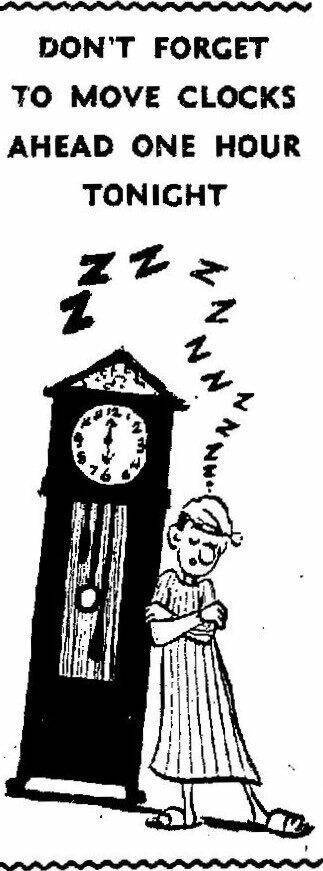
Supplied image
In 1966, three years after DST was mandated province-wide, the Free Press published reminders to readers the day before the time change came into effect.
The motion was revisited, and on March 20, 1916, council voted 8-7 in favour of Winnipeggers “springing” clocks ahead by one hour from the first Sunday in April to the last Sunday in September.
Daylight time created challenges as some senior government organizations had “standard time” written into the legislation that had created them. Railways and commodity markets also had to stick with standard time to be in line with counterparts across North America.
As rural areas and nearby urban centres such as Selkirk and Brandon did not adopt DST, the City of Winnipeg essentially had its own time zone.
Even supporters of the time change agreed that DST made little sense unless it was adopted at a regional or national level, and the bylaw was repealed in 1917.
The city returned to DST in 1918 and 1919 after the federal government imposed the National Daylight Saving Bill. After the First World War, some cities chose to continue with DST, but Winnipeg did not.
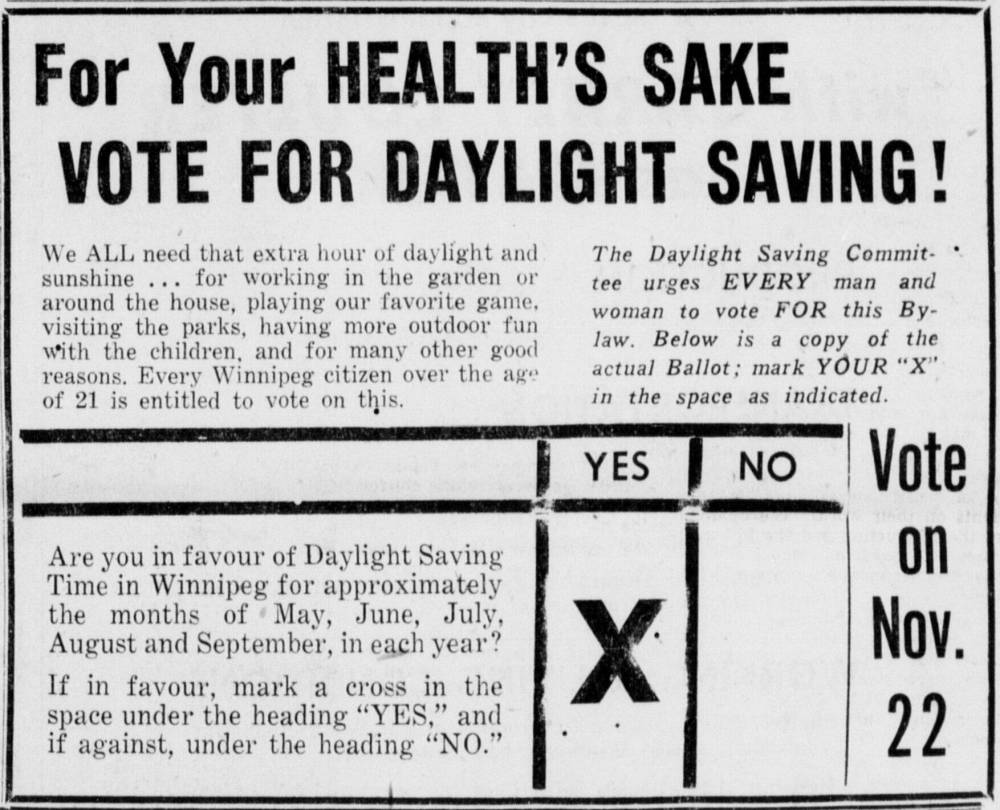
Supplied image
In this 1946 referendum ad, taken from the Winnipeg Tribune, advocates of the time change pushed the health benefit of added sunlight.
The next time DST came to Winnipeg was in 1937. This time, the city’s health committee led the charge, as there was a growing belief that the extra hour of sunlight in the evening led to people getting more sunlight on their skin and increased physical activity.
The committee’s motion went to city council in March 1937, and it won by a vote of 10 to 8. The bylaw stipulated that the continuation of DST would be put to voters in November’s civic election. It lost that referendum by a vote of 31,000 to 25,000, and DST in Winnipeg went on the back burner for several years.
The federal government reintroduced national daylight saving time from 1942 to 1945, and it was once again left to cities to decide what they wanted to do after the war was over.
By this time, public support for DST was at an all-time high. A Gallup poll showed over 70 per cent of Canadians, especially urbanites, were in favour of it. Many major North American cities said they would retain DST permanently.
Buoyed by this, Winnipeg went back on DST in 1946, with another referendum in that November’s civic election to decide if it should be made permanent. This time, citizens voted 46,000 to 20,000 in favour of keeping it.
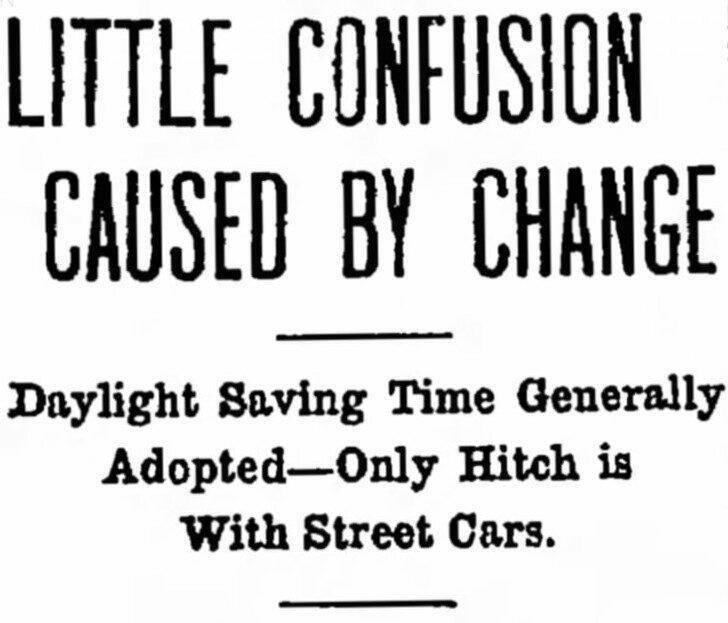
Supplied image
A headline from the Winnipeg Free Press of April 25, 1916, noted that switching to daylight saving time had not greatly affected the populace.
After decades of confusion with various municipalities having different times for part of the year, the Manitoba government under Duff Roblin introduced province-wide DST starting Sunday, May 12, 1963.
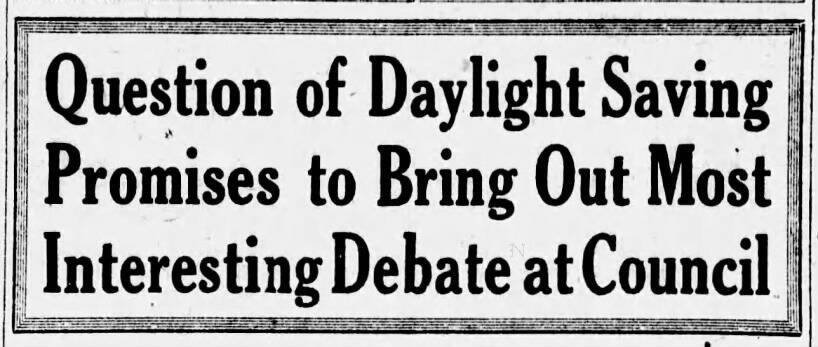
Supplied image
A headline in the Winnipeg Free Press of April 18, 1923, anticipated an upcoming city council update.
Christian Cassidy
Christian Cassidy is a Manitoba Historical Society council member and a proud resident of the West End. He has been writing about Winnipeg history for more than a decade on his blog, West End Dumplings.
Our newsroom depends on a growing audience of readers to power our journalism. If you are not a paid reader, please consider becoming a subscriber.
Our newsroom depends on its audience of readers to power our journalism. Thank you for your support.
Christian Cassidy
Christian Cassidy is a Manitoba Historical Society council member and a proud resident of the West End. He has been writing about Winnipeg history for more than a decade on his blog, West End Dumplings.
Our newsroom depends on a growing audience of readers to power our journalism. If you are not a paid reader, please consider becoming a subscriber.
Our newsroom depends on its audience of readers to power our journalism. Thank you for your support.
Advertisement Advertise With Us
Advertisement Advertise With Us