


Getting into gardening

Advertisement
Five years ago, when my wife asked for a garden, I had no idea what I was getting into.
Like any hobby, it can be as mellow or as serious as you want to make it. Gardening is no big deal, all you need is a little bit of dirt and a few seeds to water and you’re good to go. Right? On the more serious side, it becomes a science, and I have been blessed with the knowledge that my late Uncle Norm, a master gardener, has passed down to me. I hope that some of this will be helpful for your own gardening hobby.
Seeds: Some last longer than others, between two-to-five years. Storing them in a cool, dark place will maximize their lifespan. Seeds such as onions have a short shelf life of one-to-two years, whereas cucumber and squash seeds have the longest and can be good for up to five years. Others such as beans, peas, spinach and peppers can still germinate well after two or three years. Carrots, tomatoes, beets, cabbage and radishes can last up to three-to-four years. Speaking of germination, a waterproof heating pad set for approximately 18 to 20 Celsius will help with the process until the plants begin to sprout. As they grow to be an inch or so you want to shut that heating pad off.
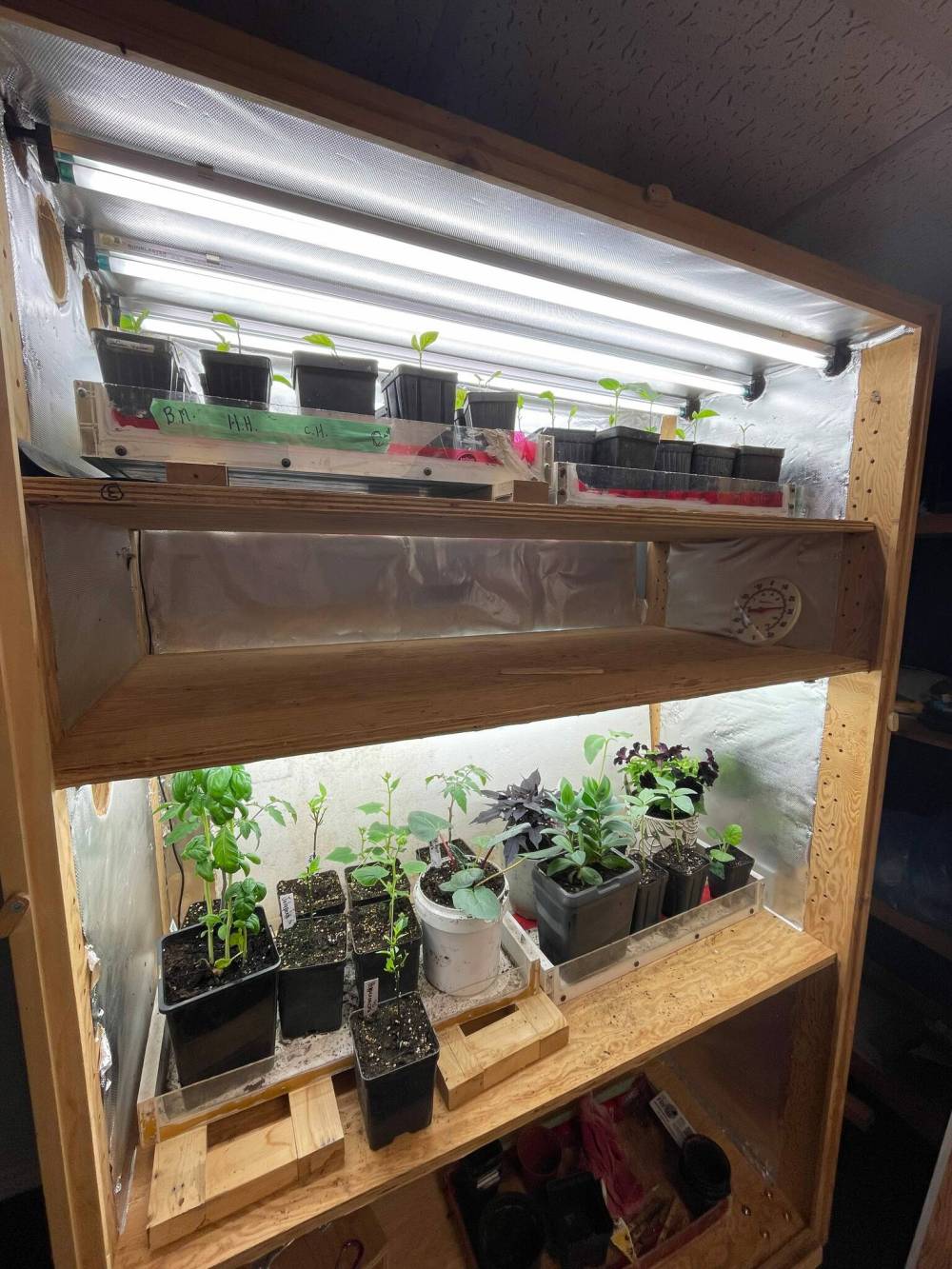
Photo by Dan Sylvestre
Community correspondent Dan Sylvestre has gotten into gardening over the past five years. Here are some plants he started indoors earlier this season.
Soil: “Just a little dirt” can vary significantly. In a garden it is suggested that you use something like a four-way or five-way compost mix from your local garden center. When planting early in a grow box you can use up to a 50/50 mix of good potting soil and compost. Watering can be done as soon as the plant is dry, best if you have a potting container that has holes in the bottom to soak up water but also to allow the roots to breathe and not to drown. Have your water room temperature, as you do not want to shock your plants with cold or hot water.
Light: Cycle the light approximately 16 hours on and eight hours off and have a thermostat in the area if you can. A timer can help keep this consistent. Temperature should range from as low as 20C at night up to 30C during the light hours depending on your plants. Peppers, for example, like it hot.
Having a fan blowing a gentle breeze on the plants will help the stems become stronger and be sure to re-pot your plants once they have grown so they do not get stagnant with no root space to grow.
Before you go to plant in the garden, approximately at the end of May to the beginning of June in Manitoba, be sure to acclimatize your plants to the great outdoors. This means that you take them outside slowly in short increments to get used to the elements: one-to-two hours first couple days, three-to-four hours for a few days and then, as long as the weather permits, for a couple seven-to-eight hour days for a total of a week or so before they find their permanent home in your garden.
From there it’s all about care with pruning and watering, eventually covering them in the chilly nights so the frost doesn’t kill them. All the best and happy gardening!
Dan Sylvestre
Fort Rouge community correspondent
Dan Sylvestre is a community correspondent for Fort Rouge.
Our newsroom depends on a growing audience of readers to power our journalism. If you are not a paid reader, please consider becoming a subscriber.
Our newsroom depends on its audience of readers to power our journalism. Thank you for your support.
Dan Sylvestre
Fort Rouge community correspondent
Dan Sylvestre is a community correspondent for Fort Rouge.
Our newsroom depends on a growing audience of readers to power our journalism. If you are not a paid reader, please consider becoming a subscriber.
Our newsroom depends on its audience of readers to power our journalism. Thank you for your support.
Advertisement Advertise With Us
Advertisement Advertise With Us