


‘Mama Goose’ goes to school in the Maples

Advertisement
Canada geese are some of the most fascinating birds, and certainly their early return to Manitoba every March is a sure sign that summer is just around the bend. It’s hard to believe that this iconic symbol of Canada was almost hunted to extinction. Today, there are approximately seven million Canada geese in North America.
Every spring, these tough, majestic birds return to their northern nesting areas to raise a family. A pair lays five to nine eggs. Six-to-nine weeks after hatching, the bird is ready to take to the air as a family unit. When the offsprings are grown, they all embarked on their fall journey back south for the winter. Their fall migration to the south extends as far as the Gulf of Mexico, starts in mid October. The last of the geese leave in early November and suddenly, within days, they are gone. Pairs then usually return to their previous nesting place each spring.
Canada geese are eccentric characters. They mate for life and every spring migration, over 1,000 pairs will make Winnipeg their summer habitat. Nests can be found in odd places across the city: in residence flower gardens, near retention ponds, on rooftops and under trees in public parks. This spring, there was a nest in a huge planter in Polo Park Mall parking lot.
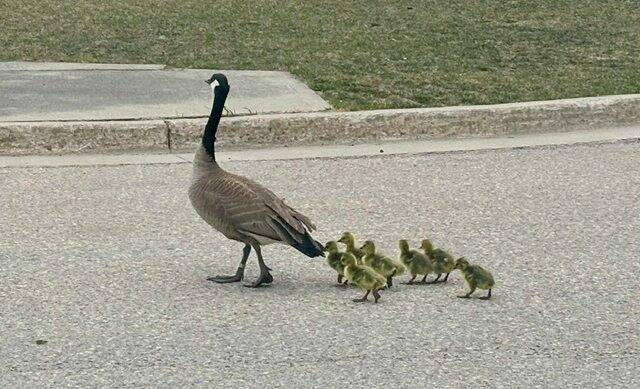
Supplied photo by Dena Arnold
The locally famed ‘Mama Goose’ nests in a clump of weeds a few metres away from the main entrance of École Leila North School in the Maples every year for the past eight years.
There is the locally famed ‘Mama Goose,’ who nests in a clump of weeds a few metres away from the main entrance of École Leila North School in the Maples every year for the past eight years.
Over 450 students, staff and neighbours adore and protect the friendly pair. They keep the appropriate distance from her and count the 25 to 30 days of incubation when the eggs are hatched. A significant moment at the school is the day or two after, when ‘mama goose’ assembles her clutch of goslings and lead a march of about 300 metres to the nearest pond where the gentle friend says goodbye until next spring.
Principal Dena Arnold added, “The goose family that returns to Leila North each year has become part of our school community. Their quiet routines teach us about patience, protection and the importance of giving creatures the space a respect they deserve.”
Like the polar bears, Canada geese have a prominent place in the hearts of Canadians. Ducks Unlimited, whose headquarters are located in Manitoba, is a national conservation non-profit organization that manages the protection of waterfowl in Canada and their wetlands. Oak Hammock Marsh waterfowl reserve near Stonewall is probably the best site in Canada to see several such species in one place. Another spectacular waterfowl mecca is the Fort Whyte Alive off McGillvary, in Winnipeg. The best time is at sunset during the month of October.
Canada geese weight up to 20 pounds, and can travel over one thousand kilometres in one day. When flying, the stately bird honk, cluck when feeding and hiss when angry. Their lighting fast forward thrust of the bow of their wings can inflict serious injuries to human.
Our newsroom depends on a growing audience of readers to power our journalism. If you are not a paid reader, please consider becoming a subscriber.
Our newsroom depends on its audience of readers to power our journalism. Thank you for your support.
Our newsroom depends on a growing audience of readers to power our journalism. If you are not a paid reader, please consider becoming a subscriber.
Our newsroom depends on its audience of readers to power our journalism. Thank you for your support.
Advertisement Advertise With Us