


Cognitive behaviour therapy with mindfulness

Advertisement
Kristen Wynnobel would like to see the cognitive behaviour therapy with mindfulness (CBTm) program become a regular part of the curriculum taught at the Winnipeg Adult Education Center (WAEC). Wynnobel, who just completed her first year as a guidance counsellor at the downtown Winnipeg School Division adult education hub, believes the skills taught in CBTm would benefit students at WAEC.
“I think it should be embedded in a lot of our classrooms. With what I’m seeing in terms of mental health, life circumstances, addictions, all those things — we want to give our students more tools,” said Wynnobel, who moved over to WAEC after 18 years at Gordon Bell High School, where she was a teacher and then later in a counselling role.
Wynnobel recently participated alongside WAEC students in a five-week offering of the CBTm program that was facilitated by Irene Maendel, the CBTm clinical lead for the CBTm Hub clinical and facilitator team. CBTm is run jointly through the University of Manitoba’s Max Rady College of Medicine’s Department of Psychiatry and Shared Health Manitoba. It was designed as a low-barrier, skill-based group education program to teach people practical CBT and mindfulness strategies before they need, or while they are waiting for, more intensive therapy.
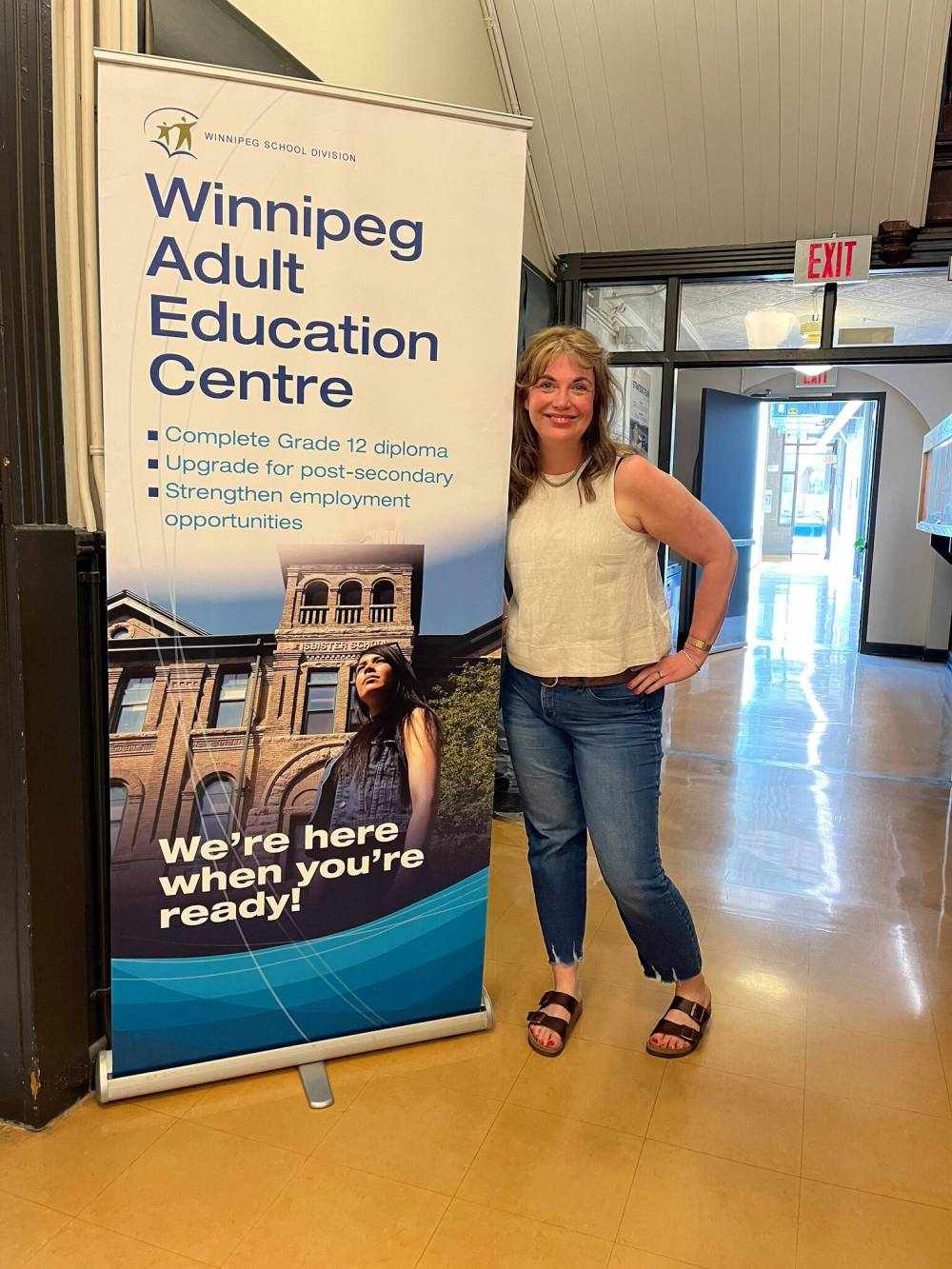
Supplied photo
Kristen Wynnobel recently completed her first year as a guidance counsellor at the downtown Winnipeg adult education hub. She believes the skills taught in the cognitive behaviour therapy with mindfulness program would benefit students at WAEC.
Maendel is a fierce advocate for the program and likes the broad appeal of the evidence-backed concepts and how they provide people with useful skills to manage stress, anxiety, low mood, worry, and difficult thoughts in an accessible and supportive way. The focus is on helping people make healthier choices in how they think and act and how that impacts overall mental wellbeing.
“In my mind CBTm is a composition of universal ideas, brought together to understand how we think, how thinking affects behaviour and emotions and how it’s all interrelated and interconnected,” said Maendel, who is a therapist, psychotherapist and a Canadian certified counsellor and came to CBTm from CancerCare Manitoba where she provided mental health support to cancer patients. It was there that she found mindfulness-based stress reduction and cognitive behaviour therapy concepts fit together nicely and could be adapted to the type of patients she was working with.
That theme of adaptation runs through the CBTm program as it seeks to be relevant and helpful to a broad swath of the population. Current versions of the program include a cross-cultural CBTm for newcomers, CBTm for youth, CBTm for older adults, CBTm for physicians and medical learners, CBTm for healthcare workers and a version for public safety personnel as well. A French version was also recently launched.
The program is usually offered online but can be delivered in-person as well. Participants are given surveys to ensure the effectiveness of the programming and to monitor the impact of strategies and newly learned skills on their day-to-day lives. The online mental health screening platform also provides data that allows clinician and clients to make evidence-based treatment choices in real time.
CBTm also offers training for facilitators and over 900 people across Canada have taken it since 2019.
Wynnobel is planning on taking the facilitator training in the fall. She has some background in CBT and mindfulness but has never used both together. She finds the two really mesh well.
“The idea of asking yourself questions, especially when your emotions are high. There’s a huge role for mindfulness to play in that,” she said. “We’re giving students the tools to calm their minds so they can use the CBTm skills.”
For her part, Maendel feels the more people who know about CBTm, the better. She likes the idea of it becoming part of the curriculum taught in schools.
“When people are able to relate and adopt the strategies, they can walk away with a skill and a better quality of life.”
You can find out more about CBTm at cbtm.ca
Colin Fraser
Colin Fraser is a community correspondent for West Kildonan. Email him at fraserfaraway@gmail.com
Our newsroom depends on a growing audience of readers to power our journalism. If you are not a paid reader, please consider becoming a subscriber.
Our newsroom depends on its audience of readers to power our journalism. Thank you for your support.
Colin Fraser
Colin Fraser is a community correspondent for West Kildonan. Email him at fraserfaraway@gmail.com
Our newsroom depends on a growing audience of readers to power our journalism. If you are not a paid reader, please consider becoming a subscriber.
Our newsroom depends on its audience of readers to power our journalism. Thank you for your support.
Advertisement Advertise With Us
Advertisement Advertise With Us