


Funding the future
NSERC grant to help St. Boniface-based YouthBIOlab connect with remote students

Advertisement
Hey there, time traveller!
This article was published 26/06/2024 (725 days ago), so information in it may no longer be current.
A healthy future for Manitobans starts at the grassroots level.
On June 14, the federal government announced $10 million in funding for NSERC’s PromoScience program, which aims to engage youth in science, technology, engineering, and mathematics. The St. Boniface Hospital-based YouthBIOlab was one of 44 recipients nationwide, having been awarded $285,000 over the next three years to continue programming for Indigenous youth in northern, rural, and remote schools in partnership with the Frontier School Division.
“We are incredibly honoured to receive this funding from NSERC’s PromoScience program,” said Stephen Jones, director of Youth BIOlab. “We are committed to inspiring the next generation of curious minds and helping them understand the science behind health. NSERC has generously supported our work for more than a decade and this renewed funding will significantly enhance our efforts.”
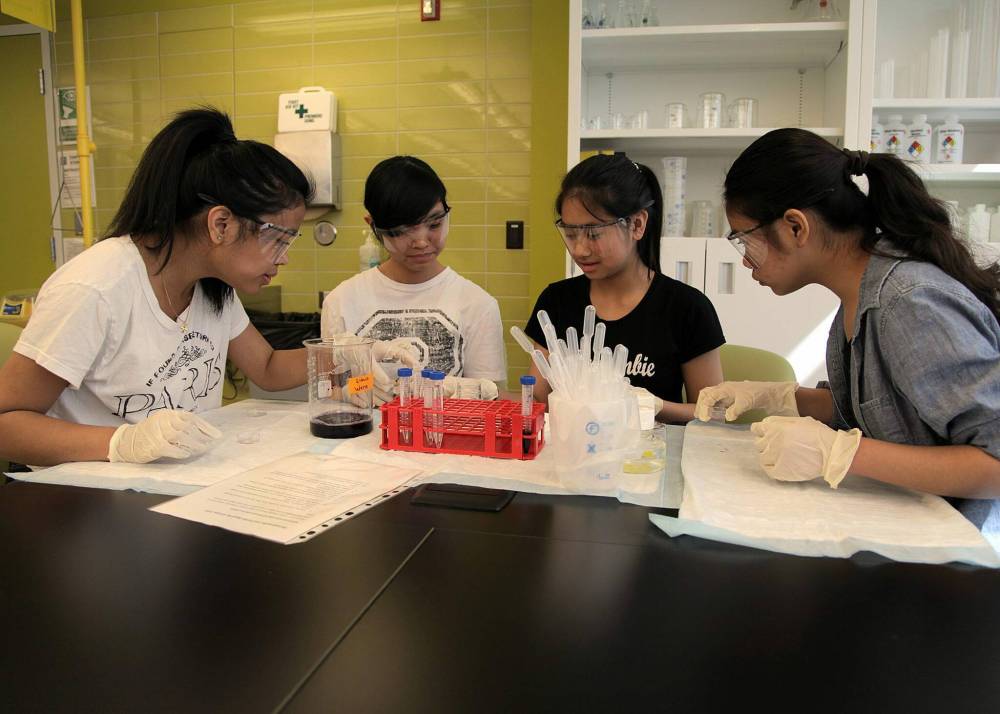
Supplied photo
Since 2013, the Youth BIOlab at St. Boniface Hospital has provided hands-on biomedical science learning experiences to more than 40,000 students. A new $285,000 NSERC grant will allow the lab to continue programming for Indigenous youth in northern, rural, and remote schools in partnership with the Frontier School Division.
Established in 2013 by way of an investment of $450,000 from Manitoba Education, the Youth BIOlab has provided hands-on biomedical science learning experiences to more than 40,000 students. The latest funding, Jones noted, will allow the lab to expand its outreach to northern and remote communities.
“We’re a full-time outreach program out of St. Boniface Hospital. We have a full-time teaching lab here,” said Jones, who has been working in heart research out of St. Boniface Hospital for 25 years in the building. “In 2005, we started looking at how we could do some meaningful outreach, using what we do here as a resource. We’ve always worked in partnerships with school divisions, starting with Louis Riel School Division. How can we support science teachers, and improve health literacy, as well? That was successful enough that we were able to build the Youth BIOlab in 2013.”
The goal, Jones added, has always been to engage with as many students, from Grade 5 to 12, as possible. In a typical year, that results in over 4,600 students visiting the lab, while another 1,500 receive classroom visits from scientists.
“Getting kids to see any real world connection and engaged in real world ideas is very meaningful,” Jones said. “Even just coming and having a positive experience at a hospital is a good thing, because that’s not always possible for kids.”
What kind of work visiting students engage in depends on both the curriculum for their grade, and the desired outcomes of the teachers, from Grade 5 students doing dissection to Grade 8 kids studying heart cells under a microscope to students in Grade 12 doing DNA work, and much more.
“It takes all shapes and forms, and that’s the fun of the partnership model we’ve developed: it’s how we can work with you to meet your needs, and it’s been very successful,” Jones said. “This gives us a little more flexibility, so that we can learn, too. There are different challenges and different things people are interested in, depending where you come from. We’re trying to work to make science meaningful to kids, no matter where they come from.”
The NSERC funding will allow the lab to bring in more students from remote communities, providing them with the same opportunities kids in the city enjoy. “We want to reach kids who can’t just get here on a bus,” Jones said. “These kids walk in here just as engaged and curious as any other kid. We want to make sure that Indigenous kids and teachers, in particular, can have the same experience that kids down the road here can.”
Sheldon Birnie is the managing editor of the Free Press Community Review. Email him at sheldon.birnie@freepress.mb.ca or call him at 204-697-7112
Our newsroom depends on a growing audience of readers to power our journalism. If you are not a paid reader, please consider becoming a subscriber.
Our newsroom depends on its audience of readers to power our journalism. Thank you for your support.
Sheldon Birnie is the managing editor of the Free Press Community Review. Email him at sheldon.birnie@freepress.mb.ca or call him at 204-697-7112
Our newsroom depends on a growing audience of readers to power our journalism. If you are not a paid reader, please consider becoming a subscriber.
Our newsroom depends on its audience of readers to power our journalism. Thank you for your support.
Advertisement Advertise With Us
Advertisement Advertise With Us