



Fogging issue remains divisive issue
Advertisement
Hey there, time traveller!
This article was published 08/07/2010 (5664 days ago), so information in it may no longer be current.
Mosquitoes have arrived en masse in Manitoba — and with the return of the blood-sucking pests comes the perennial debate about how best to effectively deal with them.
In the war on mosquitoes, two topics have proven especially contentious: Winnipeg’s use of malathion to control adult nuisance populations, and the practice of allowing residential households that don’t want to be fogged to register for a 100-metre buffer zone around their properties.
Health Canada’s Pest Management Regulatory Agency asserts that malathion poses little threat to human health or the environment when applied as per label directions. Yet some citizens insist the chemical insecticide is harmful, claiming it can cause allergic reactions and other health problems. Others opposed to its use suggest malathion is damaging to the ecosystem because it kills not only mosquitoes but also insects such as bees, butterflies and, in large enough quantities, dragonflies — the latter, natural predators that help control mosquitoes.
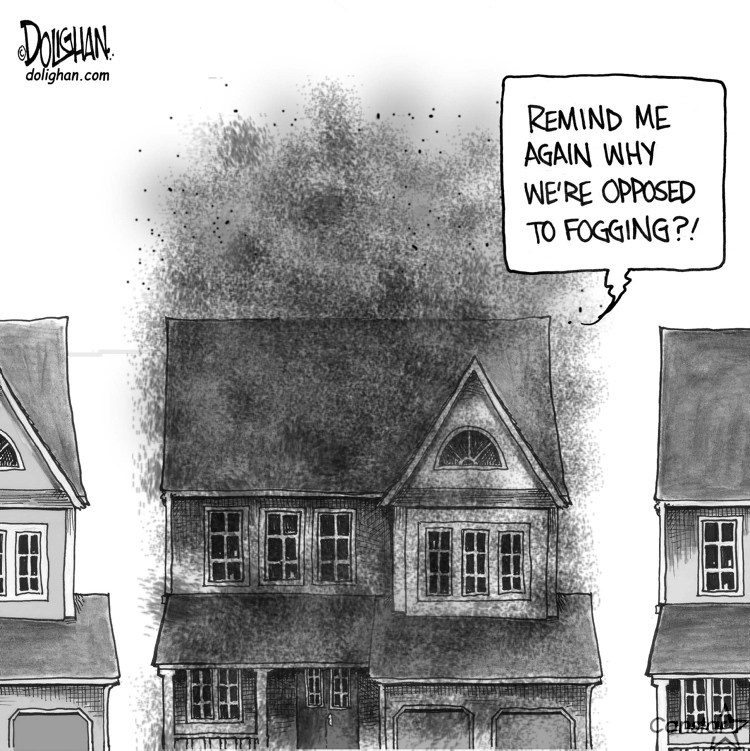
However, just as many citizens — if not more — have no problem engaging in a little chemical warfare if doing so means being able to spend time outdoors during the summer months without being attacked by swarms of biting insects.
Advocating a fog-early and fog-often approach to mosquito control, these people take specific issue with buffer zones, arguing that allowing them is unfair since the decision of one residence can affect upwards of 40 others in the surrounding vicinity. (Indeed, using that figure, as many as 60,000 homes may be skipped by city fogging trucks this season, given that approximately 1,500 Winnipeg households have already registered for buffer zones.)
With battle lines drawn, Winnipeg’s city council is in an unenviable position, tasked with representing the interests of all citizens on an issue that remains extremely divisive.
But perhaps there is still common ground to be found. Last month, council asked the city’s insect control branch to review its mosquito-control policy. Pre-emptive adulticiding methods will be examined, as will the guidelines currently dictating when fogging can take place, the methods used by other jurisdictions and the costs associated with adapting current practices.
The impact of buffer zones on mosquito-control efforts will also be reviewed, as will “the desirability of maintaining such buffer zones.”
The review is to be completed in advance of the July 21 council meeting, although any recommendations contained within the final report cannot be implemented until the province agrees to change the terms and conditions of the pesticide permit under which the city operates.
While this fact has left some wondering if all the recent talk at city hall is merely politicking in advance of October’s civic election, a comprehensive review makes sense.
In fact, it is probably overdue. In Manitoba, mosquitoes are here to stay. Therefore, it only makes sense to thoroughly investigate every possible control strategy on the chance that we can find one that will work better — and work for everyone.